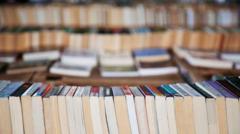
The air inside the basement shop smelled of slow oxidation, damp cellar walls, and vanilla. It is a specific fragrance, born of lignin breaking down in paper over decades, releasing vanillin as it decays. To a certain kind of person, that smell is home.
Elena stood by the cash register, sliding a rubber band off a stack of paperbacks brought in by a man whose mother had recently passed away. She did not look at the screens hanging over big-box storefronts four blocks away. She did not care about the algorithmic feeds refreshing every three seconds on devices glowing in pockets up and down the street. She was holding a 1974 mass-market edition of Ursula K. Le Guin, its cover creased like an old palm, and she was breathing.
Across the globe, an extraordinary economic quirk is quietly rewriting the retail map. Secondhand book sales are surging at a velocity not seen in a generation. Used bookstores are expanding their footprints while gleaming digital storefronts face fierce headwinds. Market analysts point to supply chain adjustments, inflation, and shifting consumer habits. But numbers on a spreadsheet never tell the whole story. They miss the human heartbeat underneath the ink.
They miss the quiet panic of a culture that feels algorithmically managed from cradle to grave.
Consider what happens when you open an e-reader or browse a hyper-optimized online marketplace. Every click is watched, categorized, and fed back into a predictive loop. You buy a book about urban architecture; within minutes, digital banners chase you across the internet offering identical titles, automated summaries, and synthetic reading guides generated by large language models. The machine is trying to be helpful. Instead, it suffocates the mystery.
We are starving for friction.
For the past decade, technology companies promised us a friction-free existence. Instant delivery. Unlimited digital libraries. Artificial intelligence designed to curate every minute of our leisure time so efficiently that we never have to encounter a dead end, a confusing chapter, or a book we didn't know we needed.
Efficiency won the logistics war, but it lost the soul.
When people talk about the modern boom in secondhand books, they often frame it as a financial calculation. Used books are cheaper. In an era where the cost of living climbs steadily upward while wages lag, buying a pre-owned copy of a novel for four dollars instead of twenty makes rational economic sense. Inflation plays its part, undeniably.
Yet that explanation treats human beings like pocket calculators. It reduces a cultural shift to a balance sheet.
Think about the physical weight of a used book. (And here, let us use a metaphor: a used book is an archaeological dig in miniature.) When you purchase a volume that has passed through anonymous hands, you inherit a secret history. You find grocery lists used as bookmarks. You find underlining in faded purple ink, penned by someone who sat by a rainy window in 1982, wrestling with an idea that mattered to them. You find dried flower petals pressed between pages 210 and 211.
That book is not sterile. It has lived.
Contrast that with the synthetic boom currently sweeping the publishing industry. Over the past couple of years, online retailers have been flooded with low-effort, AI-generated content—rapidly spun-out summaries, unauthorized "companion guides," and pastiches designed to game search algorithms and capture casual buyers searching for trending titles. Readers buy a book online, expecting a human voice, only to find the flat, uncanny cadence of machine-generated prose.
The disillusionment is profound. When the digital marketplace feels increasingly crowded with ghosts that never lived, people naturally reach for ghosts that actually did.
The resurgence of secondhand books is a quiet, stubborn rebellion against synthetic homogenisation. It is an intuitive pushback against a world where everything feels mass-produced, instantly accessible, and strangely hollow.
Let us look closer at the mechanics of this shift. Independent used bookstores, once predicted to vanish into the amber glow of digital disruption, are reporting record foot traffic. Younger demographics—Gen Z and Millennials, raised entirely on screens—are driving a massive share of this growth. They are the same generation often stereotyped as chronically online, yet they are spending their weekends elbow-deep in dusty cardboard boxes outside charity shops, hunting for vintage poetry collections and dog-eared philosophy paperbacks.
Why? Because the digital native knows better than anyone the exhaustion of the infinite scroll.
When your entire working day is mediated by pixels, notifications, and predictive text, your nervous system craves analogue weight. Touching paper with texture, smelling glue and age, reading words that were printed before algorithms decided what you should like—this is not mere nostalgia. It is sensory grounding. It is mental self-defense.
There is also the matter of curation versus discovery.
An algorithm curates based on your past behavior. If you bought a thriller, it traps you in a room full of thrillers until you suffocate from genre fatigue. It is a velvet cage built by code.
A used bookstore, on the other hand, curates by accident and serendipity. The inventory is dictated by the capricious, messy lives of real people who died, moved, cleaned out attics, or changed their minds. You walk in looking for a specific history text and walk out with a 1960s manual on amateur taxidermy because its spine caught the afternoon light just right. That element of chance is precisely what corporate digital platforms have engineered out of existence in the name of conversion rates.
And humanity hates being converted. We want to wander.
Critics sometimes argue that this trend is merely aesthetic—that people buy vintage books simply to display them on shelves for social media backdrops. No doubt, visual culture plays a role in modern consumer habits. But to dismiss the entire movement as performative is to misunderstand the deep psychological currents moving underneath. Aesthetics are often the outward symptom of an inward hunger. When people style their rooms with old books, they are signaling a desire for depth, history, and permanence in a world that feels violently ephemeral.
Consider the writer sitting at a desk today. They watch software tools sweep across the creative landscape, churning out formulaic essays, commercial fiction outlines, and marketing copy in seconds. The fear is real. When writing becomes a commodity that can be synthesized by a server farm in Ohio at zero marginal cost, the value of human expression feels threatened.
In response, readers are drawing a hard boundary. They are voting with their wallets and their time for artifacts that bear the undeniable scars of human effort. A book with coffee stains on the cover cannot be faked by a neural network. A note scribbled in the margin by a frustrated college student in 1994 is proof of life.
The secondhand book economy thrives because it offers what modern commerce has systematically erased: pedigree through survival.
A book that has lasted forty years in circulation has passed a brutal test. It survived moves, spring cleanings, floods, garage sales, and apathy. It is here because someone cared enough not to throw it away. When you pick it up, you are entering into a lineage of readers who kept a particular spark alive through time.
The big retail monoliths are scrambling to adapt. Some are trying to capture the used-book market themselves, attempting to algorithmically scale the unscalable—treating pre-owned paperbacks like just another SKU to be optimized through automated fulfillment centers.
They will miss the point.
You cannot scale serendipity. You cannot automate the smell of old paper or the conversation with an eccentric shopkeeper who remembers every volume on their crammed shelves. The magic lives in the margins—literally and figuratively.
As the sun dipped lower outside Elena’s basement shop, casting long shadows across towering stacks of biography and science fiction, the bell above the door chimed. A young woman stepped inside, brushing rain from her jacket. She didn't look at a smartphone. She ran her fingertips along the spines of a shelf dedicated to translated Japanese literature, pausing, pulling one out, and opening it to the middle pages.
She stood there in silence for a long time, reading a single paragraph under the amber glow of an old brass lamp, entirely disconnected from the hum of the machine age.
Outside, the servers hummed. Inside, time stood still.