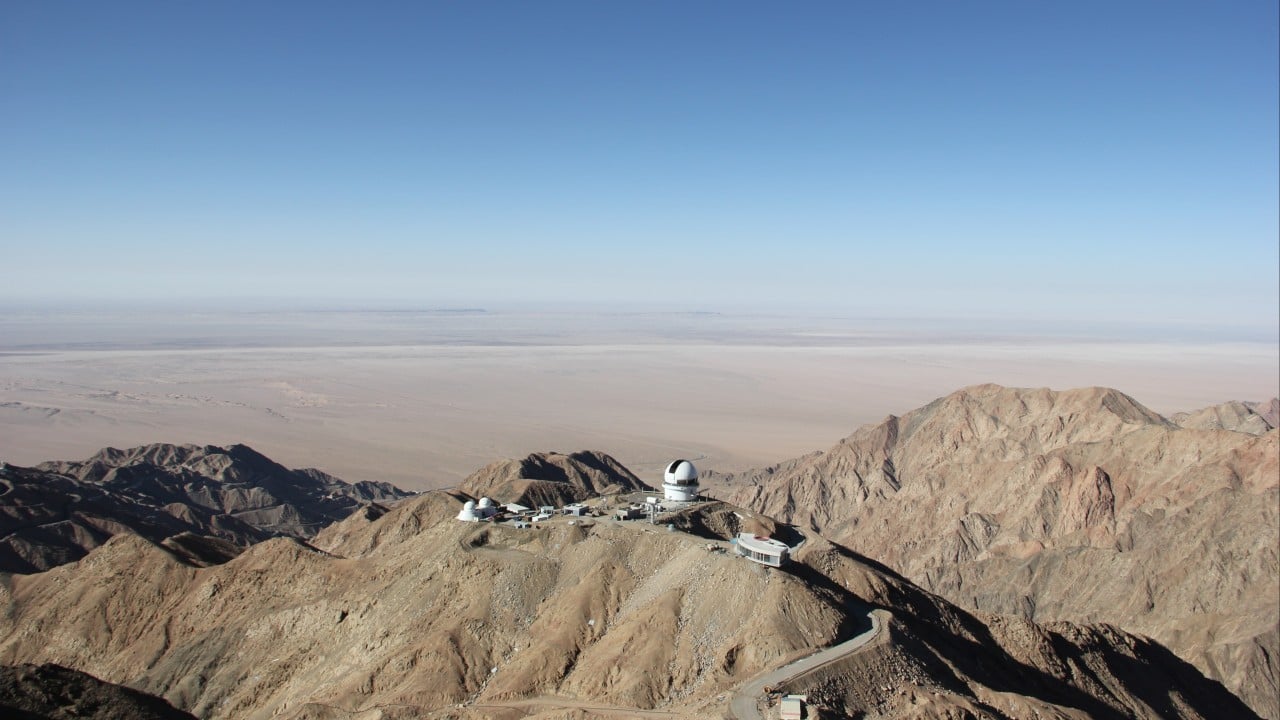
Ground-based optical astronomy operates under a strict physical bottleneck imposed by the Earth's atmosphere. For decades, the global infrastructure for deep-space observation has been highly centralized in the Western Hemisphere, specifically across a narrow longitudinal band anchoring Mauna Kea in Hawaii, the Atacama Desert in Chile, and the Canary Islands. This uneven distribution leaves a massive 120-degree gaps in longitude across Eurasia, blinding global time-domain astronomy to transient cosmic events during specific Earth rotation windows. China’s multi-billion-yuan development of the Lenghu Astronomical Observation Base on Saishiteng Mountain in Qinghai Province is a highly engineered geographical correction to this systemic vulnerability. By exploiting a rare topographical anomaly on the northern edge of the Tibetan Plateau, China is constructing an astronomical megastructure designed to secure domestic observational self-reliance and alter the architecture of international space science.
The Topographical Cost Function of Optical Seeing
The scientific viability of any astronomical site is governed by atmospheric turbulence, quantified as "seeing"—the angular diameter of a stellar image distorted by the atmosphere. Lower seeing values translate directly to higher instrument sensitivity and shorter exposure times. Saishiteng Mountain, rising to an operational altitude between 4,200 and 4,500 meters, achieves a median seeing of 0.75 to 0.80 arcseconds. This places it on par with Paranal Observatory in Chile and Mauna Kea. Meanwhile, you can find related developments here: The Anatomy of Tactical Drone Vulnerabilities A Quantitative Breakdown of Analog Encryption Systems.
The physical mechanism driving this performance is the specific boundary layer dynamics of the Qaidam Basin.
[Saishiteng Mountain Cross-Section: 1,500m Lift over 20km]
The Saishiteng range rises abruptly from the floor of the Qaidam Basin, which sits at an average elevation of 2,700 meters. The mountain generates a vertical lift of 1,500 meters over a horizontal distance of just 20 kilometers. This extreme gradient forces dominant westerly winds to shear cleanly over the peaks, compressing the turbulent surface boundary layer to a narrow zone below the summits. The air mass reaching the telescope apertures is highly laminated, minimizing the refractive index structure constant $C_n^2$, which determines optical distortion: To understand the complete picture, we recommend the recent analysis by TechCrunch.
$$\varepsilon = 5.25 \lambda^{-1/5} \left[ \int_{0}^{\infty} C_n^2(h) , dh \right]^{3/5}$$
A secondary atmospheric variable is Precipitable Water Vapor (PWV), which dictates infrared transparency. Because Saishiteng is deep within the Eurasian landmass, isolated from oceanic moisture by successive mountain ranges, its climate is hyper-arid. Data indicates that 55% of nighttime observations feature a PWV below 2.0 mm, maximizing transmission efficiency in the near-infrared spectrum.
Infrastructure Scaling and Institutional Telecoupling
The transformation of Saishiteng Mountain from an inaccessible ridge into a highly integrated observatory network relies on a heavily subsidized capital expenditure model. Between 2019 and 2021, local and provincial governments deployed over 116 million yuan in sovereign debt and direct allocations exclusively for foundational civil engineering. This mitigated the prohibitive logistical costs that typically stall deep-wilderness scientific infrastructure.
The site architecture is organized into a tiered infrastructure model optimized for data acquisition, instrument payload capacity, and aperture scaling:
- The Wide Field Survey Telescope (WFST / Mozi): A 2.5-meter primary mirror system optimized for time-domain surveys. By capturing high-cadence, large-field imagery, the WFST functions as an early-warning system for transient events, mapping large swaths of the Northern sky to identify supernovae, tidal disruption events, and near-Earth objects.
- The Multiplexed Survey Telescope (MUST): Led by Tsinghua University, this 6.5-meter project represents the core capability of the site. As the largest planned aperture on Saishiteng, MUST is designed for dark energy evolution mapping, gravitational wave cosmology, and galaxy formation surveys. It addresses a critical lack of wide-field spectroscopic capabilities in the Eastern Hemisphere.
- The Specialized Arrays: This layer includes the Stellar Observations Network Group (SONG) for stellar physics, the Infrared System for the Accurate Measurement of Solar Magnetic Field (AIMS), and the Multi-Application Survey Telescope Array (MASTA).
The proximity of Lenghu Town—located 50 kilometers from the summit—creates a localized supply chain. The site is supported by heavy cargo rail networks, direct highways, and regional airports. This proximity minimizes the operational downtime associated with replacing high-precision optical elements or cryogenic components in remote environments.
Macro-Climate Vulnerabilities and Atmospheric Structural Shifts
Despite its exceptional baseline metrics, long-term predictive models reveal that the Lenghu site is highly sensitive to macro-climatic air-sea interactions. The assumption that high-altitude desert sites remain static is false. The site's operational efficiency is bound to global climate indices.
A historical analysis of observing windows on Saishiteng highlights a major systemic vulnerability:
| Year | Fractional Observable Time (Photometric Conditions) | Primary Climatic Driver |
|---|---|---|
| 2019 | 69.70% | Baseline Stable |
| 2020 | 74.97% | Optimal Atmospheric Stability |
| 2021 | 70.26% | Normal Interannual Variance |
| 2022 | 74.27% | Elevated Photometric Clarity |
| 2023 | 65.12% | Strong El Niño Phase / Warm PDO |
The dramatic drop in observing time in 2023 exposes the site's primary environmental risk.
[Climatic Teleconnections: El Niño/PDO Impact on Upper-Level Jets]
The physical mechanism behind this disruption is structural shifts in the upper-level wind velocity at the 200 hPa pressure level ($W_{200}$). The 2023 El Niño event and a positive Pacific Decadal Oscillation (PDO) altered the temperature gradient across Eurasia, strengthening the jet stream over the northern Tibetan Plateau. High $W_{200}$ velocities generate severe wind shear near the tropopause, which triggers optical turbulence through downward momentum transport.
Furthermore, these macro-climatic shifts correlate with an increase in PWV during summer months due to the strengthening of the summer North Atlantic Oscillation (NAO), which pushes moisture deeper into Western China. Consequently, the site's performance cannot be evaluated solely on historical averages; instruments must be engineered to adapt to a changing climate that alters atmospheric stability.
Strategic Action: The Dark Sky Legislative Defense
The ultimate constraint on Saishiteng Mountain's long-term utility is not atmospheric, but anthropogenic. As astronomical infrastructure scales, the rapid economic expansion of Haixi Prefecture introduces the threat of light pollution and industrial particulate contamination from mining operations in the Qaidam Basin.
To preserve the low night-sky background, the Haixi Prefecture government enacted strict, legally binding Dark Sky Reserve regulations. This legislative buffer zone restricts industrial light placement, bans directional upward lighting, and creates a controlled radio and optical silence zone around Saishiteng.
For international research consortiums and domestic institutions looking to deploy instruments at Lenghu, the strategic play is clear: immediate capital investment should favor wide-field, time-domain spectroscopic instruments that can exploit the site’s unique longitudinal position. However, engineering designs must include adaptive optics systems optimized for high-velocity wind shear ($W_{200}$) to counter the atmospheric turbulence driven by modern El Niño cycles.


