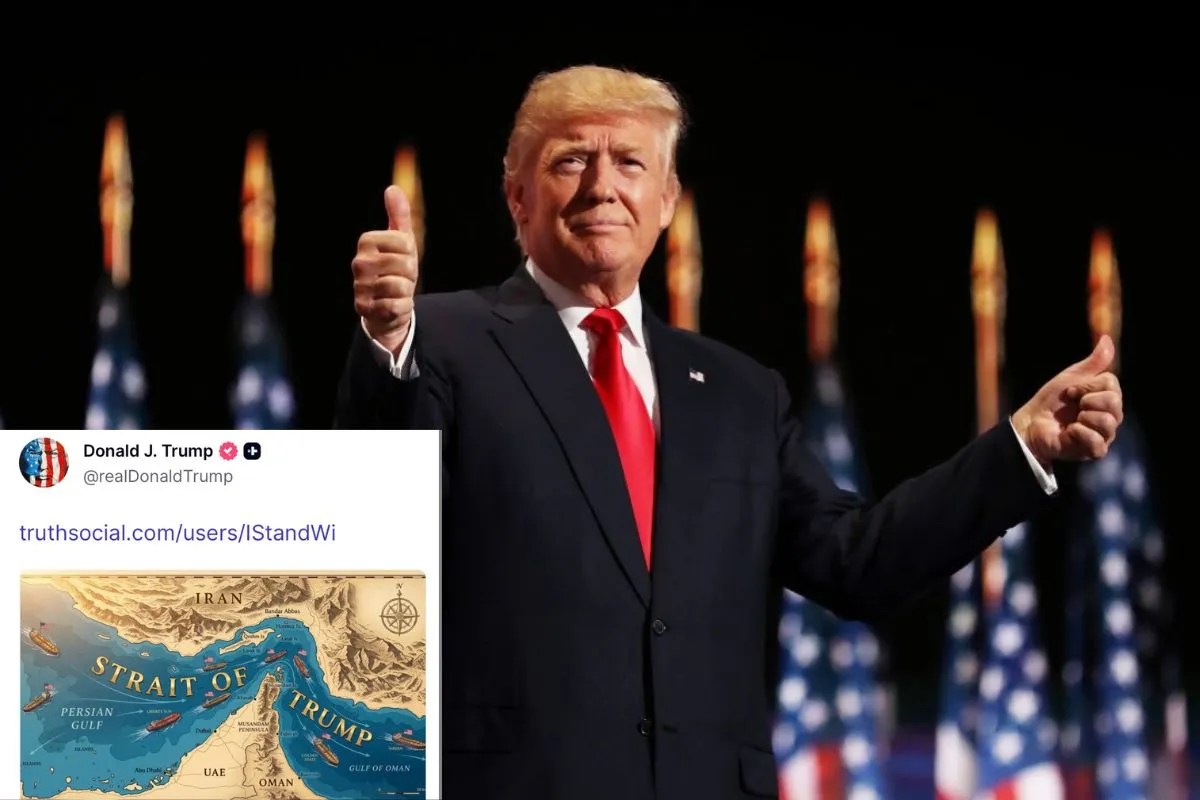
The media is obsessed with a map. When Donald Trump slapped his name across the Strait of Hormuz in a social media post, the press treated it like a standard ego trip or a bizarre diplomatic gaffe. They missed the actual story. While pundits argue over the "audacity" of the branding, they are ignoring the cold, hard reality of maritime logistics and energy shifts that make the "Strait of Trump" debate look like a fight over a Blockbuster Video franchise in 2024.
Everyone loves the narrative of the "Chokepoint." It’s easy. It’s dramatic. It suggests that a single narrow strip of water holds the entire global economy hostage. But the "Strait of Trump" isn't a strategic masterclass or a literal claim to territory; it’s a distraction from the fact that the Strait of Hormuz is becoming less relevant every single day.
The Geographic Obsession is Obsolete
For decades, the "lazy consensus" among energy analysts has been that if Iran closes the Strait, the world ends. They point to the 20 million barrels of oil flowing through that 21-mile-wide gap daily. They talk about $200-a-barrel oil.
They are living in 1979.
The world has spent forty years building workarounds that nobody wants to talk about because "everything is fine" doesn't sell ads. Saudi Arabia’s East-West Pipeline can move five million barrels a day to the Red Sea, bypassing Hormuz entirely. The UAE’s Habshan-Fujairah pipeline cuts another 1.5 million barrels out of the equation.
When you see a politician putting their name on a waterway, they are claiming ownership of a sunset industry. Branding the Strait of Hormuz is like putting your logo on a fax machine. It’s a powerful symbol of the past, but the future of energy isn't flowing through a trench in the Persian Gulf. It’s moving through HVDC (High Voltage Direct Current) cables and localized lithium supply chains.
Why Branding is the Only Tool Left
Why would a president bother with this kind of posturing? Because actual control is a fantasy.
The U.S. Fifth Fleet doesn't "own" the water. They manage a precarious, expensive, and increasingly fragile status quo. By slapping a name on the map, Trump was engaging in Cognitive Seigniorage. He is attempting to extract value from the perception of power because the physical exercise of that power—a full-scale naval blockade or a hot war in the Gulf—is economically suicidal for all parties involved.
The "experts" will tell you this is about "deterrence." It’s not. It’s about Attention Arbitrage.
In the modern geopolitical theater, being talked about is more important than being effective. If the world is debating whether the Strait should be named after you, they aren't debating the fact that the U.S. has effectively subsidized the energy security of its primary competitors (like China) by patrolling these waters for free for half a century.
I’ve sat in rooms where military contractors salivate over the "Hormuz Threat." It’s a goldmine for procurement. "We need more littoral combat ships! We need more drone swarms!" No, you need to realize that the Strait is a theater stage, not a battlefield.
The Infrastructure Trap
The common question is: "What happens if the Strait closes?"
The contrarian truth? A temporary spike followed by a permanent shift. If the "Strait of Trump" were actually blocked, it would trigger the most aggressive forced transition to alternative energy in human history. The sheer speed of capital flight from oil-dependent assets would make the 2008 crash look like a minor accounting error.
The premise that we must "protect" the Strait at all costs is the very thing that keeps us tethered to it. We are protecting our own leash.
Consider the physics of the Strait:
- The Navigation Channels: Only two miles wide in each direction.
- The Depth: Shallow enough that a few sunken tankers create a multi-year salvage nightmare.
- The Proximity: Every ship is within range of shore-based cruise missiles.
You can't "own" that. You can only rent the peace. Calling it the "Strait of Trump" is a cynical acknowledgement that the area is more useful as a media asset than a strategic one.
The Data the Media Ignored
Let’s look at the numbers the competitor article didn't bother to find.
Total global petroleum consumption is roughly 100 million barrels per day. The Strait handles 20%. While that sounds "paramount" (to use a word the bureaucrats love), it ignores the Global Strategic Petroleum Reserves (SPR).
The IEA mandates that members hold 90 days of net imports. If Hormuz shuts down tomorrow, the world doesn't stop. It pivots. The "Strait of Trump" becomes a monument to a resource that the West is actively trying to de-risk.
The Logic of the Provocateur
The "Strait of Trump" post wasn't an error of geography. It was a masterclass in Frame Control.
- The Critics: Focused on the narcissism.
- The Allies: Focused on the "strength."
- The Reality: Both sides are arguing about the name of the door while the house is being rebuilt.
If you are an investor or a policy wonk watching this and your first thought is "Is this legal?" or "Is this accurate?", you’ve already lost. The question you should be asking is: "Why are we still pretending that this specific 21-mile stretch of water is the center of the universe?"
The true disruption isn't the name change. It's the realization that the US is signaled-flashing its exit from the role of "Global Security Guard" for Middle Eastern oil. If you name it, you claim the responsibility. If you claim the responsibility, you can also be the one to walk away from it and tell the rest of the world to pay for their own protection.
Beyond the Chokepoint
Stop asking if the Strait is safe. Start asking why your portfolio or your country still cares.
The move toward energy independence and the electrification of transport isn't just a "green" initiative; it's a "get out of the Strait of Hormuz" initiative. Every time a new battery factory opens in Nevada or a solar farm goes up in Rajasthan, the "Strait of Trump" loses another ounce of its power.
The branding exercise is a desperate grab for relevance in an era where geographic chokepoints are being bypassed by technological leaps. You can own the water, but you can't own the wind, the sun, or the nuclear fission reactor.
If you're still looking at a map of the Persian Gulf to understand the future of power, you're looking at a rearview mirror. The "Strait of Trump" isn't a threat or a promise. It's a tombstone for the era of oil-based diplomacy.
Stop worrying about who owns the Strait. Start worrying about the fact that you’re still invested in the drama.



