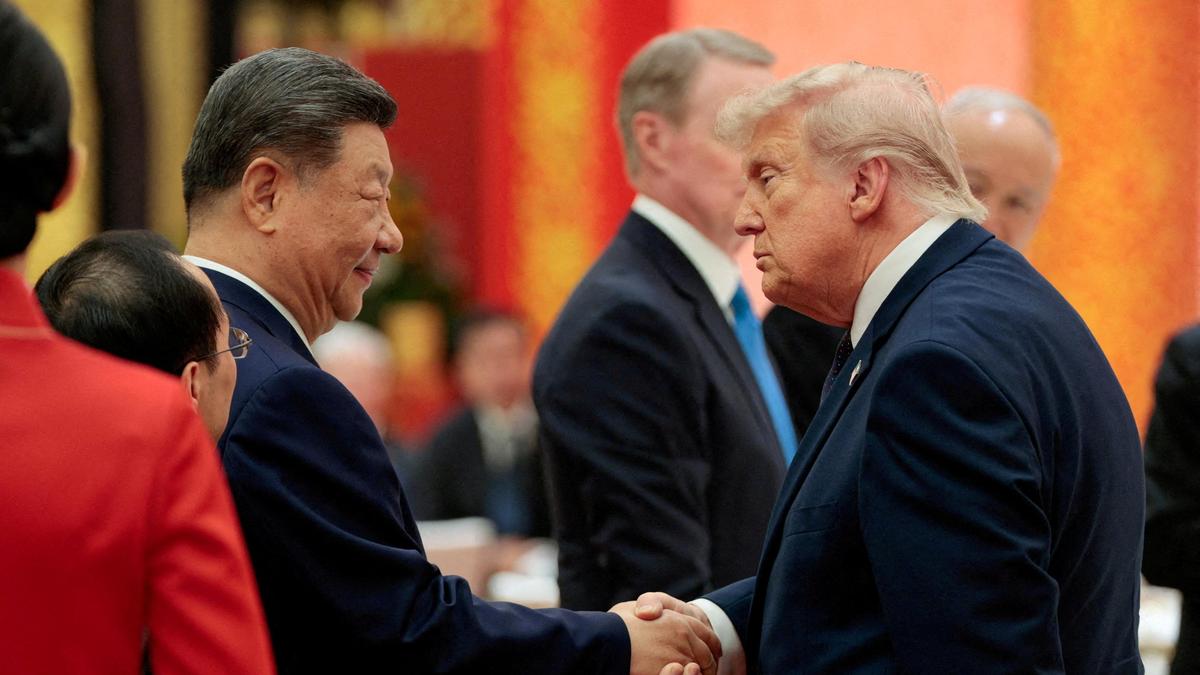
Donald Trump’s recent public alignment with Xi Jinping’s assessment of American decline represents more than a campaign soundbite. It is a calculated endorsement of a specific geopolitical narrative that suggests the United States has lost its structural integrity and global dominance. While Trump frames this erosion as a byproduct of the Biden administration’s specific policy choices—citing border security, inflation, and international withdrawal—the reality is a complex web of shifting economic power, internal social fragmentation, and a global reassessment of the American brand that started long before the current term.
The premise is straightforward. For years, the Chinese Communist Party has promoted the "East is rising, West is declining" doctrine to justify its own aggressive expansion and internal crackdowns. By agreeing "100%" with this sentiment, Trump isn't just attacking a political rival; he is validating a worldview held by America's primary strategic competitor. This creates a feedback loop where internal political divisions are used as evidence of terminal systemic failure.
The Mechanics of Manufactured Decline
Decline is rarely a sudden crash. It is a slow leak. In the halls of power in Beijing and Moscow, the perception of a failing America is based on the idea that the U.S. can no longer manage its own basic functions. They look at the gridlock in Washington, the volatility of the dollar, and the crumbling of domestic infrastructure as proof of a superpower in its twilight.
When a former president and current candidate echoes these sentiments, it functions as a force multiplier for that narrative. It signals to allies that the U.S. is an unreliable partner and to adversaries that the American project is vulnerable from within. Trump’s argument hinges on the idea that the decline is reversible through a return to "America First" protectionism, but this ignores the fact that the global economic machinery has already begun to rewire itself to bypass American influence.
The trade wars of the last decade did not bring manufacturing back in a tidal wave. Instead, they forced supply chains to diversify into Southeast Asia and Mexico, often with Chinese capital still pulling the strings from behind the scenes. This isn't a simple story of jobs leaving; it is a story of the U.S. losing its status as the indispensable hub of global commerce.
Weaponizing the Perception Gap
Public perception often lags behind economic reality. Despite the rhetoric of decay, the U.S. economy frequently outperforms other G7 nations in terms of raw GDP growth and innovation in sectors like artificial intelligence and aerospace. However, the "vibe" of the country—the sense of social cohesion and shared purpose—is undoubtedly at a low ebb.
This gap between data and feeling is where the political gold is mined. By focusing on the "decline," Trump taps into a visceral anxiety felt by voters who see their purchasing power shrinking and their communities changing. He positions Biden not as a leader making different choices, but as a symptom of a dying empire.
The Xi Trump Symmetry
It is a strange irony. Xi Jinping wants the world to believe the U.S. is finished so China can lead the next century. Trump wants his base to believe the U.S. is finished so he can be the one to save it. They are using the same diagnosis for entirely different prescriptions.
For Xi, American decline is an inevitability of history. For Trump, it is a choice made by "weak" leadership. The danger lies in the consensus. If both the leading authoritarian power and the leading opposition movement in the West agree that the current system is broken, the system effectively loses its legitimacy on the world stage. Investors hate uncertainty, and nothing says uncertainty like a superpower that has lost faith in its own durability.
The Economic Reality of the Multipolar World
The dollar remains the world's reserve currency, but the edges are fraying. Central banks are increasing their gold reserves. Trade in local currencies is rising. This isn't because the Yuan or the Euro is inherently better; it is because the world is terrified of American volatility. The constant threat of sanctions and the weaponization of the SWIFT system have pushed even friendly nations to look for insurance policies.
If the U.S. continues to project an image of a nation in freefall, the flight from the dollar will accelerate. This isn't a conspiracy; it's a risk management strategy by global finance. When the U.S. political class argues over whether the country is a "third world nation," the rest of the world starts to treat it like one.
Infrastructure and the Ghost of Industrial Might
Walk through any major Chinese city and then walk through a mid-sized American hub. The physical contrast is jarring. High-speed rail vs. potholed interstates. Gleaming ports vs. aging docks. This visual evidence is the most powerful tool in the arsenal of those preaching decline.
The U.S. spent decades exporting its industrial base in exchange for cheap consumer goods and high-finance profits. That trade-off worked until it didn't. Now, the hollowed-out middle of the country serves as the backdrop for the narrative of a nation that has forgotten how to build things. Biden’s attempts to rectify this through the CHIPS Act and infrastructure spending are multi-decade projects. They cannot produce the instant gratification required by a 24-hour news cycle or a campaign trail.
The Military Dimension of the Decline Narrative
The withdrawal from Afghanistan was a gift to the declinist school of thought. It provided the visual shorthand for a superpower in retreat. While military experts might argue over the strategic necessity of the move, the optics were a disaster that reverberated through every capital city in the world.
Trump uses these images to argue that the U.S. is no longer respected. But the "respect" he seeks is often rooted in transactional intimidation rather than long-term alliance building. This approach creates a vacuum. When the U.S. signals that its commitments are temporary and based on the whim of the current occupant of the White House, allies start making their own deals with Beijing.
The irony of the "decline" argument is that it often becomes a self-fulfilling prophecy. By withdrawing from trade agreements and questioning the value of NATO, the U.S. voluntarily abdicates the very levers of power that prevented decline in the first place.
Energy and the New Frontier
If there is one area where the U.S. defies the decline narrative, it is energy. The United States is currently the largest producer of oil and gas in the world. This energy independence is a massive strategic advantage that neither China nor Europe possesses.
However, the political battle over "green" versus "fossil" fuels creates another layer of perceived instability. To an outside observer, the U.S. looks like a country unable to decide on its own future. China is simultaneously building coal plants and dominating the world's solar and EV battery markets. They are playing both sides of the board. The U.S., meanwhile, is locked in a legislative stalemate that prevents long-term industrial planning.
The Social Fabric as a Leading Indicator
You cannot have a strong nation with a broken society. The skyrocketing rates of "deaths of despair," the opioid crisis, and the plummeting birth rates are the true markers of a nation in trouble. These are not things that can be fixed by a tariff or a border wall alone.
Both sides of the political aisle acknowledge these problems, but they use them as cudgels rather than solving them. The constant state of internal "cold civil war" is what Xi Jinping points to when he tells his people that democracy is a failed experiment. When Trump agrees with Xi’s assessment, he is inadvertently confirming that the American model of governance is no longer functional.
The Cost of the Rhetoric
Every time a major political figure calls the U.S. a "failing nation," it costs money. It raises the risk premium on American debt. It discourages foreign direct investment. It makes the brightest minds in the world think twice about bringing their talents to American universities and startups.
The "100% agreement" between a U.S. leader and a Chinese autocrat on the state of the union is a watershed moment. It marks the end of the "shining city on a hill" era and the beginning of an era of managed expectations.
The real question isn't whether the U.S. is in decline. It’s whether the U.S. has the stomach for the hard, boring work of renewal. Shouting about the fire doesn't put it out, and agreeing with the arsonist that the house is burning doesn't help the people trapped inside.
Stop looking for a savior and start looking at the balance sheet. The U.S. still holds the best hand in the global game—if it doesn't fold out of spite.