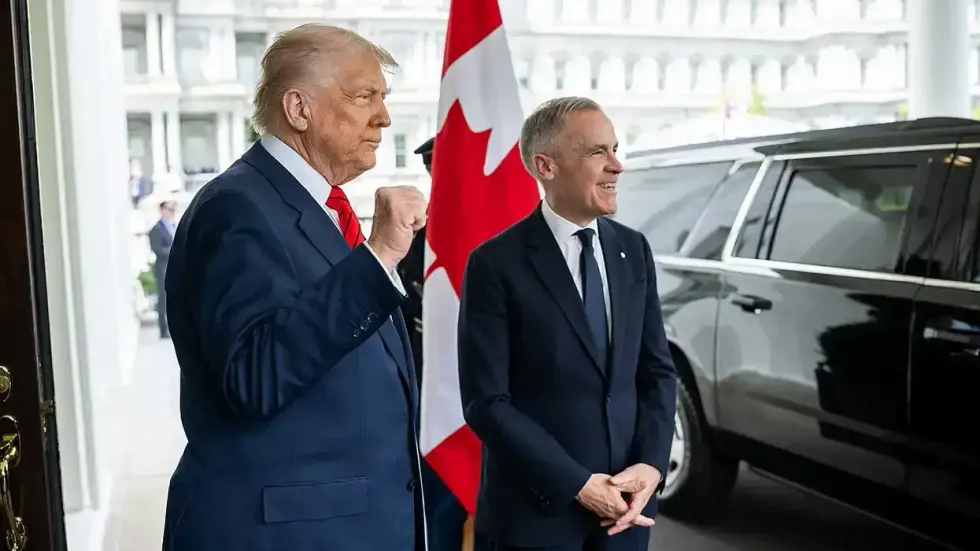
The current friction between Donald Trump’s inner circle and United States allies is not a product of personality clashes; it is a structural byproduct of two irreconcilable strategic models. On one side is the Multilateral Institutionalism model, which values predictable, long-term security guarantees and integrated trade. On the other is the Transactional Sovereignty model, which prioritizes immediate, bilateral utility and the extraction of maximum concessions. At the center of this tension sits the "MAGA Official"—a role defined by the impossible task of translating disruptive populist mandates into the rigid language of international diplomacy.
The Conflict of Divergent Utility Functions
Allies view the United States through a lens of reliability. For a European or Indo-Pacific partner, the utility of the U.S. alliance is found in its "insurance policy" characteristic: the belief that under specific conditions (Article 5 of NATO, for example), the U.S. will act regardless of the immediate cost. This creates a stable environment for economic planning and regional security.
The MAGA framework replaces this insurance model with a Spot Market model. In this framework, the value of an alliance is recalculated daily based on current trade deficits, defense spending percentages, and alignment with specific domestic political goals. The MAGA official operates as a broker in this spot market, attempting to sell "continued protection" in exchange for "immediate concessions."
The breakdown in communication occurs because these two models use different currencies. Allies trade in Diplomatic Capital and Long-term Stability, while the MAGA official is instructed to demand Fiscal Transfers and Trade Rebalancing.
The Three Pillars of Diplomatic Paralysis
The official caught in this vacuum faces three distinct structural bottlenecks that prevent effective policy execution:
- The Information Asymmetry Gap: Traditional diplomats rely on a standardized flow of information through the State Department and National Security Council. MAGA officials often operate on a separate track of "Personalist Diplomacy," where policy shifts can occur via social media or private phone calls between principals. This creates a high-variance environment where the official lacks the authority to guarantee that today’s promise will survive tomorrow’s headline.
- The Cost of Inconsistency: In game theory, a "credible threat" only works if the target believes the threat will be carried out. However, if a threat—such as withdrawing from a security pact—is perceived as a negotiating tactic rather than a firm policy, its efficacy drops. Allies have learned to "wait out" the MAGA official, betting that domestic political friction or legal challenges will neutralize the threat. This renders the official’s primary leverage—the threat of exit—increasingly impotent.
- The Sovereignty Paradox: The MAGA movement emphasizes national sovereignty. However, by demanding that allies change their internal laws (e.g., digital services taxes, energy policies, or defense budgets) to suit U.S. interests, the official is effectively asking allies to surrender their own sovereignty. This hypocrisy creates a "Resonance Conflict" in the domestic politics of the allied nation, making it harder for pro-U.S. factions within those countries to support the MAGA official's demands.
Quantifying the Burden Sharing Formula
The most frequent point of contention is the 2% GDP defense spending target for NATO members. The MAGA official is often tasked with using this single metric as a binary indicator of "friendship" or "enmity." From a data-driven perspective, this metric is a poor proxy for actual capability, but it serves as an excellent political tool for the "Transactional Sovereignty" model.
The strategic error lies in ignoring the Total Integrated Contribution (TIC). European allies argue that their contributions to regional stability—such as hosting U.S. bases, providing developmental aid to border regions, and maintaining specialized niche capabilities (e.g., mine-clearing or cyber-defense)—are not captured in the 2% figure. The MAGA official, constrained by the need for simple, populist-friendly metrics, cannot acknowledge the TIC without diluting the core political message. This creates a "Logical Deadlock" where the data used by the diplomat and the data used by the ally never overlap.
The Mechanism of Relational Decay
When an official is caught between a principal who demands disruption and an ally who requires stability, the result is a rapid decay in Strategic Trust. We can map this decay through three stages:
- Stage 1: Defensive Hedging. Allies begin looking for alternative security arrangements. This is visible in the push for "European Strategic Autonomy" or the strengthening of bilateral ties between middle powers (e.g., Japan and Australia) that bypass the U.S. center.
- Stage 2: Tactical Compliance. Allies perform the bare minimum required to avoid immediate retaliation. They might purchase a specific number of U.S. fighter jets or sign a vague trade memorandum, but they stop sharing deep intelligence or coordinating long-term industrial policy.
- Stage 3: Active Divergence. Allies openly defy U.S. mandates on critical issues—such as technology standards or relations with adversaries—calculating that the cost of defiance is lower than the cost of compliance with an unpredictable partner.
The MAGA official’s primary failure in this process is the inability to provide a Predictability Premium. In any negotiation, a party will pay more for a predictable outcome. Because the MAGA official cannot guarantee the stability of the U.S. position, the "price" the ally is willing to pay for the alliance decreases.
The Structural Incompatibility of "America First" and "Global Leadership"
The MAGA official is often accused of being "caught in the middle," but the reality is that the middle no longer exists. The post-1945 global order was built on the premise that U.S. interests and Global Order interests were largely synonymous. The "America First" doctrine explicitly decouples these two concepts.
For the official on the ground, this means every meeting is an exercise in managing Cognitive Dissonance. They must represent the most powerful nation on earth while simultaneously arguing that this nation is a "victim" of the very system it created and manages. This narrative shift transforms the U.S. from the architect of the system to a competitor within it.
Once the U.S. is viewed as just another competitor, allies shift their behavior from "partnership" to "containment." They begin to treat the U.S. as a volatility risk to be managed rather than a foundation to be built upon.
Strategic Recommendation for Navigating the Friction
If the MAGA official—or any strategist operating in this high-friction environment—wishes to achieve meaningful outcomes, they must pivot from Coercive Transactionalism to Interest-Based Alignment.
The official must identify "Parallel Objectives" where the populist domestic mandate and the ally's national interest coincide, without requiring a formal change in either party's grand strategy. This involves:
- De-linking Defense from Trade: Treat security guarantees as a fixed variable and move the "transaction" to the trade and technology sectors. This restores the "insurance policy" value of the alliance while still allowing for aggressive economic negotiations.
- Establishing Modular Agreements: Instead of pursuing massive, all-encompassing treaties that are vulnerable to political shifts, focus on small-scale, technical agreements that can be embedded into the bureaucracy. These "low-level" wins are harder to overturn and provide the stability that high-level rhetoric destroys.
- Adopting a "Tiered Partnership" Framework: Acknowledge that not all allies will meet the 2% threshold or align on every trade issue. By creating tiers of partnership based on specific, measurable contributions, the official can reward "high-performing" allies without alienating the entire bloc.
The current trajectory suggests that the role of the MAGA official will become increasingly untenable as the gap between domestic political requirements and international reality widens. The only way to bridge this gap is to replace the rhetoric of "betrayal" with a rigorous, data-backed accounting of mutual utility. Without this shift, the U.S. risks a "Hollow Hegemony," where it retains the military power to dictate terms but lacks the diplomatic architecture to ensure anyone follows them.