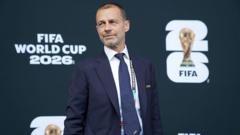
The deliberate absence of UEFA President Aleksander Čeferin from the 2026 FIFA World Cup final in East Rutherford, New Jersey, is not a mere breakdown in executive protocol. It represents a calculated institutional strike. By skipping the tournament's showpiece match between Spain and Argentina on July 19, 2026—despite having attended the opening match in Mexico City on June 11—Čeferin, who also occupies a mandatory seat as a FIFA vice-president, executed a silent, high-stakes institutional boycott.
The immediate catalyst for this rupture was FIFA's intervention in its own disciplinary apparatus under political pressure, a move that violated the foundational premise of independent sports governance. However, the conflict is rooted in a much deeper structural battle. This is an economic and regulatory war for control over the global football calendar, commercial revenue streams, and the preservation of regulatory predictability.
The Regulatory Squeeze and the Balogun Precedent
The tipping point occurred during the tournament's knockout stages. United States forward Folarin Balogun was dismissed with a direct red card for serious foul play during a Round of 32 match against Bosnia and Herzegovina. Under standard FIFA disciplinary procedures, a direct red card carries an automatic, non-appealable one-match suspension for the subsequent fixture—in this case, a Round of 16 match against Belgium.
Instead, FIFA executed an unprecedented regulatory maneuver. Following a direct telephone conversation between US President Donald Trump and FIFA President Gianni Infantino, where Trump publicly contested the validity of the referee's decision, FIFA invoked Article 27 of its Disciplinary Code. The governing body suspended the implementation of Balogun’s mandatory one-match ban, placing the player on a 12-month probationary period instead. This allowed the host nation's starting striker to play against Belgium, rendering Belgium’s subsequent legal appeals completely moot.
UEFA’s institutional response was immediate and severe, defining the action as a direct threat to the regulatory framework of international sport. The mechanism of fair competition relies entirely on the uniform enforcement of playing rules, independent of external political or executive influence. By setting aside an automatic suspension mid-tournament to appease a host nation's political executive, FIFA compromised the integrity of its own competition. UEFA summarized this breakdown in a scathing public statement:
"Football, like any other sport, relies on rules, which are the basis for fair, honest and transparent competition. When the certainty of rules is no longer guaranteed by its guardians, the integrity of the game is at stake and the credibility of a competition is undermined."
The Financial and Operational Fault Lines
While the Balogun incident acted as the detonator, Čeferin’s boycott is the result of accumulating friction across four core commercial and operational areas:
- Commercial Format Dilution and Half-Time Commercialization: UEFA strongly opposes Infantino’s ongoing efforts to alter the physical constraints of the match day for entertainment purposes. During the 2026 World Cup final, FIFA extended the standard 15-minute half-time interval to 27 minutes and 22 seconds to accommodate a multi-artist Super Bowl-style half-time show featuring global pop acts. UEFA has explicitly barred these extended intervals from its own flagship properties—the UEFA Champions League and the UEFA European Championship—arguing that format extension devalues sporting integrity to maximize broadcast advertisement windows.
- Arbitrary Tournament Expansion: The 2026 tournament marked the debut of the 48-team format, expanding the schedule to 104 matches. During the tournament, Infantino signaled an intention to explore a further expansion to a 64-team model. UEFA views this relentless expansion as a threat that dilutes the sporting product, oversaturates the broadcast market, and inflicts unsustainable physical demands on elite players, the vast majority of whom are under contract at European clubs.
- Predatory Ticket Pricing and Consumer Extraction: A major point of domestic friction emerged regarding FIFA’s dynamic pricing strategies within host stadiums. UEFA officials pointed out that the hyper-inflation of World Cup match day costs reached a point where the price of a single stadium parking space at the 2026 tournament exceeded the baseline cost of five combined match tickets for the upcoming Euro 2028 tournament, which UEFA has committed to freezing.
- Border Controls and Referee Mobility: Operational tensions peaked when Somali referee Omar Artan was denied an entry visa by United States immigration authorities, preventing him from officiating scheduled matches. UEFA directly rebuked this administrative failure by immediately inviting Artan to referee the high-profile UEFA Super Cup match between Paris Saint-Germain and Aston Villa on August 12, 2026.
The Economic War for Calendar Dominance
To properly analyze the structural divide between Nyon and Zurich, one must look at the underlying economic landscape. The relationship between UEFA and FIFA is fundamentally a battle between a regional monopoly that controls the world’s most lucrative club and international inventory, and a global governing body seeking to capture those exact revenue streams.
The core friction is centered on the International Match Calendar. FIFA's creation and subsequent expansion of the 32-team Club World Cup directly targets the summer window traditionally reserved for player rest or UEFA-sanctioned domestic programming. By filling the summer with a month-long, high-revenue club tournament, FIFA is trying to position itself as a direct competitor to the UEFA Champions League.
The economic cost function of this system is borne almost exclusively by European clubs and domestic leagues. These clubs pay player wages and absorb the long-term balance sheet depreciation caused by player injuries and fatigue. Yet, they see little of the tournament revenue generated by FIFA's expanded properties. Čeferin’s boycott signals that Europe’s sports political elite are no longer willing to cooperate with an expansion strategy that treats their billion-dollar club assets as free inputs for FIFA's commercial products.
The short-lived political truce established in early 2025—driven by the fact that both Infantino and Čeferin face re-election campaigns—has completely broken down. By coordinating a physical absence from the World Cup final, UEFA has effectively ended any pretense of institutional harmony. This move lays the groundwork for a broader coalition. UEFA is actively aligning with domestic leagues and FIFPRO, the global players' union, to mount a coordinated campaign against FIFA's unilateral calendar decisions. This building pressure will likely target the upcoming selection of host venues and commercial formats for the 2034 World Cup in Saudi Arabia.
The Royal Belgian Football Association is already exploring direct legal action through the Court of Arbitration for Sport (CAS) regarding the arbitrary handling of the Balogun disciplinary suspension. This legal challenge could establish a critical precedent. If CAS determines that FIFA violated its own binding regulations to protect a host nation's commercial viability, it will strip away the governing body's claims to regulatory autonomy. This would leave FIFA vulnerable to institutional restructuring and antitrust challenges within European courts. The era of quiet diplomacy between football's two power centers is over; a cold war defined by litigation, calendar vetoes, and public boycotts has taken its place.