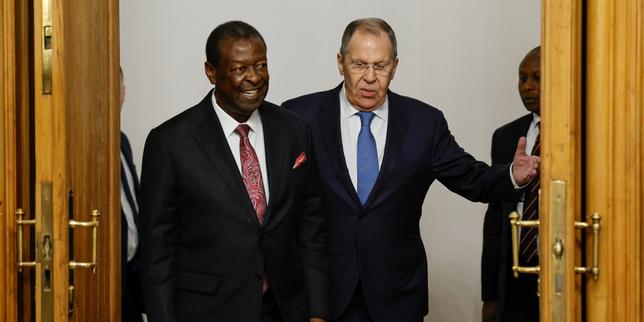
The recent diplomatic resolution between Nairobi and Moscow regarding the recruitment of Kenyan nationals into the Russian armed forces represents more than a localized labor dispute; it is a structural adjustment in the global market for high-risk human capital. When the Kenyan Foreign Minister formalized the cessation of these enforcements during his Moscow visit, he effectively recalibrated the bilateral risk-reward ratio that had begun to destabilize Kenya’s domestic security narrative and its standing within Western-aligned financial orbits. The phenomenon of Global South recruitment for the Ukrainian theater operates on three distinct pillars: economic desperation as a push factor, the professionalization of the "volunteer" through state-sanctioned pathways, and the eventual friction between private individual choice and national sovereign interest.
The Economic Mechanics of the Volunteer Pipeline
The recruitment of Kenyans into foreign conflicts is rarely a matter of ideological alignment. It is a response to a specific set of domestic economic pressures that create a surplus of military-age labor with high risk-tolerance. Kenya’s youth unemployment rate and the stagnation of the formal manufacturing sector produce a demographic that views foreign military service as a high-yield, albeit high-risk, investment.
- The Arbitrage of Risk: The wages offered by Russian recruitment entities—often quoted in multiples of the average Kenyan civil service salary—create a financial arbitrage. For an individual, the "expected value" of the contract (the probability of survival multiplied by the payout) often outweighs the certain poverty of local underemployment.
- The Remittance Variable: On a microeconomic level, these recruits function as extreme exporters of labor. However, unlike traditional labor migration to the Gulf or Europe, the capital inflow from combat service carries a "sovereign penalty." The source of the funds (the Russian Ministry of Defense) triggers anti-money laundering (AML) and "Know Your Customer" (KYC) flags in the global banking system, complicating the very utility of the earned wages.
The decision by the Kenyan government to halt this pipeline suggests that the marginal benefit of these individual remittances was being eclipsed by the systemic risk to Kenya’s diplomatic "middle power" strategy.
Diplomatic Friction and the Sovereign Risk Premium
Kenya has historically positioned itself as a stable, Western-leaning anchor in East Africa. Allowing its citizens to be enmeshed in the Russian military apparatus created a direct contradiction with this positioning. The logic of the cessation is rooted in two primary strategic bottlenecks.
The Credibility Gap in Multilateralism
Kenya’s leadership often advocates for "African solutions to African problems" and adheres to UN-centric international law. Having citizens active in a conflict that the UN General Assembly has largely condemned creates a "credibility tax." This tax manifests in weakened negotiating leverage during debt restructuring talks with the IMF or when seeking security cooperation from the United States and the UK. The "recruitment leak" was essentially devaluing Kenya’s primary diplomatic export: its reputation as a predictable, law-abiding international actor.
The Internal Security Feedback Loop
The return of combat-hardened individuals with specialized training in high-intensity electronic warfare, drone operations, and urban siege tactics presents a long-term domestic liability. Without a formal state-monitored demobilization, disarmament, and reintegration (DDR) program for these "privateers," the Kenyan state faces a potential surge in organized crime or non-state armed group capabilities. The government’s move to block further recruitment is a preemptive attempt to limit the volume of this unregulated "human hardware" returning to its borders.
The Russian Procurement Pivot
From the Russian perspective, the cessation of Kenyan recruitment indicates a shift in their "manpower procurement" strategy. When the Russian Ministry of Defense seeks foreign recruits, it is solving for a specific variable: the minimization of domestic political friction. By sourcing labor from the Global South, Moscow attempts to insulate its core Slavic population from the attrition of a prolonged conflict.
The "Kenyan experiment" likely failed due to a combination of logistical friction and diplomatic pushback that exceeded the tactical value of the recruits. Foreign fighters from non-neighboring states require significant investment in translation, cultural integration, and basic training before they become "combat-effective." If the diplomatic cost—such as the cooling of relations with a key African partner like Kenya—rises, the "unit cost" of the Kenyan soldier becomes prohibitively high for Moscow.
Structural Limitations of the "Volunteer" Narrative
The term "volunteer" in this context is a legal euphemism designed to circumvent the 1989 International Convention against the Recruitment, Use, Financing and Training of Mercenaries. The legal framework surrounding these individuals is fragile:
- Status under the Geneva Conventions: If classified as mercenaries, these individuals forfeit the right to prisoner-of-war (POW) status, increasing the legal and humanitarian burden on the Kenyan state to advocate for their release if captured.
- Contractual Enforceability: There is no international tribunal where a Kenyan national can sue the Russian state for breach of a military contract. This lack of legal recourse makes the recruitment process a predatory economic activity, which the Kenyan government is now explicitly recognizing.
The transition from allowing these departures to actively forbidding them signals a maturation of Kenyan foreign policy. It recognizes that "labor export" cannot include the export of violence when that violence is directed toward a conflict that jeopardizes the state's broader macroeconomic stability.
Tactical Realignment for Nairobi
The Kenyan administration must now manage the "legacy" recruits—those already on the front lines—while hardening its borders against recruitment agents. This requires a transition from diplomatic rhetoric to operational intelligence.
- Financial Surveillance: Monitoring the flow of funds from Russian entities to Kenyan bank accounts is the most effective way to identify active recruitment networks. This is not about individual surveillance but about identifying the "hubs" of the shadow labor market.
- Alternative Value Propositions: The state must address the core driver of recruitment: the lack of high-yield local opportunities. Without a corresponding increase in domestic security sector jobs or technical vocational training, the demand for high-risk foreign labor will simply shift to other conflict zones, such as those in the Sahel or Central Africa.
The agreement in Moscow is a tactical victory for Kenyan diplomacy, but it exposes the underlying vulnerability of any nation with a high "youth-bulge" and a low-growth economy. The move to stop the flow of soldiers to Russia is a necessary step to protect Kenya's brand as a regional peacemaker, yet the economic pressure that drove those men to enlist remains an unresolved variable.
The strategic priority now shifts to the reintegration of returnees and the formalization of laws that define the limits of "private military participation" for Kenyan citizens. Failing to codify these rules will leave the door open for the next global power seeking cheap, expendable labor for a distant war. The Kenyan state has signaled it is no longer willing to trade its citizens' lives for a temporary reprieve from its own unemployment crisis.