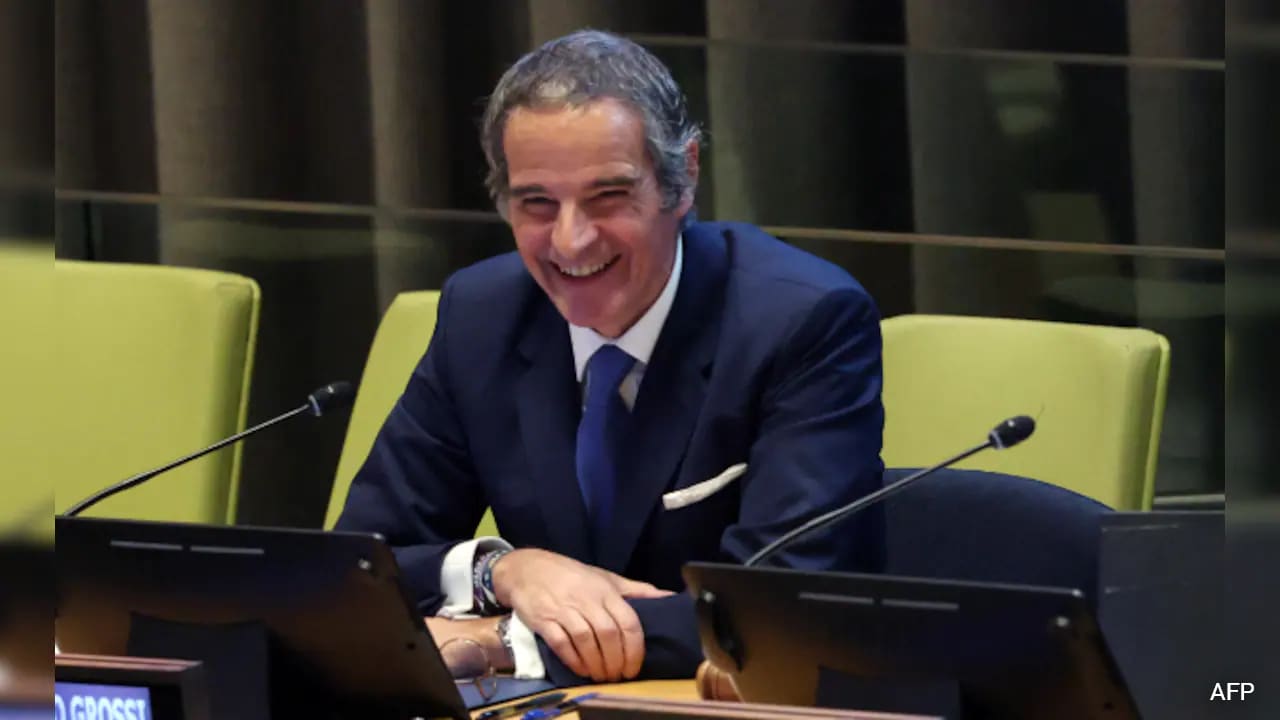
The institutional architecture established by the 1945 United Nations Charter operates on a structural mismatch: the distribution of permanent, veto-wielding seats within the United Nations Security Council (UNSC) reflects a post-World War II global configuration that bears no statistical or economic relevance to the year 2026. This disconnect has driven a crisis of confidence in multilateral crisis resolution. The statement by International Atomic Energy Agency (IAEA) Director General Rafael Mariano Grossi framing India's aspiration for a permanent UNSC seat as "only logical" points to an underlying strategic reality. The validity of India’s bid is not a matter of abstract diplomatic merit; it is a function of structural weight, technological independence, and the high systemic costs of maintaining an unrepresentative executive body.
To analyze why India's inclusion is a functional necessity for the preservation of international security architecture, we must move past rhetorical assertions of "global influence." Instead, we must dissect the quantifiable mechanisms of power: the diversification of the nuclear fuel cycle, the demographic and economic contribution to international public goods, and the structural veto bottle-necking current multilateral operations.
The Equilibrium of Force: The Structural Mechanics of India’s Nuclear Matrix
A nation’s capacity to enforce international security architectures relies heavily on its domestic technological self-reliance. The convergence of Grossi’s diplomatic endorsement with India’s localized technological milestones exposes the underlying driver of its institutional weight. India's recent operational milestone—the Prototype Fast Breeder Reactor (PFBR) at Kalpakkam attaining criticality—signals a shift in the global nuclear energy and non-proliferation equilibrium.
This technological evolution operates within a strict three-stage nuclear roadmap optimized for closed-fuel-cycle capabilities:
Stage 1: Pressurized Heavy Water Reactors (PHWRs)
   │   └─ Employs Natural Uranium to produce Plutonium-239
   ▼
Stage 2: Fast Breeder Reactors (FBRs) [Current Criticality Milestone]
   │   └─ Utilizes Plutonium-239 + Uranium-238 blanket to breed more Plutonium
   ▼
Stage 3: Thorium-Based Advanced Heavy Water Reactors (AHWRs)
       └─ Utilizes India’s vast Thorium reserves + Uranium-233 cycle
The realization of Stage 2 introduces a definitive supply-chain multiplier. By breeding more fissile material than it consumes, the fast breeder mechanism bypasses external fuel-supply cartels, removing vulnerable nodes in India’s long-term energy security apparatus.
This technological autonomy impacts global governance in two distinct ways:
- Sovereign Non-Proliferation Management: India achieves strategic nuclear sufficiency outside the formal framework of the Non-Proliferation Treaty (NPT) as a non-signatory, yet maintains an unblemished record of tracking and safety. This structural reality forces international oversight bodies like the IAEA to engage with New Delhi not as a rule-taker, but as an essential systemic anchor.
- Decoupling of Technology and External Sanctions: Complete control over the closed fuel cycle minimizes the leverage traditionally held by the permanent five (P5) members via the Nuclear Suppliers Group (NSG). When a state can scale its baseline power and strategic capabilities independent of global supply vulnerabilities, denying that state an institutional veto simply creates a parallel power node outside the UN framework.
The Cost Function of Multilateral Inertia
The current UNSC operational model operates on an institutional design that guarantees diminishing marginal utility during acute systemic shocks. The P5 veto framework (United States, Russia, China, United Kingdom, France) was structured as an equilibrium mechanism to prevent direct kinetic warfare between nuclear powers. In 2026, however, this framework generates systemic deadlocks across major theaters of conflict, including Eastern Europe and the Middle East.
The institutional failure can be expressed as a function of the divergence between real-world enforcement capability and council voting alignment. The structural bottlenecks of the current matrix are clear:
1. The Veto Asymmetry
The veto power is no longer used to maintain systemic stability; instead, it is deployed as a risk-insulation mechanism for client states. The cost of this structural paralysis is shifted entirely to the General Assembly and external agencies, rendering the UN "absent" in critical mediation roles.
2. The Capital-Contribution Disconnect
The financial and operational underpinnings of UN peace operations rely heavily on non-P5 actors. India historically and consistently ranks among the highest troop-contributing countries to UN peacekeeping missions. This creates a severe structural imbalance:
$$\text{Structural Imbalance} = \frac{\text{Troop/Operational Risk Borne by Non-P5}}{\text{Strategic Decision-Making Control Held by P5}}$$
When the actors bearing the physical and logistical costs of enforcement are decoupled from the executive body authorizing those missions, the legitimacy of the enforcement command chain decays.
3. Demographic and Macroeconomic Asymmetry
The P5 collective population represents less than 26% of the global population, a percentage that continues to trend downward. Denying a permanent seat to a nation representing more than 1.4 billion people introduces a representation deficit that compromises the statistical validity of any "global consensus" claims made by the council.
The Diplomatic Campaign Variable: The Race for the Secretariat
The timing of endorsements regarding India’s institutional elevation is deeply tied to internal UN political dynamics. The second term of Secretary-General António Guterres concludes in December 2026, triggering an active selection process for the next chief administrative officer under Article 97 of the UN Charter.
Grossi’s public positioning on India’s UNSC ambitions cannot be separated from his status as a leading candidate for the Secretary-General post. The selection architecture requires a recommendation from the Security Council—necessitating the acquiescence or affirmative vote of all P5 members—followed by a majority vote within the General Assembly.
[Candidate Nomination] ──► [Security Council Recommendation (P5 Consensual Veto Applies)] ──► [General Assembly Absolute Majority Vote]
This dual-layer selection framework creates a complex tactical landscape for any candidate:
- Securing the Global South Bloc: To command a decisive majority in the General Assembly, a candidate must consolidate support across the Global South. Endorsing India’s bid serves as a highly visible proxy signal to developing nations that a candidate intends to actively pursue structural decentralization.
- Navigating P5 Fractures: The P5 is fundamentally split on council expansion. While the US, UK, and France have offered varying degrees of formal support for India's permanent inclusion, China maintains a strategy of procedural deferral, often tying India's bid to broader, unresolvable package deals involving other regional powers. A candidate must therefore frame the expansion not as a disruptive revisionist move, but as a stabilizing, status-quo-preserving adjustment.
The limitation of any Secretary-General endorsement is structural: the office lacks statutory authority to alter the composition of the Security Council. Charter amendment requires a two-thirds vote of the General Assembly and ratification by two-thirds of the member states, crucially including all permanent members of the Security Council via Article 108. Consequently, expressions of support from candidate officials function primarily as normative diplomacy, building rhetorical momentum while leaving the underlying legislative hurdles untouched.
The Strategic Path Forward
To translate structural weight into structural position, India’s strategic play cannot rely on moral arguments for equity. The target must be the structural self-interest of the existing veto holders. The final play requires executing a dual-track strategy:
First, New Delhi must leverage its growing nuclear material autonomy—anchored by the fast breeder milestone—to establish bilateral technology partnerships across Africa and Southeast Asia, positioning itself as the primary alternative supplier of civil nuclear tech outside the traditional P5 supply lines.
Second, India must condition its future troop deployments to UN peacekeeping operations on direct, non-negotiable participation in the strategic command-and-control phases of those specific missions. By raising the operational cost of using non-P5 resources to police P5 stalemates, India can force an explicit trade-off: if the existing Council desires global enforcement capabilities, it must yield executive co-determination.


