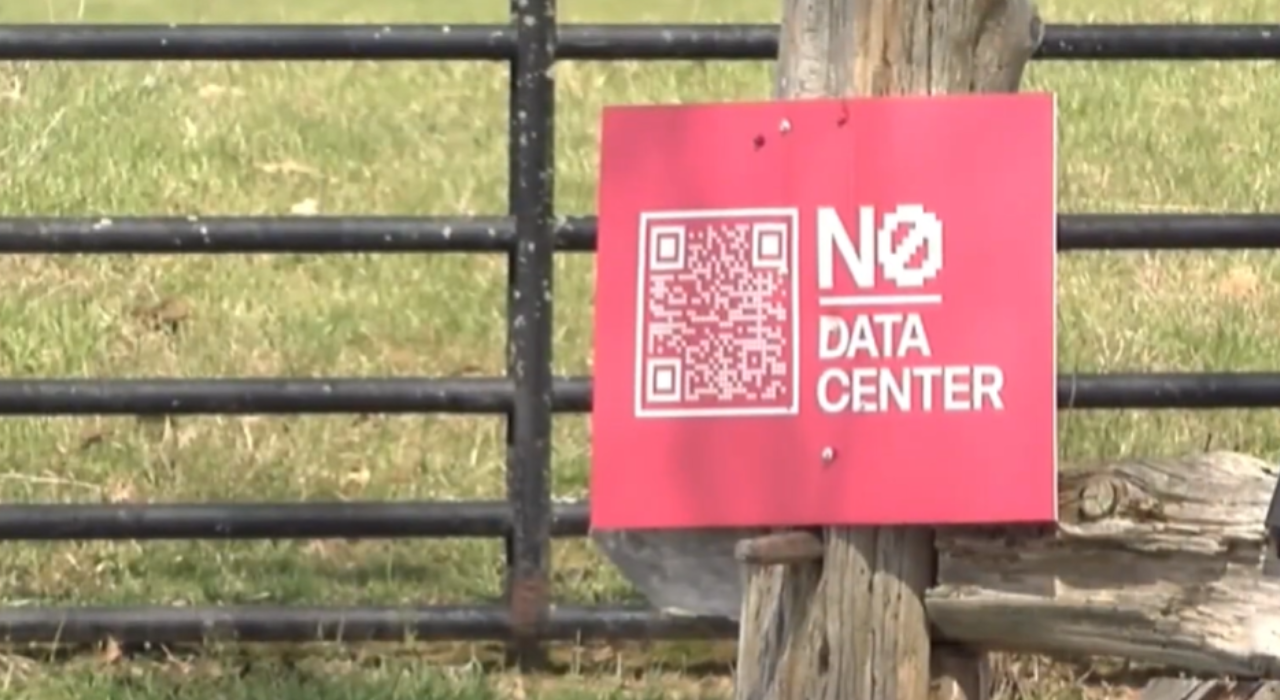
The valuation gap between agricultural utility and artificial intelligence infrastructure is no longer a matter of linear appreciation; it is a structural divergence in how capital views the earth’s surface. When a family rejects a $26 million offer for a farm to make way for a data center, the conflict is often framed as sentiment versus greed. This binary view ignores the complex interplay of high-performance computing (HPC) power requirements, the physics of fiber-optic latency, and the shifting definition of "highest and best use" in a post-generative AI economy. Understanding this friction requires a breakdown of the three variables that dictate the feasibility of a hyperscale site: power density, cooling access, and the non-linear depreciation of legacy land rights.
The Infrastructure Convergence Theory
The modern data center is not a warehouse; it is a thermal management system with a compute-heavy core. The transition from general-purpose cloud storage to AI training requires a massive increase in power density per rack. Traditional data centers might operate at $10$ to $15$ kW per rack, whereas AI clusters involving H100 or B200 GPUs demand $40$ to $100$ kW per rack. This shift forces developers to seek land that sits at the intersection of three specific physical constraints.
- Grid Proximity and Substation Lead Times: As the demand for electricity outpaces grid expansion, the value of land is tied directly to its existing proximity to high-voltage transmission lines. A site that requires a new substation or a five-year wait for a utility interconnection loses its competitive edge, regardless of its geographic location.
- The Latency Radius: While training large language models (LLMs) can happen in remote areas, "inference"—the act of the AI providing an answer—requires proximity to the end-user to minimize latency. This creates a geographical "goldilocks zone" where rural farms on the periphery of major metropolitan hubs become the only viable candidates for expansion.
- Water Rights for Thermal Dissipation: Data centers are heat engines. Evaporative cooling remains the most cost-effective method for thermal management, requiring millions of gallons of water per day. Agricultural land often comes with grandfathered water rights that are more valuable to a cooling tower than to a cornfield.
When a developer offers $26$ million for a property valued at a fraction of that for agricultural use, they are not paying for the dirt. They are paying for a "time-to-market" premium. The offer represents the avoided cost of litigation, rezoning, and the multi-year delay of finding an alternative site with equivalent power access.
The Economic Friction of Generational Holdouts
The decision to refuse a buyout highlights a breakdown in standard Net Present Value (NPV) modeling. From a purely financial perspective, $26$ million invested at a conservative $5%$ yield generates $1.3$ million in annual income—surpassing the yield of almost any medium-sized farming operation. However, the "holdout" phenomenon is driven by an asymmetric view of risk and the illiquidity of "priceless" assets.
The Tax Shield of the Family Farm
Federal and state tax codes often provide significant protections for agricultural land, including "Current Use" valuations that keep property taxes artificially low. Selling the land triggers a massive capital gains event. For a family that has held land for generations, the "step-up in basis" at the time of inheritance is a more powerful wealth preservation tool than a liquid cash payout that is immediately eroded by a $20%$ to $37%$ tax hit.
The Replacement Cost Fallacy
A primary driver of resistance is the inability to replicate the asset. In the context of the modern land rush, a $26$ million payout does not guarantee the ability to purchase a similar $200$-acre plot with the same water rights and soil quality within a reasonable distance. The consolidation of land by institutional investors and REITs has created a scarcity that makes cash a poor substitute for tangible, productive acreage.
The Physics of AI Land Scarcity
The demand for AI data centers is currently decoupled from the broader real estate market. This is because the "tenant" is often a trillion-dollar tech entity with an insatiable need for "compute." This creates a predatory pricing environment where land prices are driven by the projected revenue of the chips housed on the property, rather than the square footage of the building.
The revenue density of a $100,000$ square-foot data center filled with H100 GPUs is orders of magnitude higher than any other form of real estate. A single AI cluster can represent billions of dollars in CapEx. In this environment, the cost of the land—even at $26$ million—is a rounding error in the total project budget. Developers are willing to pay a "nuisance premium" to secure a site that is "shovel-ready."
Structural Barriers to Rezoning and Community Resistance
The transition from "Rural-Agricultural" to "Industrial-Data Center" zoning is the most significant hurdle in the development lifecycle. Communities often perceive data centers as "vampire assets": they consume massive amounts of power and water, occupy huge footprints, but provide very few permanent jobs once construction is complete.
- The Employment Paradox: A retail distribution center might employ $1,000$ people. A data center of the same size may only require $30$ to $50$ technicians and security personnel.
- The Soundscape Problem: Cooling fans and backup diesel generators create a constant low-frequency hum that can devalue surrounding residential properties, leading to "NIMBY" (Not In My Backyard) legal challenges.
- Infrastructure Strain: While data centers pay significant property taxes, they do not contribute to the local economy in the same way a manufacturing plant does. They don't buy local raw materials or create a large local payroll.
These factors create a political environment where a single family’s refusal to sell can become a focal point for broader community resistance. The family isn't just protecting a farm; they are often acting as a proxy for a community that fears the "industrialization of the rural."
Risk Assessment for Tech Infrastructure Developers
For developers and investors, the "generational farm" represents a high-risk asset class. The primary risk is not financial, but "entitlement risk." If a project is contingent on a specific parcel of land, the developer loses all leverage.
To mitigate this, sophisticated players are moving toward a "Distributed Hub" model. Rather than betting on a single massive site, they are acquiring smaller, non-contiguous parcels and linking them via private fiber clouds. This reduces the impact of a single holdout and allows for a more modular expansion of the power grid.
The Valuation of the Intangible
There is a quantitative limit to what "priceless" means in a negotiation. In land acquisition, this is known as the "Endowment Effect," where an owner values an asset more highly simply because they own it. However, in the case of generational land, this is compounded by the "Option Value of Sovereignty." Owning the land provides the family with the option to change its use in the future, whereas selling it is an irreversible exit.
If the AI boom continues its current trajectory, the $26$ million offer of today may look like a low-ball bid in five years. Conversely, if localized fusion or modular nuclear reactors (SMRs) become viable, the requirement for land to be near existing high-voltage lines will vanish, and the "location premium" of these specific farms will evaporate.
Strategic Recommendation for Landowners and Developers
The current standoff between legacy landholders and AI infrastructure firms is a temporary equilibrium. Landowners must recognize that the "data center gold rush" is subject to the same boom-bust cycles as any other technological shift. The window of opportunity to exit at $10x$ or $20x$ agricultural value is tied to the current centralized grid architecture.
Developers must shift their strategy from "hostile acquisition" to "partnership models." This involves offering the landholding family a stake in the long-term lease or a percentage of the "megawatt-hour" revenue generated by the site. By converting the family from a seller into a landlord, developers can align incentives, bypass the emotional hurdles of "selling the legacy," and secure the high-density power access required to sustain the next decade of AI scaling. The goal is not to buy the dirt, but to lease the geography.
The final strategic play for any entity facing a $26$ million refusal is to pivot from a "fee simple" acquisition to a "ground lease with participation." This allows the landowner to maintain the "priceless" title to the land while the developer gains the "operational right" to build. This structure bridges the gap between the finite nature of generational sentiment and the infinite demand for compute.