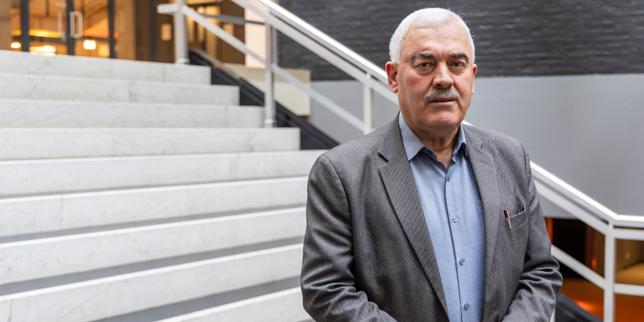
Shawan Jabarin does not exist in the eyes of the French state as a man, but as a file.
A file is thin. It is composed of paper, ink, and perhaps a digital stamp. A man, conversely, is composed of thirty years of advocacy, a seat at the table of Human Rights Watch, and the leadership of Al-Haq, one of the most storied human rights organizations in the Arab world. When Jabarin applied for a visa to enter France, he wasn't looking for a vacation. He was invited to speak, to consult, and to bear witness. Instead, he found himself staring at a closed door, guarded by a logic that refused to name itself.
The French Ministry of the Interior issued a refusal. They didn't cite a missed signature or an expired passport. They cited a threat. But when asked to define the shape of that threat, the room went silent.
The Anatomy of a Shadow
In the bureaucracy of border control, there is a tool known as the "note blanche." It is an anonymous intelligence memo. It has no author. It lists no specific evidence that can be cross-examined in a traditional court. It is a whisper from the shadows that carries the weight of law.
For years, the French government relied on these whispers to keep Jabarin out, vaguely gesturing toward "links" to organizations they deemed problematic. To the Ministry, Jabarin was a risk. To the international community, he was a decorated defender of justice who had been granted visas by almost every other Western democracy.
This creates a friction that is hard to ignore. How can a man be a respected partner for the United Nations on Tuesday and a national security threat to Paris on Wednesday?
The tension broke in a courtroom. The Council of State, France's highest administrative court, looked at the file. They looked for the substance behind the "threat." They found a void.
The Weight of a Rubber Stamp
When a government denies a visa to a human rights defender, they aren't just stopping a traveler. They are signaling a boundary for what kind of speech is permissible. Imagine a hypothetical scholar invited to a university to discuss climate change, only to be stopped at the border because an unnamed source claims their research is "disruptive." The university remains, the students are in their seats, but the voice is missing. The silence is the message.
The Council of State’s recent decision was a rare, sharp rebuke to the Ministry of the Interior. The judges didn't just suggest a second look; they "somméd"—summoned or ordered—the Ministry to re-examine Jabarin’s case within two months.
The court noted that the Ministry had failed to provide any concrete, recent evidence to justify the ban. Security cannot be a magic word that cancels out the right to move and speak. You cannot build a wall out of thin air.
This isn't just about one man from Ramallah. It is about the precedent of the "secret file." If the government can ban a globally recognized figure without showing their hand, they can ban anyone. The Council of State effectively ruled that the Ministry’s "discretionary power" is not a blank check.
The Cost of Cold Shoulders
There is a specific kind of exhaustion that comes with being a Palestinian advocate. It is the exhaustion of being perpetually screened. Jabarin has spent decades navigating Israeli travel bans, only to find the same barriers replicated in the heart of Europe—a continent that prides itself on being the cradle of human rights.
When the Ministry of the Interior refuses to justify its stance, it creates a Kafkaesque loop. Jabarin is told he is a danger, but not why. Because he doesn't know why, he cannot prove he isn't. The burden of proof is flipped upside down, resting on the shoulders of the accused rather than the accuser.
Consider the ripple effect. When France shuts out the head of Al-Haq, it sends a chill through the entire NGO sector. It tells every researcher and lawyer working in the Palestinian territories that their credentials offer no protection against the whims of an anonymous intelligence officer.
The court's intervention is a crack in that wall. It demands that if France wants to use the word "security," it must back it up with facts that can stand the light of day.
Beyond the Bureaucracy
The Ministry now sits with a ticking clock. Two months.
They must decide if they will produce actual evidence or if they will finally concede that the ghost in the file was never there to begin with. The "note blanche" has lost its luster. The judges have signaled that while the state has a right to protect its borders, it does not have a right to ignore its own principles of transparency.
Jabarin remains in his office, continuing the work he has done since the 1980s. He is accustomed to waiting. He has waited at checkpoints, waited for court dates, and waited for the world to align its actions with its rhetoric.
The invisible stakes here aren't about a stamp in a passport. They are about whether "security" remains a legitimate shield for the state or becomes a convenient rug under which inconvenient voices are swept.
The door is no longer locked; it is merely stuck. The Ministry is now being forced to put its shoulder to it. Whether they push it open or lean against it with all their weight will tell us everything we need to know about the current state of French liberty.
Somewhere in a desk drawer in Paris, a file is being reopened. The ink is old, the accusations are dusty, and for the first time in a long time, someone is asking for the truth instead of a signature.