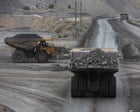
The federal government is expanding taxpayer-funded diesel subsidies to coal mining giants, lock-stepping with recent approvals for massive new mining projects. While public messaging focuses on emission reduction targets, a quiet financial mechanism ensures that the heavier a mining company digs into fossil fuels, the more tax relief it secures. This arrangement funnels billions of dollars away from public revenue and directly back into the operational budgets of the world’s wealthiest extraction companies.
The Hidden Mechanics of the Diesel Fuel Rebate
The core of this wealth transfer rests within the Fuel Tax Credit scheme. To understand how a multi-national mining company claws back billions of dollars, one must look at how standard road taxes are structured.
When an ordinary motorist fills up a vehicle at a commercial gas station, the price per gallon includes a substantial federal excise tax. This tax is explicitly designed to fund public infrastructure, maintaining the roads, highways, and bridges that heavy transport and civil vehicles degrade over time.
Mining companies operate under a radically different legal framework. Because their massive haul trucks, excavators, and generators operate on private leases and specialized mining tenements rather than gazetted public roads, the industry argued successfully decades ago that they should not be legally obligated to pay a tax meant for public road maintenance.
The resulting legislation allows companies to claim a total or near-total rebate on the excise tax paid for every gallon of diesel consumed off-road.
This is not a minor bureaucratic deduction. A standard ultra-class haul truck used in open-cut coal operations carries a fuel capacity of over 1,000 gallons and consumes tens of gallons per hour. When multiplied across a fleet of fifty trucks operating twenty-four hours a day, 365 days a year, the fuel burn becomes astronomical. The rebate turns what should be a massive variable cost into a heavily discounted operational expense.
Labor Policy Contradictions in Plain Sight
The current administration finds itself trapped between environmental rhetoric and economic dependency. On the international stage, policymakers pledge aggressive timelines to phase out carbon-intensive industries. On the domestic front, the approval of new coal mine expansions triggers an automatic extension of these diesel credits.
When a regulatory body approves a new metallurgical or thermal coal project, it does not just approve the extraction of the physical resource. It signs off on a predictable, multi-decade stream of fuel tax credits.
Critics from independent economic think tanks point out that this framework creates a perverse incentive structure. If the state subsidizes the primary energy input required to extract coal, it artificially lowers the cost of production. This makes older, less efficient mining practices economically viable for longer periods than they would be under true market conditions.
The political defense of the scheme usually hinges on international competitiveness. Proponents of the rebate argue that removing the fuel tax credit would immediately drive up the cost of production, placing domestic mining operations at a severe disadvantage against global competitors who operate in jurisdictions with lower regulatory or tax burdens.
The argument presents a false binary. It assumes the only options are total capitulation to industry demands or the immediate collapse of the sector.
Follow the Capital to Foreign Shareholders
To truly gauge who benefits from these diesel provisions, look at the share registries of the entities executing these new mining projects. The narrative pushed by industry public relations firms often spotlights the local workforce, suggesting that any change to the subsidy framework threatens regional towns and blue-collar jobs.
The financial realities tell a different story. The entities operating the largest open-cut mines are predominantly multinational conglomerates or foreign-owned entities. When the federal treasury foregoes billions in revenue via fuel tax credits, that money does not manifest as higher wages for local operators or better infrastructure for mining communities.
Instead, it preserves corporate profit margins. Those margins dictate the size of dividends distributed to institutional investors in London, New York, and Tokyo.
Consider a hypothetical mining operation extracting twenty million tons of coal annually. Under a standard tax environment without fuel offsets, the rising cost of diesel would force the operator to invest heavily in fleet electrification or alternative conveyor systems to protect their bottom line. With the subsidy intact, the financial pressure to innovate evaporates. The cheaper alternative is to keep burning diesel, collect the taxpayer rebate, and export the untaxed profits overseas.
The Technological Stagnation of Big Mining
Heavy industry frequently boasts about its transition toward green technology. Press releases feature trial runs of hydrogen fuel cell prototypes or battery-powered haulage options. Yet the actual deployment of these technologies across major production sites remains negligible.
The fuel tax credit acts as a financial buffer against technological evolution. Transitioning an open-cut mine from diesel-powered haulage to an electrified trolley-assist or battery-electric system requires immense upfront capital expenditure. Mining executives are bound by fiduciary duties to maximize short-term returns for shareholders.
If the government absorbs a massive percentage of the diesel cost, the financial payback period for switching to clean technology stretches out to a point where it becomes unfeasible.
The subsidy actively crowds out cleaner alternatives. It creates an environment where burning fossil fuels to extract fossil fuels remains the most commercially logical path forward. By the time these new mine approvals reach their peak production phases in the mid-2030s, the volume of diesel consumed per ton of extracted material is projected to rise as pits grow deeper and haulage distances lengthen.
The Cost to the Public Ledger
Every dollar refunded to a mining company for its off-road diesel use is a dollar that vanishes from the national budget. This shortfall must be compensated for elsewhere, either through increased taxation on individual citizens and small businesses or through spending cuts to public services like healthcare, education, and regional infrastructure.
The scale of the fuel tax credit scheme makes it one of the largest single expenditure items in the federal budget, frequently outstripping total government spending on targeted environmental initiatives or regional development funds.
This creates a bizarre fiscal loop. The state spends millions trying to incentivize low-emission technologies while simultaneously spending billions to cheapen the cost of heavy diesel consumption for the world's most carbon-intensive sector.
The structural flaw in the policy is its lack of scalability or economic targeting. The rebate applies equally to a small-scale family farming operation using diesel for a single tractor and a multi-billion-dollar mining corporation running a massive fleet of heavy machinery. There is no cap, no means-testing, and no built-in reduction mechanism aligned with national emission targets.
Transitioning Away from the Extraction Crutch
Reforming this system requires moving past the standard political theater that dominates the resource policy debate. Industry lobbyists routinely warn that any modification to the fuel tax credit will result in immediate mine closures and mass layoffs.
Historical data from past commodity cycles suggests otherwise. Mining operations live and die by global commodity prices, not marginal adjustments to domestic tax frameworks.
A gradual, phased reduction of the credit specifically for large-scale resource extraction would force companies to reckon with the true cost of their carbon footprint. The funds saved from scaling back the rebate could be redirected into public infrastructure in the very regions currently dependent on coal mining, building a genuine economic cushion for when global demand inevitably shifts.
The current trajectory ensures that taxpayers will continue to underwrite the operational costs of foreign-owned mining operations for decades to come, even as those same operations complicate the country’s ability to meet its long-term climate obligations.