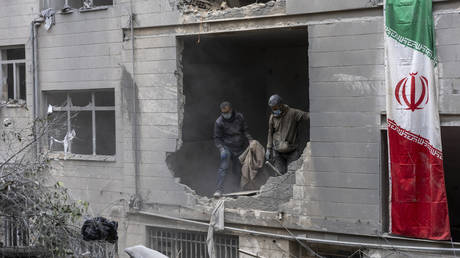
The collapse of the June 17, 2026, interim memorandum of understanding between the United States and Iran was mathematically predictable. The agreement attempted to stabilize the Persian Gulf through an unworkable trade-off: immediate, verifiable US economic concessions in exchange for temporary, unverifiable Iranian maritime restraint. When Washington reinstated its naval blockade and revoked oil export waivers on July 13, it did not merely react to tactical skirmishes in the Strait of Hormuz; it acknowledged that the structural incentives of asymmetric conflict favor escalation over status-quo maintenance.
To evaluate the trajectory of this conflict, we must move past political rhetoric and analyze the underlying strategic mechanics. The current escalation cycle—marked by US strikes expanding to Tehran, Semnan, and Qeshm Island alongside retaliatory Iranian drone strikes against US-allied facilities in Bahrain, Jordan, and Kuwait—reveals a fundamental breakdown in the cost-benefit calculus of both state actors. If you liked this post, you should look at: this related article.
The Strategic Asymmetric Cost Function
The primary flaw in US maritime strategy in the Persian Gulf is an asymmetric cost imbalance. We can model this dynamic through a simplified operational cost function ($C$):
$$C_{US} = f(O_c, P_c, S_r)$$ For another angle on this story, see the latest coverage from The Guardian.
Where:
- $O_c$ represents direct operational costs (naval deployments, high-cost munitions, and air wings).
- $P_c$ represents political costs (domestic sensitivity to energy inflation and troop casualties ahead of upcoming elections).
- $S_r$ represents systemic risk (the probability of broader regional escalation drawing in regional allies).
Conversely, Iran’s operational cost function ($C_{IR}$) is optimized for high-friction, low-cost persistence:
$$C_{IR} = f(A_m, P_n, D_c)$$
Where:
- $A_m$ represents asymmetric munitions (locally produced, low-cost loitering munitions and anti-ship cruise missiles).
- $P_n$ represents proxy networks (distributed non-state actors that absorb retaliatory costs).
- $D_c$ represents decentralized command structures (autonomous localized units requiring minimal top-down coordination).
Because $C_{US} \gg C_{IR}$ per unit of kinetic engagement, Iran can sustain low-intensity maritime friction indefinitely, while the US requires rapid, decisive containment to justify its deployment costs.
The Operational Attrition Ratio
The cost-exchange ratio of individual tactical engagements exposes this structural divergence. A standard US Navy engagement to defend a commercial vessel typically requires the deployment of SM-2, SM-6, or ESSM interceptors, costing between $1 million and $4.3 million per unit. These assets are fired to neutralize Iranian-manufactured Shahed-series loitering munitions or light anti-ship missiles, which cost between $20,000 and $100,000 to produce.
This creates a 50-to-1 operational attrition ratio in favor of Iranian forces. By targeting commercial shipping along the alternative Omani coastal routes established by the US, Tehran forces Washington into a continuous defensive posture that depletes high-end missile inventories faster than US industrial capacity can replenish them.
The Sovereignty Toll Dispute and the Strait of Hormuz Bottleneck
The immediate catalyst for the collapse of the June truce was a fundamental disagreement over the legal status of the Strait of Hormuz under international maritime law.
The interim agreement stipulated that Iran would use its "best efforts" to ensure the safe passage of commercial vessels for a 60-day window. Tehran interpreted this clause as a recognition of its sovereign right to manage, regulate, and potentially levy service tolls on traffic transiting through its territorial waters within the strait. The US and its allies rejected this interpretation, maintaining that the strait is an international waterway subject to transit passage under the United Nations Convention on the Law of the Sea (UNCLOS)—even though the US has not ratified UNCLOS and Iran is a signatory but has not ratified it.
This legal dispute translated into operational friction through three distinct steps:
- Route Defiance: The US established an alternative shipping lane hugging the coast of Oman to bypass Iranian-controlled territorial waters.
- Kinetic Interdiction: Iran viewed this alternative lane as a violation of the transit management framework it sought to establish. The Islamic Revolutionary Guard Corps Navy (IRGCN) deployed loitering munitions and fast attack craft to target tankers using this US-protected route.
- Re-imposition of the Blockade: In response to these interdictions, the US revoked the crude oil export waivers issued to the US Department of the Treasury and re-established its naval blockade of Iranian ports, culminating in US forces opening fire on a block-breaking vessel on July 16, 2026.
The US objective—opening the strait by force without committing ground troops—faces severe logistical constraints. Securing a 21-mile-wide choke point bordered by hundreds of miles of mountainous, heavily fortified Iranian coastline cannot be achieved solely through standoff air strikes. Operational simulations indicate that suppressing Iran’s mobile, concealed anti-ship missile batteries and drone manufacturing facilities would require a sustained campaign involving tens of thousands of ground troops to secure critical coastal staging areas. Absent this political will, naval escorts remain a reactive, suboptimal mitigation strategy.
Escalation Geographies: Mapping the Strike Matrix
The current phase of the conflict has expanded beyond the maritime domain into a wider geographical strike matrix. The target selection of both adversaries indicates a shift from tactical posturing to strategic degradation.
                  [US Strike Profile]
                           │
         ┌─────────────────┴─────────────────┐
         ▼                                   ▼
 [Counter-Force Targets]            [Industrial Capacity]
 - Port of Bandar Abbas             - Semnan Ballistic Facilities
 - Qeshm Island Munition Depots     - Tehran Military Command Hubs
 - Greater Tunb Island Missile Sites- Hamedan Airbase Logistics
                 [Iranian Retaliatory Profile]
                           │
         ┌─────────────────┴─────────────────┐
         ▼                                   ▼
 [US-Host Facilities]               [Regional Energy Infrastructure]
 - Bahrain (NSA Bahrain)            - Basra Transit Terminals
 - Jordan (Muaffaq Salti Airbase)   - Bab el-Mandeb (via Houthi Assets)
 - Kuwait (Camp Arifjan)
The US Targeting Logic
By striking Semnan province, the US is directly targeting the heart of Iran’s ballistic missile and space launch production networks. The objective is to permanently degrade Tehran’s long-term production capability rather than merely intercepting stockpiled weapons in the south. Strikes near Tehran and the 388th Mechanized Infantry Brigade in Sistan and Baluchestan represent a systematic effort to signal that conventional military assets are no longer off-limits.
The Iranian Retaliatory Logic
Iran's response bypasses direct confrontation with US carrier strike groups. Instead, it utilizes precision ballistic missiles and one-way attack drones to target the logistics hubs of US regional partners. This strategy serves a dual purpose:
- It increases the political cost of the alliance for host nations like Kuwait, Bahrain, and Jordan.
- It exposes the vulnerability of regional energy infrastructure, driving up global maritime insurance premiums even if no physical damage occurs to the oil fields themselves.
Strategic Limits and Policy Options
The Trump administration faces a trilemma: it cannot simultaneously achieve zero-tolerance maritime security, avoid a large-scale land deployment in the Middle East, and maintain downward pressure on global energy prices.
Three potential pathways emerge from this bottleneck, each presenting distinct trade-offs.
Option 1: Vertical Escalation to Infrastructure Destruction
The US could act on its warnings to strike Iran’s electrical grid, domestic bridges, and oil refinement infrastructure on Kharg Island.
- Mechanic: Severe degradation of Iran’s domestic economic survival capability.
- Limitation: This would trigger an immediate asymmetric response. Iranian military command has warned that such strikes would result in systematic attacks on all energy and desalination infrastructure across the western coast of the Persian Gulf. The resulting disruption of 20% of the world's daily oil supply would trigger a global energy shock.
Option 2: The Parallel Diplomacy Track
Despite the kinetic escalation, mediators from Pakistan, Qatar, and Egypt have kept backchannels open.
- Mechanic: A return to the negotiating table to draft a revised maritime code for the Persian Gulf, potentially establishing joint Oman-Iran administrative oversight.
- Limitation: Hardliners within the Iranian parliament and the US national security apparatus view negotiations as a form of capitulation. Any deal that leaves Iran's regional proxy funding intact will face severe resistance from regional allies, who argue that sanction relief directly underwrites the next round of asymmetric warfare.
Option 3: Distributed Escort and High-Energy Laser Defense
The US Navy could shift from active blockade enforcement to a localized point-defense model using directed-energy weapons (DEWs) and high-power microwave (HPM) systems.
- Mechanic: Deploying prototype DEW systems on Arleigh Burke-class destroyers to neutralize low-cost drones at a cost of less than $10 per shot, neutralizing the operational attrition ratio.
- Limitation: Directed-energy systems are highly susceptible to atmospheric conditions in the Persian Gulf, including high humidity, dust, and thermal bloom. They cannot completely replace kinetic interceptors against high-velocity, low-altitude anti-ship cruise missiles.
The Imminent Operational Playbook
The conflict is moving toward a point of strategic exhaustion rather than a decisive military conclusion. The US naval blockade cannot force a total capitulation because Iran has spent four decades optimizing its economy and military doctrine for autarkic, blockaded operations. Conversely, Iran cannot force a US withdrawal because Washington cannot allow the precedent of an adversary unilaterally closing an international transit bottleneck.
The next tactical shift will likely involve a coordinated Iranian attempt to close the Bab el-Mandeb strait using Houthi assets in Yemen, synchronized with renewed maritime friction in the Strait of Hormuz. This dual-chokepoint pressure campaign is designed to overstretch US naval deployment structures and force a renegotiation of the June 17 terms on conditions more favorable to Tehran's regional posture.
For planners and market participants, the assumption of a return to the pre-war maritime status quo is structurally flawed. Operating in the Persian Gulf now requires pricing in permanent war-risk premiums and expecting localized, high-intensity drone and missile exchanges as the default operating environment. The immediate strategic priority for commercial operators must be the rapid diversification of energy transit routes away from littoral choke points, bypassing the Gulf entirely via overland pipelines where feasible.