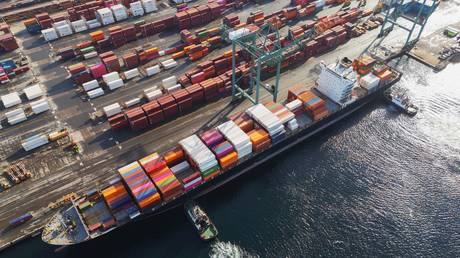
Salt cakes thick on the hull of an idle container ship anchored off the coast of Hodeidah. Below deck, the air tastes of stale diesel and damp iron, trapped in a metallic womb that has forgotten the rhythm of the open ocean. For months, the crew has watched the horizon for a change in the wind, a signal from a distant capital, anything to break the heavy stagnation. They are ghosts in a maritime graveyard, victims of an invisible dragnet tightening around a nation that the rest of the world prefers to blur at the edges.
Upward, in the high-stakes corridors of international diplomacy, the chess pieces are shifting. Moscow has stepped onto the board with a sharp, uncompromising demand: the absolute, unconditional lifting of the blockade choking Yemen's ports. It is a calculated move, hurled directly across the bows of Washington and Tel Aviv. The Kremlin points a steady finger across the geopolitical chessboard, laying the blame for the spiraling regional inferno squarely at the feet of American and Israeli policy.
To understand the gravity of this demand, you have to look past the sterile language of diplomatic cables and drop down to the docks where children chew khat leaves under the blinding Arabian sun. You have to trace the journey of a single bag of wheat, delayed by endless inspections, rerouted through bureaucratic mazes, and inflated by the invisible tax of conflict until it becomes an unattainable luxury for a mother standing in a dusty market square.
Diplomacy is often spoken of as an art of delicate whispers, but in the corridors of the United Nations Security Council, it sounds more like breaking glass. Russian diplomats argue that treating humanitarian access as a political bargaining chip is not just cynical—it is the primary catalyst keeping the wider Middle East on the precipice of war. When ports are closed or heavily restricted, the shockwaves do not stop at the shoreline. They ripple outward, manifesting as explosive drones streaking over dark waters, retaliatory strikes lighting up midnight skies, and a global supply chain that remains permanently braced for the next shock.
Washington and its allies view the situation through a different lens, framing the maritime restrictions as a necessary shield against the flow of advanced weaponry to the Houthi movement. They see a security puzzle where every cargo container is a potential conduit for chaos. Yet, this defensive posture carries a staggering collateral cost. When you choke the arteries of a nation dependent on imports for nearly ninety percent of its basic needs, you do not starve a military machine into submission. You starve the baker, the teacher, the mechanic, and the infant in the crib.
Consider the sheer scale of the humanitarian deficit. Millions of lives hang suspended in a gray zone of bureaucratic paralysis. Food insecurity is not a distant statistical abstract here; it is an intimate, hollow ache felt by families who have learned to ration water by the cup. When global powers spar over who bears responsibility for the regional escalation, ordinary Yemenis bear the physical reality of the fallout.
The Russian intervention lays bare a profound hypocrisy in international crisis management. Moscow’s sudden vocal defense of Yemeni maritime sovereignty is transparently strategic, designed to fracture Western moral authority and rally the Global South against what it depicts as selective enforcement of international law. Yet, cynical motivation does not automatically invalidate the underlying truth of the argument. A blockade that restricts the flow of life-sustaining goods under the banner of security creates the very instability it claims to prevent. Desperation is a potent fuel, and a population backed into a corner has little incentive to heed calls for regional restraint.
Down on the waterfront in Hodeidah, the crane operators wait. They do not care about the speeches delivered in Geneva or New York. They do not parse the intricate legal arguments concerning freedom of navigation or the rules of engagement in asymmetric warfare. They want the iron locks opened. They want the ships to move. They want the suffocating quiet of the harbor to be shattered by the roar of winches and the grinding scrape of cargo shifting into place.
Until that happens, the geopolitical chess match continues above their heads, a high-altitude game played with real lives as currency. The demand for the complete lifting of the blockade is on the table now, loud and unyielding, forcing every player to reveal the true limits of their patience. The Red Sea remains a pressure cooker, sealed tight, waiting to see which wall gives way first under the mounting steam.
The wind shifts slightly, carrying the distant, low thrum of an engine that goes nowhere. Somewhere across the water, a cargo manifest is stamped, filed, and ignored. And the silence holds.