The afternoon sun in Damascus has a way of turning the ancient limestone walls into a warm, deceptive gold. For a moment, if you close your eyes and listen only to the distant murmur of the marketplace, you can almost pretend the bones of this city aren't weary. You can pretend the air doesn't carry the faint, metallic tang of old smoke.
Karim knew that gold well. He had spent forty years watching it crawl across the front of his small spice shop just off the straight street. He knew the exact hour when the light would hit the jars of sumac and cumin, turning them into vibrant jewels. On this particular Tuesday, however, the air felt different. Heavy. The streets were lined with security personnel, their uniforms crisp, their postures rigid. Rumors had been swirling through the alleys for days. A foreign leader was coming. Not just any leader, but the President of France.
Diplomacy is a theater played out in heavily armored caravans and soundproofed rooms. To the politicians arriving under the tight embrace of security details, Damascus is a chess square, a strategic checkpoint on a map of global influence. But to the people who sweep the dust from the doorsteps every morning, the city is a living, breathing entity that bleeds when it is cut.
When Emmanuel Macron’s convoy crossed into the city, it brought the eyes of the international press with it. The cameras captured the handshakes. They recorded the stiff, formal smiles meant to signal a new chapter, or perhaps just a pragmatic acknowledgment of reality. The high-stakes dialogue was designed to project control.
Control, however, is an illusion in a city that has seen empires rise and fall like the tide.
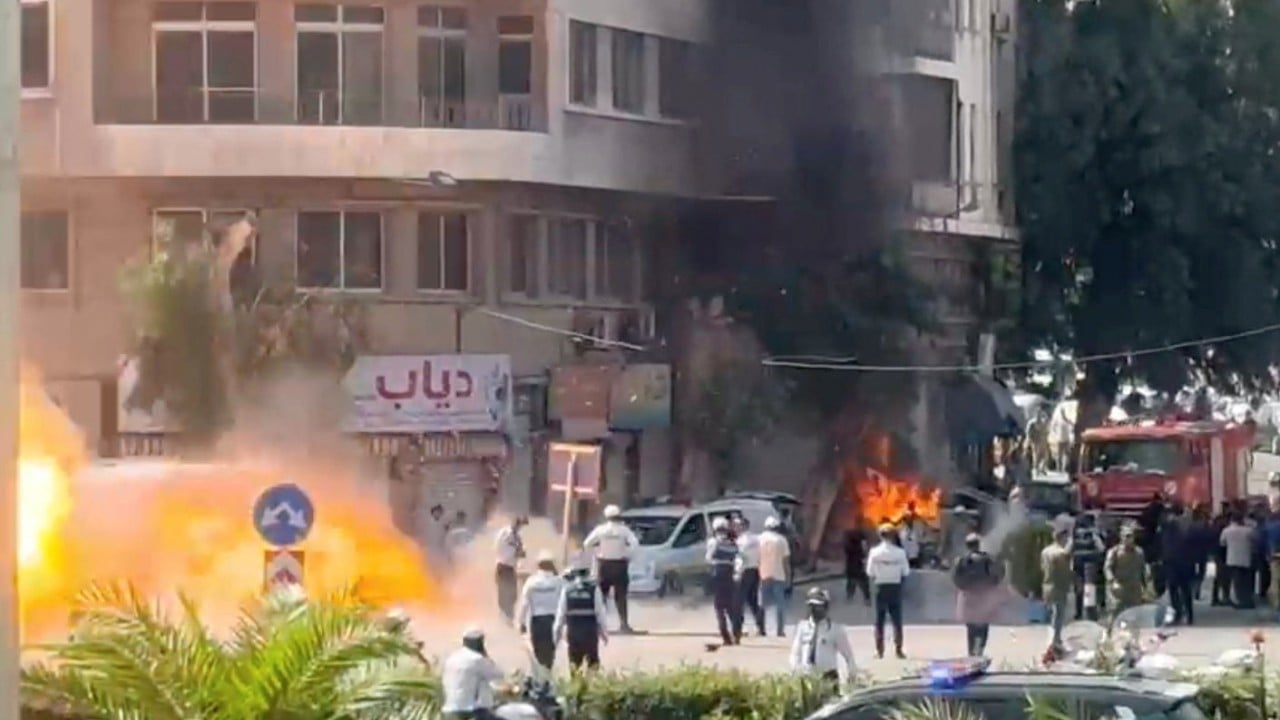
The first blast did not sound like an explosion at all. From a distance, it was a dull, thudding bass note that vibrated through the soles of Karim’s shoes before it hit his ears. Then came the second. Shorter. Sharper. The kind of sound that tears through the air and leaves a vacuum in its wake.
Silence followed. A terrible, suffocating silence that lasted for perhaps two seconds.
Then, the screaming began.
Smoke rose above the rooftops, a thick, gray column defacing the pristine blue sky. The illusions of the diplomatic summit shattered faster than the storefront windows along the avenue. Eighteen people. That was the number that would later flash across tickers on international news broadcasts. Eighteen wounded.
To the world watching through screens in Paris, London, or New York, eighteen is a small number. It is a manageable statistic in the grand ledger of Middle Eastern conflict. It sits neatly in the lower paragraph of a news brief, a minor complication during a high-profile state visit.
But eighteen is not a statistic when you are standing in the dust.
Consider a young woman named Maya. She was not a politician. She had no opinion on French foreign policy or the complex web of alliances that governs the Levant. She was twenty-two, carrying a bag of fresh mint and a textbook on her way home from the university. When the shockwave hit, the blast threw her against a concrete barrier. The mint scattered into the dirt, its sweet fragrance mixing instantly with the smell of burning rubber and sulfur. Her world shrank to the sensation of sharp gravel pressed against her cheek and the sudden, terrifying realization that she could not hear anything out of her left ear.
Beside her, an old man who had survived a decade of civil strife sat on the curb, staring blankly at his own hands, which were mapped with tiny, bleeding cuts from flying glass. He didn't move. He didn't cry out. He simply looked at the crimson drops falling onto the dry earth, as if observing a phenomenon that belonged to someone else.
This is the real cost of a geopolitical gesture. The violence doesn't care about the diplomatic immunity of the visitors. It strikes the periphery. It strikes the bystanders who are merely guilty of existing in the same zip code as a headline.
The Disconnect at the High Table
A few miles away, inside the secure perimeters where the French delegation met with Syrian officials, the atmosphere shifted instantly. The air conditioned calm was punctured by the urgent whispers of security aides. Phones buzzed against mahogany tables. The heavy doors were closed tighter.
For the visiting dignitaries, the explosions were a security variable. A logistical nightmare to be managed by men with earpieces and escape plans. The machinery of statecraft dictates that the show must go on, or at least, the exit must be carefully choreographed to avoid the appearance of panic.
There is a profound hypocrisy in how the world views these moments. The arrival of a Western leader is treated as an act of profound historical weight, an exercise in courage and strategic foresight. Yet, the local population lives under the constant weight of this volatility every single day without the benefit of a motorcade or a bulletproof vest.
The Western narrative often treats the Middle East as a stage play where the local actors are merely background extras, existing only to provide atmosphere for the main protagonists from Washington, Paris, or Moscow. When the bombs go off during a visit, the immediate question asked by foreign editors is rarely "Who were the eighteen people hurt?" Instead, it is "How does this affect the President's agenda?"
The agenda remains unaffected, of course. The statements are already written. They use words like condemn, cowardly, and resolve. These words are hollow. They are coins that have been rubbed smooth by decades of repetitive use, losing all their currency in the process.
The Anatomy of the Number Eighteen
To understand the weight of what happened in Damascus, we have to look past the political posturing and dissect that number. Eighteen.
- Two children who were walking with their mother to a clinic, now terrified of the sound of thunder for the rest of their lives.
- Four shopkeepers whose livelihoods were reduced to splinters and shards in less than a second.
- A taxi driver whose car was his only asset, now staring at a melted chassis.
- Eleven ordinary citizens who woke up thinking it was just another Tuesday.
When the smoke cleared, the emergency vehicles arrived, their sirens wailing a familiar, agonizing tune through the streets. The wounded were loaded into ambulances, their clothes stained with the gray soot of pulverized concrete. They were taken to hospitals that have been running on shortages and sheer willpower for years.
Medical staff who had hoped for a quiet afternoon were thrown back into the meat grinder of triage. They didn't ask about Macron. They didn't ask about the geopolitical implications of France re-engaging with the region. They simply reached for the gauze, the antiseptic, and the surgical needles.
The contrast is stark. On one side of the city, speeches were being prepared about the future of nations. On the other side, a surgeon was trying to save the fingers of a young boy who happened to be playing too close to the blast radius.
The Echoes of the Past
France and Syria share a long, complicated history, one rooted in the old colonial mandates of the early twentieth century. The streets of Damascus still bear the subtle imprints of French architecture, and the older generation still remembers a time when Paris held the keys to the country's destiny.
Macron’s visit was supposed to be a recognition of a shifting reality, an attempt to find a foothold in a region where traditional Western influence has been crumbling. It was a move calculated to project strength and diplomatic agility.
But history has a long memory, and the soil of Damascus is soaked in it. Every time a Western power attempts to write a new chapter in the region, the ink used is almost always red. The explosions that rocked the city were a brutal reminder that you cannot separate high-level diplomacy from the volatile reality on the ground. You cannot walk into a house that is still smoldering and expect the floorboards not to give way beneath your feet.
The afternoon lengthened. The golden light that Karim loved so much began to fade, replaced by the long, cool shadows of evening. The sirens eventually grew distant, leaving behind the dull hum of a city trying desperately to return to its normal rhythm.
That is perhaps the most tragic part of it all. The terrifying speed with which normalcy reasserts itself. By nightfall, the glass would be swept from the sidewalks. The blood would be washed into the gutters. The French delegation would prepare for its departure, their planes waiting on the tarmac, engines idling, ready to carry them back to a world where explosions are things that happen on the evening news.
Karim stood in the doorway of his shop, looking out at the darkened street. The smell of sumac was gone, replaced entirely by the acrid scent of burnt plastic that always lingered after a car bomb. He began to close his heavy wooden shutters, locking them one by one.
Tomorrow, the newspapers in Paris would run photos of the President looking resolute against the backdrop of an ancient city. They would analyze the body language. They would debate the strategic wisdom of the trip.
But in the quiet alleys of Damascus, eighteen families would be sitting in hospital waiting rooms, watching the monitors blink in the dark, wondering how a piece of metal from a world they don't belong to found its way into their lives.