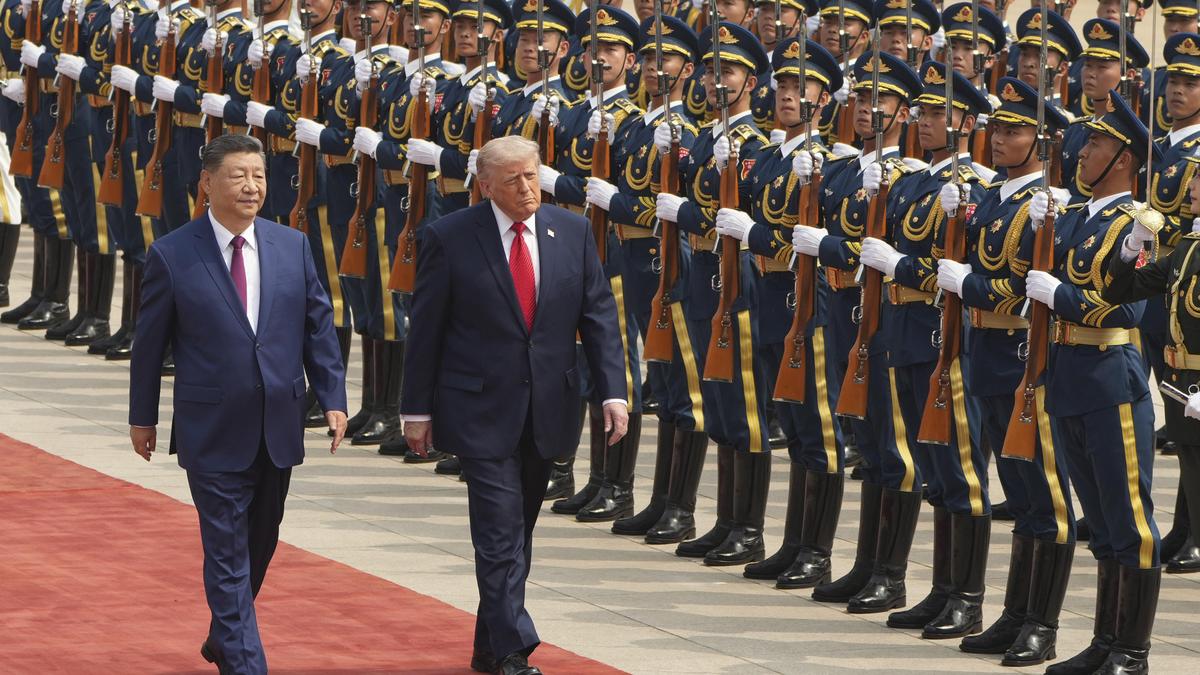
The diplomatic theater in Mar-a-Lago and Beijing has shifted from open hostility to a calculated, high-stakes performance of "partnership." When Xi Jinping tells Donald Trump that the United States and China should be partners rather than rivals, he isn't offering a sudden olive branch born of genuine friendship. He is deploying a survival strategy designed to stall American protectionism while China recalibrates its internal economy. This pivot seeks to replace the blunt force of trade wars with a sophisticated framework of mutual dependence, yet the underlying structural friction between a rising superpower and an established one remains entirely unresolved.
For years, the narrative focused on "decoupling," a messy divorce of the world’s two largest economies. That experiment proved more painful and less practical than many hawks anticipated. Now, we are seeing the emergence of a "tactical thaw." This isn't peace; it is a restabilization of the front lines. Xi’s rhetoric serves a specific purpose: to provide the Chinese Communist Party (CCP) with the breathing room necessary to manage a domestic property crisis and a demographic slump, all while ensuring that American capital doesn’t flee the mainland en masse.
The Strategy Behind the Partnership Script
Xi Jinping understands the specific language that resonates with the current American administration. By framing the relationship as a "partnership," Beijing is moving away from the ideological lectures of the past and toward a transactional model. This appeals to a Washington mindset that views foreign policy through the lens of trade deficits and manufacturing jobs.
The "partner" label acts as a diplomatic shield. If China can convince the White House—and more importantly, the American business community—that cooperation leads to direct financial gain for the U.S. working class, it can effectively blunt the momentum of bipartisan anti-China legislation in Congress. It is a play for time. Every month spent in "partnership" negotiations is a month where new tariffs are not implemented and technology export bans are not tightened further.
The Trade Leverage Reality
Despite the talk of being rivals no more, the trade data tells a story of deepening entrenchment. China remains the dominant supplier of the rare earth elements required for the American "green" transition and high-tech defense systems. Washington knows this. Beijing knows Washington knows this.
When Xi speaks of partnership, he is subtly reminding his counterparts that the global supply chain is a web, not a series of independent silos. A "rivalry" implies a winner-take-all outcome that could leave American factories idle for want of specific Chinese components. By contrast, a "partnership" allows for a managed competition where the lights stay on in both Ohio and Guangdong.
Domestic Pressure as a Catalyst for Diplomacy
To understand why China is pursuing this shift now, one must look at the cracks within the Great Wall. The Chinese economy is no longer the unstoppable juggernaut of the early 2010s. The debt-heavy real estate sector, once the primary engine of growth, is a shadow of its former self. Youth unemployment has reached levels that keep provincial governors awake at night.
Xi needs the U.S. market. More importantly, he needs U.S. technology. The aggressive pursuit of self-reliance—the "Made in China 2025" initiative—has hit significant roadblocks, particularly in the realm of advanced semiconductors. A "rivalry" guarantees that the U.S. will continue to lead a global coalition to block China’s access to the lithography machines and high-end chips necessary for the next generation of artificial intelligence. A "partnership," however, creates room for exemptions, licenses, and "carve-outs."
The Trump Factor
The re-engagement with Donald Trump is a calculated gamble. Beijing views Trump as a pragmatist who can be reasoned with if the price is right. Unlike the more traditional, alliance-heavy approach of the previous administration, the Trump doctrine often prioritizes bilateral deals over multilateral pressure. Xi sees an opportunity here to bypass the G7 and the EU, dealing directly with the one man who can unilaterally alter American trade policy with a single executive order.
This bilateralism suits China. It is much easier for Beijing to negotiate with one leader than it is to navigate a united front of Western democracies. If Xi can convince Trump that a "partnership" is the "greatest deal in history," he effectively neutralizes the threat of a broader, more organized Western economic containment strategy.
The High Cost of the New Normal
This diplomatic dance comes with a heavy price tag for both sides. For the United States, acknowledging China as a partner requires a quiet retreat from certain human rights critiques and a softening of rhetoric regarding the South China Sea. It means accepting a world where China is not just a participant, but a co-architect of global trade rules.
For China, the cost is a loss of face among its more nationalistic domestic base. For years, the state-run media has painted the U.S. as a declining hegemon intent on suppressing China’s rightful rise. Pivoting to a "partnership" narrative requires a delicate internal PR campaign to ensure that the Chinese public sees this not as a surrender, but as a masterful maneuver to outlast American hostility.
Security Versus Prosperity
The central tension of this meeting remains the insoluble conflict between national security and economic prosperity. The U.S. wants Chinese investment and cheap consumer goods, but it does not want Chinese code in its telecommunications hardware or Chinese sensors in its ports. China wants American capital and software, but it does not want American "interference" in what it deems its internal affairs.
We are entering an era of "selective engagement." Both nations are identifying "safe" zones where they can be partners—agriculture, climate initiatives, perhaps certain sectors of finance—while maintaining a cold, high-tech standoff in "red zone" areas like AI, quantum computing, and biotechnology.
The Illusion of Stability
Investors should not mistake this rhetoric for a return to the era of globalization that defined the 1990s and early 2000s. That world is dead. The current "partnership" is a marriage of convenience between two parties who still fundamentally distrust each other. It is a tactical pause.
The risk for the global economy is that this pause is misinterpreted. If companies begin to reinvest heavily in China on the back of these friendly headlines, they may find themselves caught in a "trapdoor" scenario. The moment a geopolitical flashpoint—a naval skirmish or a cybersecurity breach—occurs, the "partnership" rhetoric will evaporate, replaced by the same sanctions and tariffs that have characterized the last eight years.
Managing the Unmanageable
The success of this partnership depends entirely on personal chemistry and the ability of both leaders to control their most hawkish advisors. Within the Beltway, there is a deep-seated suspicion that any deal with Xi is a Trojan horse. Within the Zhongnanhai, there is a conviction that the U.S. will never truly allow China to equal its power.
To make the partnership work, both sides must stop trying to change each other’s fundamental systems. The U.S. will not become less democratic, and China will not become less authoritarian. If the partnership is built on the hope of systemic convergence, it is doomed. If it is built on the cold, hard reality of mutual economic survival, it might just hold for a few years.
The Bottom Line for Industry
For CEOs and supply chain managers, the "partners not rivals" headline is a signal to diversify, not to double down. The rhetoric provides a window of stability to move operations, find secondary suppliers, and shore up balance sheets. It is an opportunity to execute a "China Plus One" strategy without the immediate pressure of a collapsing trade relationship.
The definitive reality of the modern era is that these two nations are destined to be rivals in power but partners in trade. Balancing those two diametrically opposed roles requires a level of diplomatic agility that neither side has consistently demonstrated. The meeting in Florida was a masterpiece of optics, but optics don't ship containers or build microchips.
The true test will not be the joint statements or the handshakes before the cameras. It will be the quiet, grinding work of the trade delegations in the months to follow. If the tariffs don't move and the export bans remain in place, the word "partner" will be remembered as nothing more than a polite euphemism for a very dangerous competitor.
Watch the secondary indicators. Look at the flow of venture capital into Chinese startups. Monitor the frequency of military drills in the Taiwan Strait. If those two metrics don't align with the "partnership" narrative, then the peace we are seeing is a facade. Businesses should prepare for a world where the rhetoric is warm, but the underlying policy remains frozen in a permanent state of economic warfare.