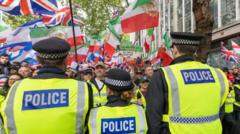
The sound hits you long before you see the crowd. It is a low, vibrational hum that rattles the glass in the shopfronts along Whitehall. It sounds like a storm rolling in from the Thames, but the sky above London is a brittle, pale blue.
If you stand outside Westminster tube station on a Saturday afternoon like this, you can feel the city splitting down the middle. To your left, a sea of emerald green, red, and black flags waves under the shadow of Big Ben. To your right, just a few hundred yards away, the Union Jack snaps in the wind alongside the blue and white of the Israeli flag.
Tens of thousands of people have descended on the capital. The evening news will call them "rival protests." They will show wide-angle drone footage of choked streets, quote a spokesperson from the Metropolitan Police, and tally the number of arrests on a neat digital graphic.
But a city block cannot be summarized by a statistic. A crowd is not a monolith. It is a collection of beating hearts, sore feet, and conflicting griefs.
Look closer at the barrier.
The Geography of Anger
On one side stands Maya. She is twenty-four, wearing a woolen scarf to guard against the biting wind, and her knuckles are white from holding a cardboard sign. The ink is running because her hands are sweating despite the chill. She didn't sleep last night. She spent the hours scrolling through social media, watching live feeds from a world away, her chest tightening with every refresh. For Maya, being here is not a political hobby. It is an act of survival. She feels that if she stays home, if she remains silent, she is complicit in a tragedy that keeps her awake at 3:00 AM.
Now look across the thin ribbon of tarmac, past the row of fluorescent-jacketed police officers who form a human wall.
There is David. He is fifty-two, an accountant from North London. He brought a small flask of tea that he hasn't touched. He is standing next to his teenage son. David remembers London during different eras, quieter eras. Today, he feels like a stranger in his own hometown. He looks at the opposing crowd not with anger, but with a profound, heavy dread. To him, the chants echoing off the limestone buildings feel like an existential threat, a wave of noise designed to erase his identity.
Two people. One street. An ocean of misunderstanding between them.
This is the reality of the modern public square. It is a place where nuance goes to die. The architecture of London—built on centuries of debate, compromise, and slow institutional evolution—is suddenly forced to play host to two entirely different realities occupying the exact same geographic coordinate.
The Machinery of the Crowd
We tend to think of protests as spontaneous eruptions of human emotion. They are not. They are massive logistical undertakings.
Behind the raw emotion of Maya and David lies an invisible infrastructure. Megaphones are charged. Coaches are chartered from Manchester, Birmingham, and Leeds, bringing thousands of people who woke up at dawn just to walk three miles in the rain. High-vis vests are distributed. Legal observers take their places on the corners, notebooks poised.
The police strategy is one of dynamic containment. It is a delicate, high-stakes game of psychology. If the authorities push too hard, they trigger a riot. If they step back too far, the two factions bleed into one another, and control is lost. They use metal barriers to create a sterile zone—a no-man's-land of grey asphalt that separates two deeply held convictions.
Imagine a giant piston pumping in a sealed chamber. That is the pressure inside the barricades. The air feels thick. Every time a chant goes up from the left, the right responds with a wall of whistles. The noise becomes physical. It presses against your eardrums until you can no longer hear individual words, only the raw cadence of defiance.
But what happens when the banners are rolled up?
The Friction of the Monday Morning
The true cost of a divided city is not measured in the overtime pay of the Metropolitan Police, though that number runs into the millions. It is measured in the quiet moments that happen forty-eight hours later.
On Monday, Maya and David might catch the same Jubilee line train. They might stand shoulder-to-shoulder, holding the same silver handrail, eyes fixed on their phones, completely unaware that they stared each other down across a police line just two days prior.
The friction doesn't disappear when the streets are swept clean of discarded placards and plastic bottles. It moves underground. It seeps into office breakrooms, where people suddenly hesitate before mentioning what they did over the weekend. It lingers in family WhatsApp groups, where certain topics are now permanently banned to prevent a war between aunts and nephews.
We are witnessing a profound shift in how we relate to our neighbors. The internet has allowed us to curate our realities so perfectly that we can live in entirely different universes while sharing the same postal code. A protest is simply the moment those digital universes crash into each other in the physical world.
The collision is violent, not necessarily in terms of physical blows, but in the emotional wreckage it leaves behind. It hardens opinions. It turns neighbors into symbols.
The Weight of the Invisible Stakes
It is easy to look at the flags and the fury and see only a geopolitical dispute played out on British soil. But that misses the deeper current. This isn't just about a foreign policy debate; it is about belonging.
Everyone on the street is fighting for the right to feel safe in their skin, in their city. The tragedy is that the methods one group uses to assert their safety often directly trigger the terror of the other. It is a closed loop of anxiety.
The afternoon begins to fade. The pale blue sky turns a bruised violet. The temperature drops sharply, and people begin to shift their weight from foot to foot, feeling the ache in their lower backs. The energy of the crowd changes. The fierce adrenaline of midday gives way to the heavy, exhausting reality of the evening.
A woman near the front of the green-and-red contingent drops her banner. Her hands are too cold to hold it anymore. She bends down, rolls it up carefully, and secures it with a rubber band. Across the divide, David's son says something to his father, and David nods, checking his watch. They slip away toward the tube station before the final dispersal begins.
The crowd thins out, shattering into thousands of individuals heading back to suburbs, towns, and quiet flats. They will carry the adrenaline with them for days. They will look at the news coverage tonight and feel angry that their specific pain was reduced to a twenty-second soundbite.
As the last transit vans of police rumble away down Whitehall, the street is left empty. The wind catches a stray piece of paper—a flyer with a bold headline, now smudged with mud—and tumbles it down the gutter. The limestone walls of the government buildings stand silent, absorbing the echo of a grievance that will return next weekend, and the weekend after that, looking for a resolution that a street protest can never quite provide.