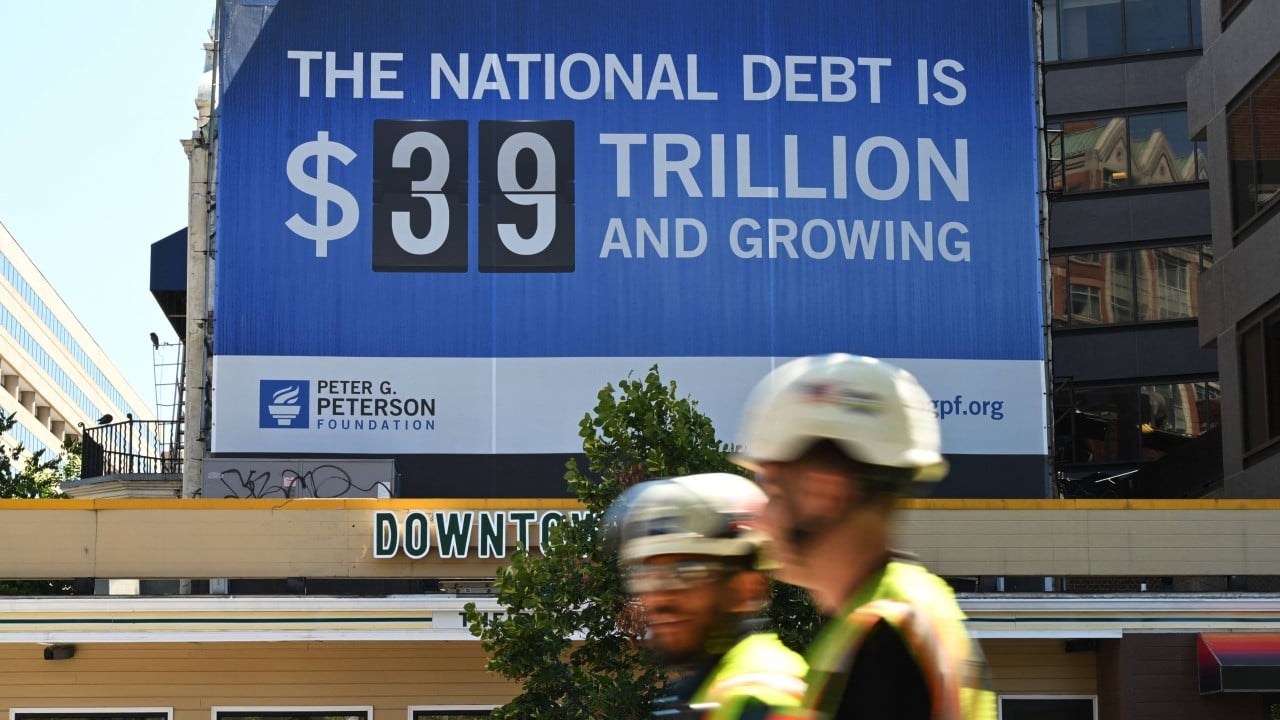
The United States national debt just crossed the forty trillion dollar threshold. This figure is not merely a milestone in a ledger; it serves as a flashing red signal that the engine of the American economy is burning through its own structural integrity. We have entered a period where the federal government spends more on interest payments alone than on national defense or medical care for the elderly. The math has ceased to be a theoretical concern for economists and has morphed into a tangible weight dragging down every household in the country.
When the government consistently spends more than it collects, it must borrow the difference. This practice has accelerated over the last two decades, driven by a cycle of aggressive tax cuts, unfunded spending growth, and necessary interventions during global shocks like the 2008 recession and the pandemic. The result is a compounding interest trap. Because the debt is now so massive, even minor fluctuations in interest rates create astronomical increases in the cost of servicing that debt. The government is essentially borrowing money just to pay interest on money it already borrowed.
Consider a hypothetical household that decides to put its groceries and utilities on a credit card every month. If they only pay the minimum interest, the total balance grows regardless of whether they buy anything new. Eventually, the interest payment alone exceeds their entire paycheck. That is the trajectory of the federal budget. The government must now issue new Treasury securities to cover the shortfall, often offering higher yields to entice investors to keep funding this deficit. This creates upward pressure on interest rates across the entire economy, affecting everything from mortgage approvals to small business credit lines.
The so-called doom loop that analysts discuss is not a sudden crash but a slow, grinding decline. As the government competes with the private sector for capital, it pushes out other investments. This phenomenon, known as crowding out, means that money that might have gone toward private sector innovation or infrastructure development instead disappears into the maw of sovereign debt servicing. The more the government borrows, the more expensive it becomes for anyone else to borrow.
There is an underlying assumption that because the United States issues the world's reserve currency, this game can continue indefinitely. This confidence is starting to crack. Global investors are not blind to the trajectory of the fiscal path. Three separate credit rating downgrades in recent years were not mistakes; they were warnings from the market that the current reliance on constant borrowing has reached its physical limits.
Fixing this is not a matter of simply cutting one specific program or raising one tax rate. The structural mismatch between revenue and mandatory spending is baked into the foundation of the modern federal budget. Aging demographics mean the cost of social safety nets will continue to climb regardless of political will. Meanwhile, the political appetite for the necessary trade-offs—broad tax reform or the trimming of popular programs—remains non-existent.
Investors often look for a catalyst that might break the current cycle, such as an unexpected shift in geopolitical alliances or the sudden bursting of a speculative asset bubble. If the market for U.S. debt experiences a liquidity crunch, the repercussions will not be limited to Wall Street. Ordinary citizens will feel the shock through inflation, reduced purchasing power, and the degradation of public services that have become entirely dependent on borrowed capital.
The situation is not irreversible, but it requires a level of fiscal discipline that Washington has not demonstrated in decades. Without a fundamental recalibration, the nation remains on a course where the debt load eventually dictates every policy decision. Freedom of choice for future generations is being bartered away to pay for the consumption of the present. We are effectively choosing to sacrifice long-term prosperity for the sake of avoiding short-term discomfort, a trade that rarely pays off in the history of any empire. The clock is ticking, and the interest on forty trillion dollars does not pause for election cycles or political excuses.