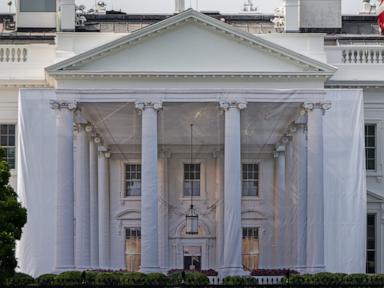
The construction crews at the North Portico are not just laying concrete. They are erecting a multi-million dollar monument to a flawed premise.
Mainstream media outlets cover the latest round of "security enhancements and upgrades" at the White House with predictable, stenographic reverence. The narrative is always the same: threats are evolving, so the perimeter must grow taller, thicker, and more intimidating. The public is told that a higher fence, reinforced checkpoints, and upgraded bollards equal safety.
They are wrong.
This relentless focus on hardening physical perimeters represents an outdated, twentieth-century mindset that fails to address modern vulnerabilities. I spent over a decade assessing high-value physical architecture and digital networks against sophisticated threat vectors. I can tell you exactly what happens when you build a bigger wall: you simply convince yourself that the threat is still outside it.
The current upgrades are not a triumph of modern security engineering. They are a glaring admission of strategic failure.
The Maginot Line on Pennsylvania Avenue
Physical barriers create a psychological trap known as the security illusion. When an institution spends millions to increase a fence from eight feet to thirteen feet, it satisfies a political urge to look secure. It is the ultimate manifestation of security theatre.
Consider the mechanics of a modern perimeter breach. Threat actors targeting a head of state rarely rely on a chaotic, cinematic rush against a iron gate. When breaches do happen, they almost exclusively exploit human compliance errors, systemic communication breakdowns, or technical blind spots.
Look at history. In 2014, an intruder bypassed the Secret Service perimeter not because the fence was too short, but because multiple internal alarm systems were muted, an officer failed to deploy a canine, and the front door was unlocked. A higher fence does not fix a muted alarm. A thicker gate does not lock an open door.
By pouring capital into visible, physical deterrents, we are fighting the last war. We are building a digital-age Maginot Line—an impressive, immovable barrier that can simply be bypassed by anyone who understands how the system actually operates.
The High Cost of Visible Defenses
Defending a static position through brute physical force introduces massive operational friction. Every new checkpoint, every additional layer of reinforced glass, and every biometric bottleneck slows down the execution of daily operations.
[Threat Vector] ---> [Physical Perimeter] ---> [Internal Vulnerability]
                           |                             |
                 (Billions Spent Here)         (Real Risk Ignored Here)
In the corporate world, I have watched financial institutions spend fortunes turning their headquarters into fortresses, only to get wiped out by a single phishing email that bypassed every security guard in the lobby. The White House faces the exact same structural flaw.
The downside of my contrarian view is obvious: removing visible barriers requires an appetite for political risk that few leaders possess. If a low fence is breached, the public blames the fence. If a high fence is bypassed via a sophisticated insider threat or a technical exploit, the public blames the leadership. Therefore, officials choose the politically safe option every time: they build the wall higher.
Dismantling the Perimeter Myth
Let us look at the "People Also Ask" consensus regarding government facility upgrades. The public generally asks: How do these new upgrades stop intruders?
The brutal, honest answer is that they do not stop a determined, resourceful adversary; they only delay them by a matter of seconds. Physical security engineering dictates that a barrier's only job is to buy time for a response force to deploy. If your internal response mechanics are sluggish, chaotic, or plagued by poor radio interoperability, buying an extra five seconds at the fence line is completely useless.
Instead of obsessing over physical posture, security architecture must shift toward a model of zero-trust physical access and rapid containment.
- De-emphasize the Perimeter: Assume the outer line has already been crossed.
- Dynamic Internal Zoning: Implement automated, intelligent internal zoning that shifts dynamically based on threat levels, sealing off critical sectors instantly without human intervention.
- Cognitive Load Reduction: Reduce the data overload on the ground-level officers. The Secret Service does not suffer from a lack of cameras; they suffer from an inability to synthesize thousands of concurrent data streams in real time.
Stop Hardening Concrete, Start Hardening Systems
The obsession with physical upgrades ignores the reality of modern asymmetric threats. An adversary looking to disrupt the executive branch is far more likely to target the supply chain of the technology running inside the building, exploit the cellular devices of staff members walking through the gates, or deploy small-scale unmanned aerial systems that ignore ground-based barriers entirely.
Upgrading the gates while leaving the underlying systemic vulnerabilities unaddressed is like putting a bank vault door on a cardboard box.
True operational resilience is quiet. It is invisible. It relies on redundant communications, behavioral analytics, protocol discipline, and automated containment systems. It does not need a photo opportunity with a crane and a piece of steel.
Stop measuring safety by the metrics of the construction industry. The moment you rely on a piece of iron to keep you safe, you have already lost the initiative.



