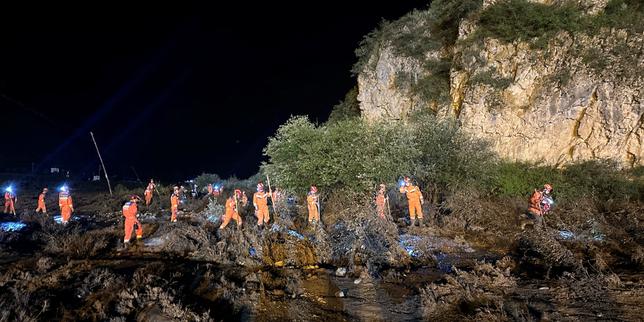
The death toll following the catastrophic flash floods in northwest China has risen to twenty-five, with several individuals still unaccounted for as rescue crews comb through mud-choked ravines and collapsed structures. This disaster, sparked by sudden and torrential downpours in a notoriously arid region, highlights a recurring vulnerability. Extreme weather events are slamming areas structurally unprepared for high-volume precipitation.
When mountainsides strip away under the weight of relentless rain, the ensuing wall of water and debris moves faster than any evacuation warning can travel. Meteorologists point to atmospheric anomalies drawing moisture deep into continental interiors, colliding with dry air masses to drop months of rain in mere hours. Yet, focusing solely on the meteorological trigger misses the systemic institutional failures that turn heavy rainfall into a mass casualty event.
The Geography of Vulnerability
Northwest China is defined by stark geography. Ancient river valleys, loess plateaus, and deep gorges form a landscape where water has historically been scarce. Communities grew up around seasonal riverbeds, relying on trickles of water for agriculture and daily life. For generations, these dry washes seemed benign. They were convenient places to build roads, set up temporary markets, and construct dense residential clusters.
Urban planning in these remote administrative zones historically prioritized economic expansion and connectivity over hydrological safety. Engineers built narrow culverts and low-water bridges designed to handle moderate seasonal runoff, not the apocalyptic torrents generated by modern climate volatility. When a cloudburst unleashes a wall of water down a dry canyon, those narrow channels act as funnels. They accelerate velocity rather than containing flow, turning ordinary riverbeds into high-speed slurry chutes loaded with boulders, uprooted trees, and mud.
Local disaster management agencies face a brutal geographical handicap. Mountainous terrain creates communication black zones where radar coverage is patchy and satellite links fail precisely when power grids go down. By the time automated gauges register a spike in upstream water levels, the surge has already covered the distance to downstream settlements.
Regulatory Blind Spots and Construction Pressures
Infrastructure construction across China has expanded at a blistering pace over the past three decades, connecting remote provinces to the national economic engine. Roads cut across mountainsides, altering natural drainage basins. Every cut-and-fill operation changes how rainwater sheds off a slope.
Environmental impact assessments for rural highway projects and local commercial developments routinely underestimate extreme precipitation thresholds. Planners often rely on historical rainfall records spanning fifty or one hundred years. Those historical baselines are now obsolete. Climate change has compressed centuries of statistical probability into single decades. A bridge rated for a century flood now faces that exact volume of water every few summers.
Furthermore, economic incentives discourage local governments from abandoning vulnerable zones or funding expensive retrofits for drainage systems that sit dry for eleven months out of the year. Budget allocations favor visible infrastructure like high-speed rail stations, industrial parks, and gleaming civic centers. Flood mitigation, buried deep beneath concrete and stone, remains invisible until disaster strikes.
When flash floods hit, blame is frequently cast on the sheer fury of nature. Officials point to unprecedented rainfall figures to deflect scrutiny. Investigative findings from past disasters, however, routinely reveal ignored warnings from hydrologists and compromised building codes in zones designated as protected ecological corridors.
The Human Toll and Rescue Realities
Behind the rising casualty statistics lie communities caught completely off guard. Many of the victims in northwest China were agricultural workers, travelers navigating mountain passes, or residents living in older housing stock constructed without reinforced foundations.
Search and rescue operations in these environments are nightmarish logistical exercises. Heavy machinery cannot easily reach narrow gorges where bridges have been sheared away. Rescuers often have to deploy on foot, navigating unstable mudslides where secondary collapses remain an constant threat. Drone surveillance provides aerial maps of the devastation, but thermal imaging struggles to penetrate thick layers of wet silt covering potential survivors.
Communication breakdowns exacerbate the chaos. Families miles away spend agonizing days waiting for updates as telecommunications networks are rebuilt from scratch. Local hospitals, themselves sometimes impacted by power outages and flooding, struggle to triage incoming trauma cases while managing supply shortages.
Moving Beyond Reactive Disaster Management
Disaster relief efforts, no matter how rapid or well-funded, arrive after the tragedy is complete. Shifting the paradigm requires acknowledging that traditional engineering approaches are failing.
Governments must invest in real-time sensor arrays embedded deep within upper watersheds, paired with automated alarm systems directly linked to mobile devices in downstream villages. Early warning is the single most effective tool against flash flooding, buying precious minutes for vertical evacuation.
Land-use regulations must also undergo a ruthless overhaul. Continued residential and commercial expansion inside historical floodways and narrow canyons must be prohibited, regardless of local economic pressures. Relocating communities out of high-risk mountain ravines is politically difficult and financially punishing, but the alternative is a perpetual cycle of rescue, recovery, and mourning.
The twenty-five lives lost in northwest China are not merely statistics of a changing climate. They are casualties of a developmental model that ignored the fundamental power of water in a fragile landscape. Until infrastructure policy catches up with environmental reality, the next torrential downpour will follow the exact same devastating script.