The winter sky over the Baltic Sea does not clear; it merely changes shades of grey. In the port of St. Petersburg, the Baltic’s crown jewel, the air usually smells of salt, diesel, and the heavy, sweet scent of crude oil waiting for transport. It is a place built on the grand calculations of empire. Pipelines meet tankers here. The global economy breathes through these valves.
Then came the drone.
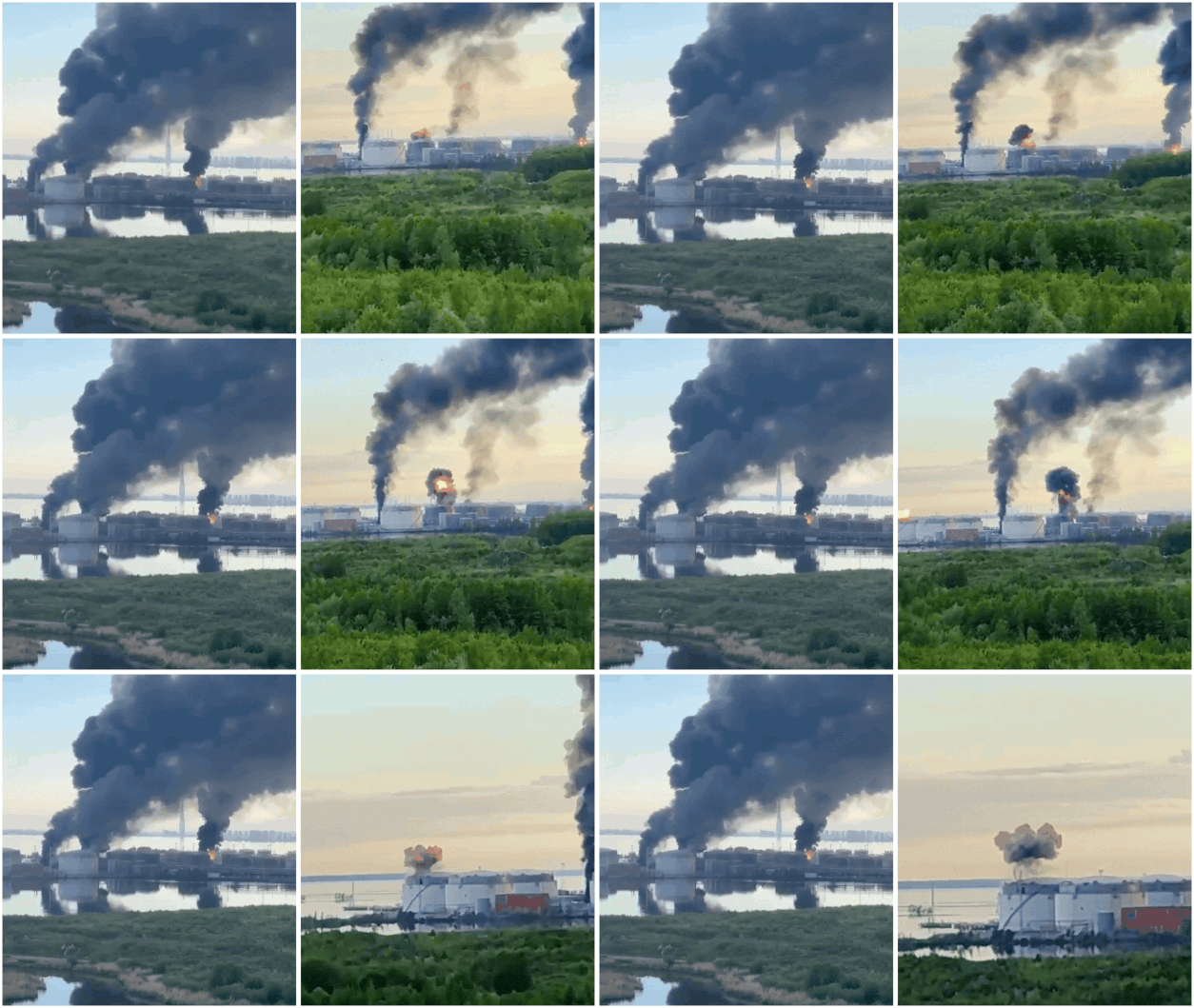
It traveled hundreds of miles, a fragile silhouette of composite material and buzzing gasoline engines, navigating the dark spaces between radar webs. When it struck the Ust-Luga oil terminal, it did not just detonate a tank of hydrocarbons. It shattered a geographic illusion. For nearly two years, the war felt distant to the citizens of Russia’s second city. It was something watched on flat-screen televisions in warm living rooms, a geopolitical chess match played out in the muddy fields of the Donbas or the blackened ruins of Avdiivka.
Not anymore. The orange fireball that rose over the Gulf of Finland was bright enough to be seen from high-rise apartments miles away. It lit up the snow. It turned the black water into a mirror of flame.
Wars have a way of doing this. They begin with grand strategies plotted on maps in well-heated rooms. They end by tearing through the fragile fabric of everyday life, miles from any recognized front line. On the exact same day that the oil infrastructure burned in the north, a crowded passenger bus in a frontline town hundreds of miles to the south became a charred metal hull. Eight civilians, people with grocery lists in their pockets and mundane worries in their heads, steps away from their front doors, never made it home.
This is the dual reality of modern conflict. One side strikes at the economic arteries of an empire; the other strikes, intentionally or through brutal negligence, at the literal veins of a community. The stakes are no longer just territory. They are the basic certainties of human survival.
The Geography of Vulnerability
To understand why a drone strike on a Baltic port matters, you have to understand how Russia moves its wealth.
Imagine a massive, sprawling network of veins pumping lifeblood from the deep interior of Siberia toward the edges of the continent. For decades, Western Europe was the primary consumer. When those doors slammed shut, the flow had to redirect. St. Petersburg and its surrounding terminals became even more vital. They are the funnels through which millions of barrels of oil pass toward buyers in Asia and the global south, circumventing sanctions and keeping the machinery of state funded.
The Kremlin has always operated under the assumption that its vast distance was its greatest shield. Moscow is far; St. Petersburg is farther still from the borders of Ukraine.
But distance is dying.
The weapon that hit the terminal was not a million-dollar cruise missile launched from a stealth bomber. It was a long-range kamikaze drone, likely built in a converted warehouse, powered by an engine not much more complex than the one in your lawnmower. When these machines fly low, hugging the tree line and utilizing the geographic blind spots of conventional air defense systems, they become ghosts.
Consider the psychological shift this forces upon a population. For thirty months, the conflict was an abstraction for the urban elite of St. Petersburg. Now, the smoke from a strategic asset drifts over their harbors. The economic war has broken through the screen. It is loud. It smells of burning petroleum. It forces the realization that no one, no matter how far from the trenches, is entirely safe from the reach of a desperate adversary.
The Cost in the Cargo
When an oil terminal burns, the damage is measured in columns of figures. Lloyds lists change their risk assessments. Insurance premiums for maritime transport tick upward. Tankers are forced to drop anchor and wait in the freezing waters, their captains calculating the financial loss of every idle hour.
But look closer at the dockworkers.
Think of a man we will call Nikolai, a crane operator who has worked the Baltic docks for twenty years. His job is a rhythm of steel cables and heavy containers. He knows the precise tilt of a ship when it is fully laden. For him, the war was a background noise of rising food prices and missing import brands at the supermarket.
When the alarm sounded at the terminal, Nikolai was in a breakroom drinking tea from a thermos. The shockwave rattled the reinforced glass windows. The sky outside turned the color of a setting sun, though it was three in the afternoon. In that moment, the macroeconomic reality of oil exports vanished. What remained was the primal instinct to run, the choking black smoke that tasted like pennies, and the sudden, terrifying understanding that his workplace was now a bullseye.
Ukraine’s strategy here is cold and calculated. They cannot match Russia soldier for soldier, artillery shell for artillery shell. The mathematical reality of attrition favors the larger nation. Therefore, Kiev must strike where it hurts the most: the wallet. By demonstrating that the Baltic ports are within reach, they throw a wrench into the delicate machinery of Russian energy logistics. If the ports are unsafe, the shipping companies hesitate. If insurance companies refuse to cover the hulls, the oil stays in the ground. Without the oil revenue, the funding for the next generation of tanks begins to dry up.
It is a grand, logical equation of war. But equations do not account for the terror of a dockworker realizing the ground beneath his feet is flammable.
The Bus Stop on the Frontline
While the fire in St. Petersburg dominated the financial tickers and Western intelligence briefings, a different kind of tragedy unfolded in the east.
A standard municipal bus, painted a faded blue, pulled up to a stop. It was the kind of scene repeated ten thousand times a day across Eastern Europe. Passengers stepped inside, stamping the gray slush from their boots. An elderly woman adjusting her shawl. A man coming home from a shift at a municipal utility plant. A teenager looking at a phone.
The shell did not care about their destinations.
The blast was instantaneous. The metal skin of the bus peeled back like paper. In the aftermath, there were no press releases about strategic victories or economic leverage. There was only the silence of a snow-covered street, broken by the hiss of a ruptured radiator and the distant wail of sirens. Eight people died in the debris. Multiple others were carried away on stretchers, their lives permanently altered by shrapnel and blast waves.
The Russian government immediately blamed Ukrainian artillery, labeling it a terrorist attack on civilian infrastructure. Kiev, as is typical in frontline artillery duels, maintained that it targets only military positions and blamed Russian forces for locating ammunition depots within residential zones, or suggested the tragedy was the result of a misfired Russian air defense missile.
The truth of who pulled the trigger matters deeply for justice, but for the families standing in the slush looking at the blood on the snow, the geopolitics are irrelevant. The tragedy highlights the horrific asymmetry of the war. In the north, high-tech drones strike multi-million-dollar economic infrastructure to choke off a regime's funding. In the south, ancient, indiscriminate artillery fire continues to grind human beings into statistics.
The Illusion of Separation
We prefer to view these events as distinct chapters. The financial analyst reads about the St. Petersburg terminal and adjusts oil futures. The humanitarian worker reads about the bus attack and updates a casualty database.
But they are deeply, inextricably linked.
The strikes on Russia’s economic core are a direct response to the slow, brutal pressure Russia exerts on Ukraine’s civilian infrastructure. For two winters, Moscow has launched massive waves of missiles and drones aimed at Ukraine’s power grid, trying to freeze the population into submission. Kiev’s message with the Baltic strike is clear: If our cities sit in the dark, your economic engines will burn.
It is a dangerous escalation cycle, a kinetic conversation carried out in explosions. The danger lies in the normalization of the extraordinary. A year ago, a strike on St. Petersburg would have been unthinkable, a red line that threatened to pull the entire continent into a wider conflagration. Today, it is a Tuesday morning headline, sandwiched between corporate earnings reports and celebrity gossip.
We adapt to horror with frightening speed. We learn to read past the numbers. Eight dead in a bus attack becomes a minor detail, a footnote in a larger story about territorial gains or international aid packages. But every one of those eight individuals possessed an entire universe of connections, memories, and unfulfilled plans. They were killed while participating in the most ordinary act imaginable: trying to get from one place to another.
The Fire That Doesn't Go Out
The fires at the Ust-Luga terminal were eventually contained. The black smoke dissipated into the gray Baltic sky, leaving behind twisted steel and the heavy smell of scorched chemicals. Engineers will assess the damage. Crews will begin the slow process of rebuilding the pipes and tanks. The tankers will eventually line up again, their captains watching the sky with a new, sharp anxiety.
But something fundamental has shifted. The war is no longer contained within a designated geographic box. It has spilled out onto the shipping lanes of the north and into the daily commutes of the south.
The strategy of targeting economic infrastructure reveals a hard truth about modern conflict: victory is no longer achieved solely on the battlefield. It is achieved by breaking the opponent’s domestic will and capacity to fight. When the war enters your harbor, when it disrupts your economy, when it turns your industrial pride into a bonfire, the narrative of a controlled, distant operation crumbles.
Meanwhile, on the frontline, another bus will be brought in to replace the one that was destroyed. A new driver will take the wheel. Passengers will step aboard, their eyes scanning the sky, their ears tuned to the distant thud of artillery. They will ride through the scarred streets because life, even when reduced to its most terrifying essentials, demands that you keep moving forward.
The fire on the water and the blood on the snow are not separate events. They are the two sides of a single, tragic coin, spinning through the winter air, waiting to land.