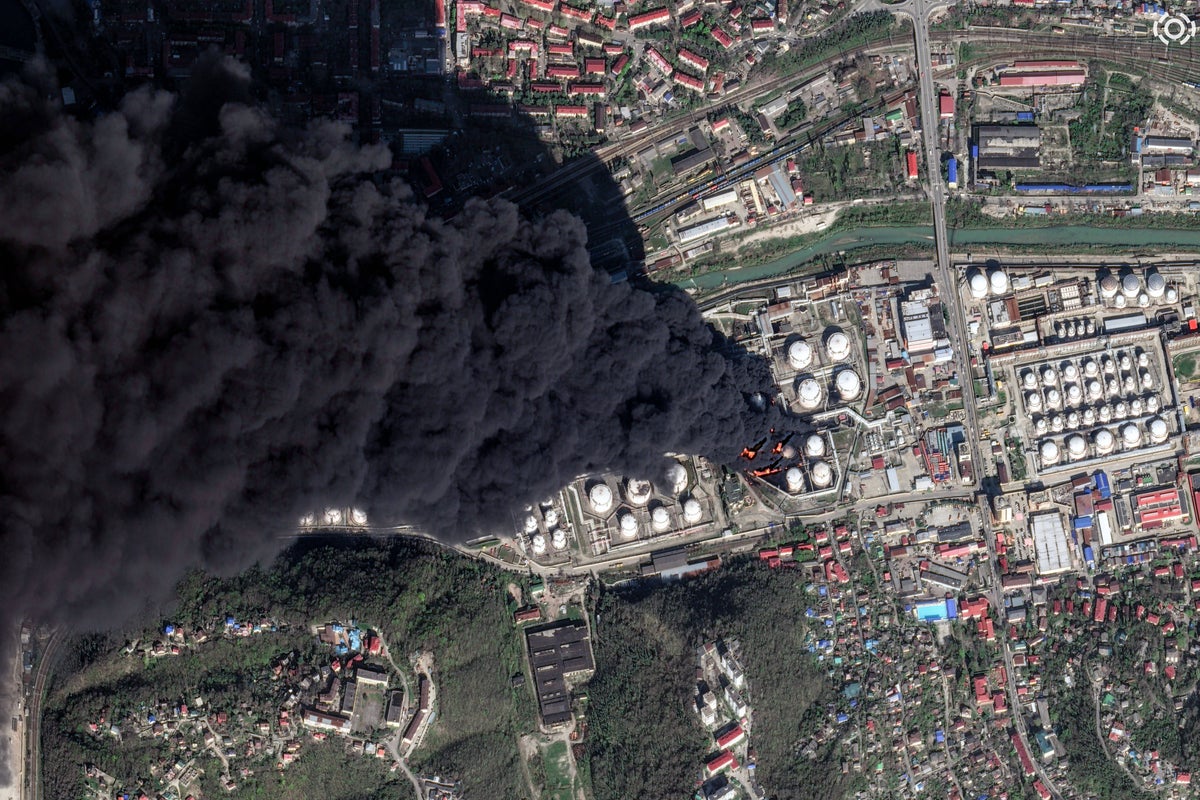
Somewhere in the Russian interior, perhaps near the banks of the Volga or deep in the Ryazan industrial belt, a steel tower as tall as a cathedral hums with a low-frequency vibration. This is a distillation column. It is the heart of a refinery, a massive, pressurized lung that breathes in thick, black crude and exhales the clear, volatile spirits that move the modern world.
Then comes the sound. It isn't the heavy roar of a jet engine, but the persistent, lawnmower-whine of a long-range drone.
The explosion is surgical. It doesn’t aim for the barracks or the tanks; it aims for the "lung." When a fractionating column is pierced, the refinery doesn't just stop for a lunch break. It dies. Replacing that specific, high-tech piece of engineering is a nightmare in a world of sanctions and severed supply chains. In an instant, thousands of gallons of potential gasoline evaporate into a plume of orange flame and acrid black smoke.
Ukraine has found a new way to fight. They are no longer just trading blows in the mud of the Donbas; they are reaching across the border to cut the carotid artery of the Russian war machine. But as the smoke clears over these scorched industrial sites, the ripples move outward. They cross oceans. They flow through digital tickers on Wall Street. Eventually, they arrive at a gas station in Ohio, or a transport hub in Berlin, in the form of a rising number on a digital pump.
The Chemistry of Conflict
To understand why this matters, we have to look past the fire.
Russia is essentially a gas station with a nuclear arsenal. Its ability to wage a long-term war of attrition depends entirely on its capacity to process and sell hydrocarbons. By shifting their focus to oil refineries, Ukrainian planners have identified a critical vulnerability. It is much harder to fix a refinery than it is to patch a hole in a pipeline.
Consider a hypothetical engineer named Viktor. In this scenario, Viktor has spent thirty years maintaining the Ryazan refinery. He knows the temperament of every valve. When a drone strike hits his facility, Viktor isn't just looking at a fire; he’s looking at a multi-year engineering crisis. The specialized components required to process crude at high temperatures often come from Western firms. With those firms gone, Viktor is left trying to keep a 21st-century war machine running with 20th-century spare parts.
This is the "invisible front." For every refinery that goes dark, Russia loses a percentage of its internal fuel supply. This creates a desperate internal tug-of-war. Does the Kremlin prioritize the diesel needed for the T-90 tanks on the front line, or the gasoline needed to keep the civilian population from grumbling as they drive to work in Moscow?
If they choose the tanks, the domestic economy begins to seize. If they choose the civilians, the offensive stalls. It is a mathematical pincer movement.
The Global Pendulum
History rarely stays within its borders.
When Russia’s refining capacity drops, the world’s supply of refined products—not just crude oil, but the stuff you actually put in your car—tightens. This is where the narrative shifts from a David-and-Goliath struggle in Eastern Europe to a boardroom headache in Washington and a kitchen-table crisis for the global consumer.
The math of energy is brutal and unsympathetic. If Russia cannot refine its own oil, it might try to export more raw crude to compensate for lost revenue. On the surface, you would think more crude on the market would lower prices. But the global economy doesn't run on crude. It runs on diesel and gasoline. When the world loses refining "slack," the price of the finished product spikes.
We see the result in the "crack spread"—the industry term for the difference between the price of a barrel of crude and the products refined from it. When refineries start blowing up, the crack spread widens. Investors get nervous. Speculators hedge their bets. Suddenly, a drone strike three


