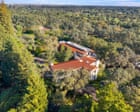
Stucco catches the late afternoon sun in a way that feels almost cinematic, a warm, buttery gold that has anchored countless ambitions along the coast. For years, Spanish-style architecture in California has sold a very specific promise. It whispered of terracotta tiles baking under an endless blue sky, of heavy wooden doors opening to private courtyards, of a sanctuary built far away from the grinding noise of public life. It was a physical manifestation of arrival.
Now, that particular chapter is quietly closing.
When the gates of a $7.5 million estate in one of the state's most coveted enclaves swing open for prospective buyers, the news ripples far beyond the local real estate ledger. The property, famously tied to California Governor Gavin Newsom, carries a weight that extends well beyond its square footage or its carefully manicured drought-resistant landscaping. It represents a pivot. A shedding of skin.
Real estate, particularly at this altitude, is rarely just about shelter. It is autobiography written in brick, mortar, and limestone. Every archway tells a story of where a person was, what they valued, and how they wished to be seen by the world.
Step inside for a moment. Imagine the acoustics of a high-ceilinged foyer where political futures were quietly debated over glasses of local wine. Picture the expansive kitchen where family dinners tried, against all odds, to mimic a semblance of normalcy amid the suffocating crush of a 24-hour news cycle. Homes like this are pressure cookers disguised as art. They hold the echoes of late-night phone calls, the silent tension of handling crises that span thirty-eight million lives, and the fleeting, quiet weekends snatched back from the public gaze.
Yet, houses must eventually be emptied.
The decision to list a multi-million-dollar estate is never made in a vacuum. It is a deliberate recalibration. For public figures, real estate moves are chess plays executed in plain sight. They signal transition, a shifting of priorities, or a physical necessity dictated by changing chapters in life. When you pack up the photographs, box the books, and hand over the heavy iron keys, you are acknowledging that the space no longer fits who you are or where you need to be.
Consider the neighborhood itself. Fair Oaks, nestled near the American River in Sacramento, has long been a haven for those who want proximity to the seat of power without living inside its immediate glare. It offers a pastoral illusion—winding oak-shaded lanes, horses grazing in nearby pastures, and an old-world charm that feels a million miles away from the hyper-partisan frenzy of the state capitol. It is a place designed for breathing room.
And yet, even the most secluded sanctuary eventually demands a reckoning with reality.
Real estate markets do not care about political affiliation, approval ratings, or legacy. They operate on cold, hard mathematics and shifting buyer sentiments. A $7.5 million price tag is a heavy anchor in any economic climate. It requires a very specific kind of buyer: someone who commands immense liquidity, values architectural pedigree, and possesses the stomach for the inevitable public curiosity that clings to a celebrity-adjacent address like salt air.
There is an irony inherent in selling a home that drips with old California elegance during an era defined by economic anxiety for everyday residents. Optics matter, especially when you lead a state wrestling with housing affordability crises, homelessness, and the grinding cost of living. Every square foot of imported tile and custom woodwork becomes a talking point. Every amenity—whether it is the sprawling pool, the wine cellar, or the sprawling acreage—is weighed on an invisible scale by constituents who measure their own lives in tightening budgets.
Perhaps that is why the listing feels less like a simple financial transaction and more like a cultural artifact.
Homes are containers for our identities until they become too small, too public, or simply too heavy to maintain. We all know what it feels like to outgrow a space, even if our versions of outgrowing involve a cramped suburban rental rather than a multi-million-dollar Mediterranean revival masterpiece. We know the bittersweet ache of packing tape tearing against cardboard boxes. We know the strange, hollow feeling of walking through empty rooms that no longer echo with our voices.
Newsom’s journey with this property reflects a broader truth about modern public life. The sanctuary is never truly secure. The walls, no matter how thick or how artfully plastered, remain porous to the outside world. When the pressures mount, sometimes the only remedy is to wipe the slate clean, lock the heavy wooden front door behind you, and let someone else write the next stanza.
As the listing photos circulate through luxury brokerages and social media feeds, millions will look at the arched doorways and sun-drenched patios with varying degrees of envy, cynicism, or mere passing curiosity. They will dissect the staging, critique the interior design choices, and speculate on the motives driving the sale.
But beneath the breathless headlines and the market analysis lies a quiet, universal human moment. It is the sound of a key turning in a lock for the very last time. It is the realization that no matter how grand the estate, chapters inevitably end. The stucco cools in the evening air, the shadows lengthen across the courtyard, and the house waits quietly for its next inhabitant to come along and dream their own version of the California dream.