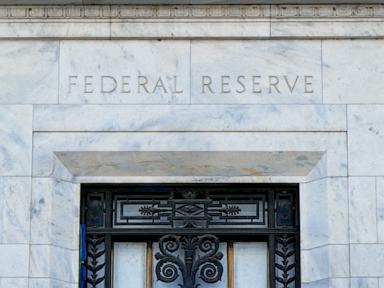
Jerome Powell walked into the William McChesney Martin Jr. Building today to lead what is almost certainly his final interest rate decision as Chair of the Federal Reserve. The outcome was exactly what the market anticipated: a hold. The federal funds rate remains locked at 3.5% to 3.75%, a defensive stance against a stubborn inflation rate of 3.3% and a global energy market reeling from the U.S.-Israeli conflict with Iran. But the real story isn't the number; it is the looming shadow of Kevin Warsh, whose confirmation by the Senate Banking Committee this morning effectively begins the countdown to a new era of American monetary policy.
The Fed is currently trapped between a cooling labor market and a red-hot geopolitical landscape that has sent oil prices through the ceiling. Powell's decision to hold rates steady reflects a central bank that has run out of easy options. While the public expects a clean handoff when Powell’s term expires on May 15, the internal reality is a complicated chess match involving institutional independence and a direct challenge to the "Fed Chair" archetype.
The Ghost of Marriner Eccles
History usually forgets that Federal Reserve Chairs don't have to vanish once their leadership term ends. Jerome Powell’s term as Chair expires in two weeks, but his seat as a Governor on the Fed Board is technically safe until January 2028. For decades, the tradition has been "one out, all out"—when a Chair is replaced, they resign from the board entirely to give their successor clear air.
Powell is reportedly considering breaking that 78-year-old precedent. The last time a former Chair stayed on as a regular Governor was Marriner Eccles in 1948, following a fallout with Harry Truman. If Powell stays, he creates a firewall. By occupying that seat through 2028, he prevents the White House from appointing another loyalist to the seven-member board. It is a quiet, bureaucratic act of defiance aimed at preserving the bank's independence from a White House that has been vocal about wanting lower rates regardless of what the PCE data says.
The Warsh Transition and the Dovish Pivot
Kevin Warsh is a known quantity with an unknown mission. At 55, he is returning to an institution where he was once the youngest governor in history during the 2008 financial crisis. Back then, he was the primary bridge between the Fed and the heavyweights of Wall Street. Since then, he has spent years at the Hoover Institution criticizing the Fed for being too interventionist and for ballooning its balance sheet.
The paradox of Warsh is his alignment with a presidency that demands cheap money. While his academic writing suggests a "hard money" hawk who wants to shrink the Fed’s footprint, his political proximity suggests he might find a way to justify the rate cuts the administration is clamoring for. The theory circulating in bond markets is that Warsh will argue for "supply-side" rate cuts—the idea that lower borrowing costs will spur productivity and AI-driven growth so efficiently that the resulting goods will offset the inflationary pressure of the money supply. It is a high-stakes gamble that ignores the current 3.3% CPI.
The Energy Shock Factor
No amount of monetary theory can fix a broken supply chain or a closed shipping lane. The ongoing war in the Middle East has introduced a "geopolitical premium" to inflation that the Fed's tools are ill-equipped to handle. Raising rates won't lower the price of Brent crude if tankers can't navigate the Strait of Hormuz. Conversely, cutting rates now would be akin to throwing gasoline on a fire.
The Fed's statement today made it clear: they are "attentive to the risks to both sides" of their mandate. This is central-bank-speak for "we are flying blind." With job gains stalling but energy costs rising, the Fed is facing a stagflationary cocktail that Powell likely wants to leave on the desk for his successor.
- Current Fed Funds Rate: 3.5% - 3.75%
- Target Inflation: 2.0%
- Actual CPI (March 2026): 3.3%
- Unemployment Rate: Stable but hiring has "remained low"
The Final Press Conference
When Powell takes the podium this afternoon, he isn't just defending a rate hold; he is defending a legacy. Over the last four years, he has navigated the fastest tightening cycle in forty years and a post-pandemic recovery that defied every model. His tone today will likely be one of "principled data-dependence," a phrase he uses to signal that the Fed won't be bullied by the 24-hour news cycle or the latest tweet from the Oval Office.
Investors are looking for a "tell." If Powell signals that a rate cut is still possible in 2026—despite the energy shock—it will be seen as a final gift to the markets. If he remains hawkish, he is essentially handing Kevin Warsh a loaded gun.
The Federal Reserve thrives on the illusion of being above the fray. But as the Senate prepares to confirm Warsh and Powell prepares to possibly haunt the board for another two years, the fray has arrived at the front door. The era of "The Maestro" or the "Volcker-esque" stoic is ending, replaced by a central bank that is becoming just another theater in the broader political war.
The handoff on May 15 won't just be about who signs the meeting minutes. It will be about whether the world’s most powerful central bank can remain a technocratic island in a sea of populism. Powell’s decision to stay or go will be the most significant move of his career, more than any 25-basis-point tweak. Watch the Board of Governors roster, not just the interest rate ticker.