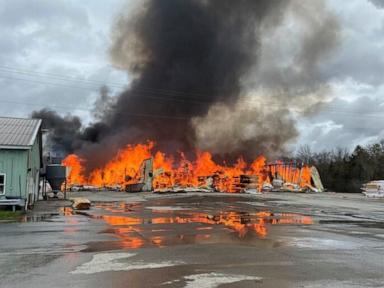
The traditional narrative surrounding industrial disasters follows a predictable, tragic script. A fire breaks out at a commercial facility, emergency crews rush to the scene, a secondary explosion occurs, and lives are lost. In the aftermath, the public conversation inevitably pivots to local heroism, community mourning, and demands for increased funding, better equipment, or heavier gear for local volunteer and municipal fire departments.
This reaction is emotionally satisfying, but it misses the fundamental structural crisis entirely.
When a massive fire tore through a Maine lumber mill, resulting in the tragic deaths of two firefighters from injuries sustained during the initial blast and subsequent collapse, the media focused heavily on the immediate tragedy. The underlying assumption presented to the public was that this was an unavoidable operational hazard of a dangerous job, met by brave personnel who simply lacked the luck or the split-second timing to survive.
That perspective is dangerously wrong. The lazy consensus assumes that rural industrial fires are standard structural fires writ large, requiring the same offensive tactics just scaled up. They are not. Treating a chemical, dust, or heavy industrial facility fire with the same operational playbook as a residential house fire is a systemic failure of risk management.
We do not need more funding for rural municipal departments to fight raging industrial infernos. We need a complete, uncompromising halt to offensive operations at these facilities by municipal crews.
The Myth of the Generalist Firefighter
Municipal and volunteer fire departments do incredible work saving homes, rescuing drivers from car accidents, and managing local emergencies. But the harsh reality of modern industrial manufacturing is that the materials, structural dynamics, and explosive potentials inside these facilities require highly specialized, asset-specific knowledge that a standard firefighter cannot maintain.
Industrial environments are hyper-complex ecosystems of risk. A lumber mill is not just a pile of wood. It is an intricate web of pressurized hydraulic lines, volatile organic compounds, structural steel that warps rapidly under high heat, and, most dangerously, combustible dust suspension.
Standard structural firefighting training focuses heavily on search, rescue, and internal fire suppression. In a typical residential or light commercial setting, entering the structure or establishing a tight perimeter is a calculated, manageable risk.
In a heavy industrial setting, that same calculation becomes a statistical gamble with a loaded deck.
When combustible dust—whether from wood, grain, or metal—is disturbed by high-pressure hose streams or initial structural shifts, it creates a fuel-air mixture. The resulting secondary explosion is exponentially more devastating than the initial fire. To send municipal crews, who may only encounter an industrial fire once a decade, into defensive or close-range offensive positions around these facilities is to fundamentally misunderstand the nature of the hazard.
The Financial Delusion of Local Preparedness
Municipalities frequently fall into the trap of believing that purchasing a new ladder truck or upgrading to advanced thermal imaging gear makes them capable of handling a catastrophic failure at a local major employer. It is a massive waste of taxpayer capital.
Consider the sheer scale of an industrial fire. A major incident at a processing plant can easily demand water flow rates exceeding 5,000 gallons per minute, specialized chemical foam suppression systems, and heavy monitoring equipment that can operate autonomously for days. No small-town department, or even a mid-sized regional coalition, can afford to maintain the infrastructure required to actively suppress a fully involved industrial disaster safely.
Worse, attempting to acquire this gear creates a false sense of security. It emboldens local commanders to opt for offensive or close-range defensive strategies because they "have the equipment."
I have watched municipalities sink millions into specialized apparatus to protect a single local factory, only to realize during an actual emergency that they lacked the sheer volume of personnel and continuous water supply to make the gear effective. The asset sits in the bay for years, degrading, while the true vulnerability remains unaddressed.
Shifting the Burden to Corporate Ownership
If municipal departments should not be fighting these fires, who should? The answer must be the corporations that profit from these hazardous operations.
Current regulatory frameworks like OSHA’s Process Safety Management (PSM) standards place the burden of internal safety systems on the company, but the external emergency response still defaults to the local community's 911 system. This is an unsustainable privatization of profit and socialization of risk.
We need to enforce a brutal, uncompromising standard: if a facility processes materials capable of producing catastrophic secondary explosions, that facility must maintain its own fully self-sufficient, industrial fire brigade on-site, or it must rely entirely on automated, built-in suppression systems.
Imagine a scenario where a manufacturing plant operates with the understanding that local fire crews will strictly establish a cold-zone perimeter at the property line and will not cross it under any circumstances unless a confirmed life-safety rescue is achievable without entering the blast radius.
If corporate executives knew that local firefighters would simply stand back and let the facility burn to the ground rather than risk their lives to save physical capital, corporate investment in automated deluge systems, spark detection, and structural isolation would skyrocket overnight. Insurance underwriters would demand it. The market would force a level of safety that government regulations have failed to achieve for decades.
The Flawed Premise of the "Good Fight"
The public desperately wants to believe that every fire can be fought, that every blaze can be conquered if we just throw enough bravery and water at it. This mindset creates a toxic operational culture where "standing down" is viewed as a failure of courage rather than a triumph of logic.
Look at the data from historical industrial disasters. The vast majority of firefighter fatalities in these scenarios do not occur during the initial outbreak. They occur during the secondary phases—when crews have already deployed lines, entered the perimeter, and are actively engaged in suppression. They are caught by structural collapses, unexpected chemical reactions, or secondary dust explosions triggered by the very chaos of the emergency response itself.
The premise of the question we ask after these tragedies is fundamentally broken. We ask: "How can we better protect our firefighters when they respond to these mills?"
The correct question is: "Why are we allowing them to respond at all?"
A Hard Strategy for Survival
To stop the body count, fire service leadership must adopt a deeply unpopular, fiercely contrarian doctrine for heavy industrial incidents.
- Establish Immediate Radial Evacuation Zones: Upon confirmation of an active fire involving combustible dust or hazardous chemicals, the default perimeter must be set outside the maximum calculated blast radius. No exceptions for property preservation.
- Mandate Zero-Entry Policies: Unless there is definitive, verified intelligence of civilian life inside the structure that can be reached immediately, the operational posture must be 100% defensive from a safe distance.
- Forced Automation: If an industrial facility cannot contain its own fires through automated engineering controls, the facility is fundamentally unsafe to operate within a civilian jurisdiction.
This approach will result in millions of dollars of lost commercial property. Plants will burn to the ground. Local economies will suffer short-term disruptions as facilities are destroyed.
That is an acceptable trade-off. Brick, mortar, and machinery can be replaced by an insurance check. The lives of firefighters cannot. It is time to stop sacrificing human beings to protect corporate real estate under the guise of public safety. Let the buildings burn.