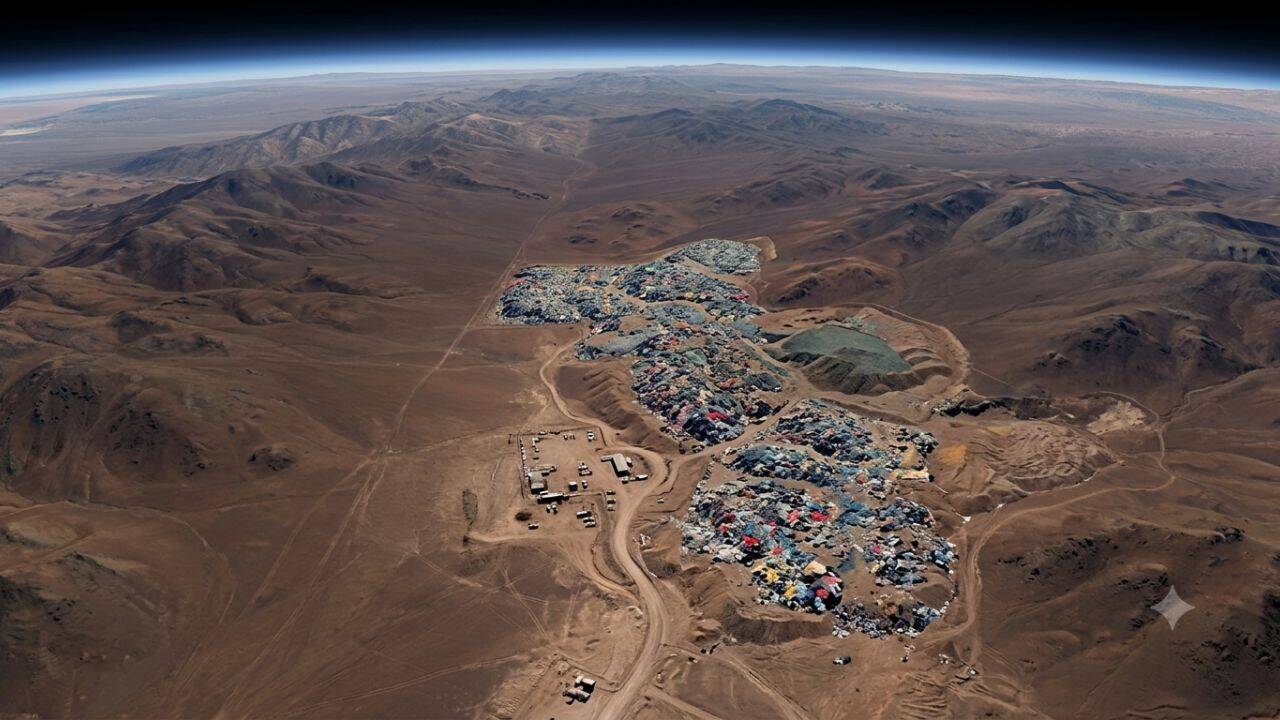
The dust here tastes like old polyester and crushed dreams.
I stood at the edge of the Atacama Desert on a blistering Tuesday afternoon, squinting against a glare that felt less like natural sunlight and more like an interrogation. Beneath my boots, the earth did not yield. It crunched. I bent down, brushed away a crust of salt and sand, and pulled a neon pink synthetic blouse from the ground. The label was intact. A trendy mall brand based in Europe. Size small. Never worn. The plastic price tag fluttered in the dry wind like a dying moth.
Behind me, stretching across the barren plains of Alto Hospicio in northern Chile, lay a corrugated ocean of discarded textiles. From orbit, astronauts mistake these shimmering patches for geological anomalies. On the ground, it is an alien landscape built entirely from our closet clear-outs. Sixty thousand tonnes of clothes arrive here every year. Sixty thousand tonnes of cheap, unwanted, disposable modernity dumped into one of the driest, most fragile ecosystems on the planet.
We talk about fashion as an expression of identity. We buy it to feel new, to capture a mood, to reinvent ourselves for a Friday night or a Monday morning meeting. But the industry operates on an invisible conveyor belt. It pulls fibers from the earth, spins them in distant mills, dyes them with toxic chemicals, ships them across oceans, and sells them to us at prices so low they induce cognitive dissonance.
And then, we throw them away.
The Journey of a Trend
To understand how a dress sewn in a Dhaka sweatshop ends up rotting under the fierce Chilean sun, you have to follow the trade winds of global capitalism.
Port of Iquique. Say it out loud. It sounds like a gateway to adventure, but for decades it has functioned as the ultimate dumping ground for the world's sartorial sins. Importers buy second-hand clothing bales by the container load from the United States, Europe, and Asia. These bales are supposed to supply local thrift markets across South America.
But there is a catch. A dark, economic math that the fast-fashion machine relies on.
Roughly sixty percent of the clothing entering these ports is of such abysmal quality that no one will buy it. Think ultra-thin polyester blends that tear upon the second wash, cheap acrylic sweaters that pill into felt balls, or fast-decaying polyurethane faux-leather jackets that peel in the humidity. These garments cannot be worn, they cannot be mended, and they cannot be easily recycled.
They are economic zero-values.
So, what happens to them? Legally, they are supposed to be processed by municipal waste management systems. Practically, the sheer volume overwhelms local infrastructure. Truckloads of unsellable garments vanish into the desert night. Drivers dump them in clandestine ravines, illegal landfills, and sprawling open-air pits just outside the city limits.
I watched a stray dog pick its way through a jagged mountain of discarded winter coats. It was eighty-five degrees Fahrenheit. The absurdity of the scene struck me like a physical blow. Heavy wool-blend overcoats from Scandinavian winters, sitting forgotten in the driest desert on Earth, baking beneath a relentless South American sun.
The Invisible Chemistry of Waste
We tend to think of trash as passive. We imagine it sitting quietly in a landfill, slowly turning back into dirt through some gentle, natural alchemy.
Synthetic clothes do not return to dust. They linger.
Polyester, nylon, acrylic, elastane—these are plastics. They are petroleum wrapped in thread. When exposed to the intense ultraviolet radiation of the Atacama, these fabrics begin to break down, not into soil, but into microscopic fragments. They shred into invisible plastic dust that marries with the desert winds, blowing into the nearby neighborhoods of Alto Hospicio, contaminating the air children breathe and the dry washes where occasional flash floods carve through the sand.
Worse still is the chemical payload. Modern clothing is drenched in thousands of synthetic chemicals during manufacturing. Heavy metal dyes, water-repellent perfluorinated substances, flame retardants, and formaldehyde fixatives are baked into the fabric to make them look vibrant on a hanger and survive shipping.
As these clothes cook in the desert heat, those chemicals leach out. They seep into the shallow water tables. They poison a landscape that has spent millions of years adapting to absolute scarcity, only to be suddenly drowned in a toxic tide of unwanted synthetic dyes and plastic plasticizers.
Consider what happens when desperation meets this mountain of waste. Sometimes, people living in the surrounding informal settlements set fire to the piles just to clear space or try to scavenge for scrap metal zippers and buttons. A textile fire fueled by synthetic blends does not burn cleanly. It releases thick, acrid black plumes of hydrogen cyanide, carbon monoxide, and chlorinated dioxins. The sky turns the color of a bruised plum. Residents cough into their shirts, closing windows that offer no real protection against the heavy, chemical-laden smoke.
The Illusion of Circularity
For years, the retail giants responsible for this deluge have offered us a comforting narrative. They place green bins near the front doors of their flagship stores. They tell us to bring back our old clothes. They promise us coupons, discounts, and peace of mind.
Drop your jeans in the box, they whisper, and we will close the loop.
It is a comforting lie.
Very little of what goes into those retail collection bins ever gets reworn, let alone recycled back into new yarn. The technology for commercial-scale fiber-to-fiber recycling is in its infancy. Blended fabrics—the 60-40 cotton-polyester shirts that dominate high street racks—are chemically nearly impossible to separate efficiently. To untangle them requires energy, water, and specialized facilities that barely exist at scale.
So, what do clothing brands do with the millions of garments collected worldwide? They box them up and ship them to the Global South. They export our guilt. We pat ourselves on the back for being sustainable consumers, while cargo ships haul our discarded excess across the Pacific to dump it in nations with weaker environmental protections and overwhelmed municipal budgets.
Chile did not ask for this. The Atacama did not ask for this.
Yet here it is. Visible from the International Space Station. A monument to our collective addiction to novelty, manufactured at a speed that human hands and planetary ecosystems can no longer sustain.
The Weight We Carry
I walked deeper into the dunes, moving away from the main highway. The silence here is profound, broken only by the strange rustling sound of my own footsteps crunching over miles of synthetic fabric.
I found a child's polyester superhero cape, faded by the sun, half-buried in the sand. Someone wore that. Someone washed it, folded it, packed it in a suitcase, or tossed it into a donation bin with the vague, optimistic belief that it would find a second life on another child's shoulders.
Instead, it migrated thousands of miles to die in the most desolate place on Earth.
We are drowning in our own choices. Every time we chase a micro-trend, every time we buy a five-dollar shirt designed to be worn twice and thrown away, we are casting a vote for this landscape. We are feeding the machine that turns finite resources into permanent garbage.
The sun began to dip toward the horizon, painting the Atacama in shades of bruised copper and deep indigo. The neon colors of the textile mountain faded into the growing shadows, but their presence remained heavy in the air. You can sweep it under the rug, you can ship it across an ocean, you can hide it behind corporate sustainability reports and greenwashed marketing campaigns.
But the desert remembers everything. And the mountain is still growing.