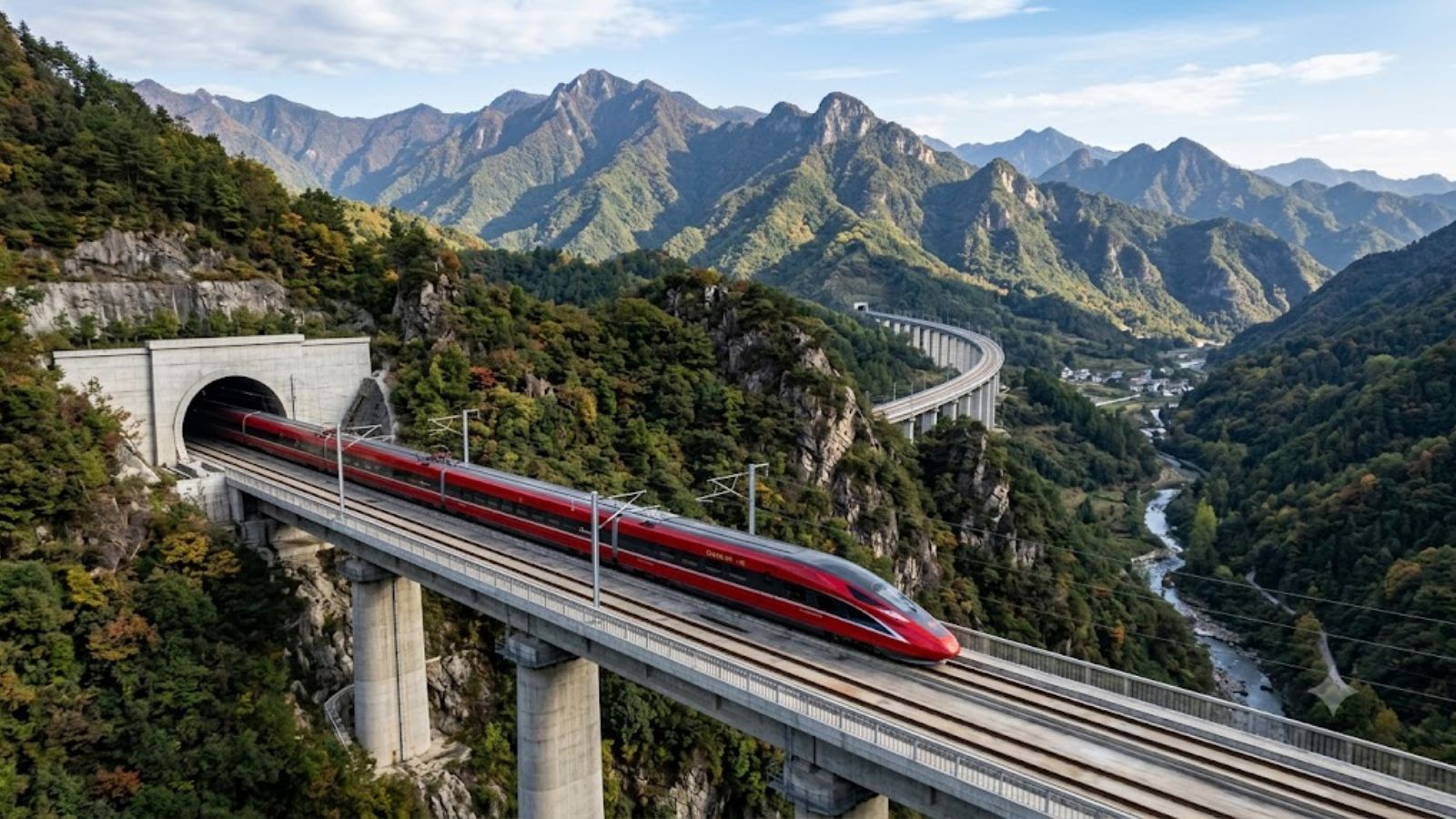
Building a high-speed railway through a massive mountain range isn't just about moving people faster. It's about completely reshaping how a country works. China just proved this again by opening the brand-new Xi'an-Shiyan high-speed railway. Running at a blazing 350 kilometers per hour, this bullet train cuts through the formidable Qinling Mountains, slashing travel times between the two cities from over six hours on traditional lines down to just about one hour.
Most news reports focus entirely on the speed. They tell you it's fast, and they leave it at that. But the real story isn't just the 350 km/h speedometer reading. It's the sheer engineering audacity required to punch through a geographic wall that has divided northern and southern China for millennia. If you want to understand what modern infrastructure looks like when it pushes the absolute limits of technology, you have to look closer at what just happened in Shaanxi and Hubei provinces.
Breaking the Mountain Barrier
For centuries, the Qinling Mountains stood as an impassable barrier. They didn't just block travelers. They altered weather patterns, isolated cultures, and choked off trade between the inland northwest and the central plains. Traditional trains crawled through winding passes, taking hours of agonizingly slow detours.
The new 257-kilometer rail corridor changes everything. By cutting directly through the rock instead of going around it, the project achieves what once seemed impossible. If you board a train at the newly built Xi'an East Railway Station, you can now reach Shiyan East Railway Station in central China in sixty minutes.
It doesn't stop there. This track hooks up directly with the existing Wuhan-Shiyan line. Because of that connection, the journey between the major hubs of Xi'an and Wuhan drops to a mere 2 hours and 41 minutes. Previously, trains had to take a massive detour that consumed four and a half hours. That's a massive win for commuters who value their time.
The Brutal Reality of Building Through a Geological Museum
Engineers didn't have an easy time with this. In fact, project chief designer Mao Lei openly described the route as running through a "natural geological museum" because the terrain is so incredibly complex.
Look at the numbers. Bridges and tunnels make up more than 90 percent of the entire 257-kilometer route. Think about that for a second. The train is almost never running on flat, open ground. It's either suspended high in the air or buried deep inside solid rock. The project required 42 tunnels and 62 separate bridges to negotiate the wild topography.
Construction started back in December 2021. It took over four years of intense, around-the-clock work and an investment of 47.68 billion yuan—roughly 7 billion US dollars—to finish the job. Workers dealt with unstable faults, underground water rushing into drill sites, and intense rock pressure. You can't build something like this with standard, off-the-shelf methods. Every kilometer required custom engineering solutions.
Green Technology and Full Connectivity Underground
Building a high-speed line through pristine mountain ecosystems requires serious environmental discipline. One of the toughest parts of the build was the Yunyang Hanjiang River Rail Bridge. This massive structure spans the Danjiangkou Reservoir, which supplies critical drinking water all the way to Beijing through the South-to-North Water Diversion Project.
Engineers couldn't just dump construction waste into the water. They had to schedule foundation piling strictly during the dry season to minimize disturbance. They stored dirty drilling slurry on specialized vessels rather than letting it leak into the river, and they put dust-control systems on every single concrete mixer nearby.
Passengers won't just experience a green ride. They will experience a completely connected one. Flying through a dark tunnel at 350 km/h usually means losing your phone signal instantly. Not here. The entire line features full 5G coverage, even inside the deepest mountain tunnels. You can stream high-definition video or take a work call while completely encased in rock.
The stations themselves use some serious tech. The new Xi'an East Railway Station spans over 100,000 square meters. Builders used 5G-enabled BeiDou high-precision positioning to place structures perfectly. Even better, they lined the roof with more than 30,000 square meters of solar panels. That setup generates 7 million kilowatt-hours of clean electricity every year for the station's own use.
What This Means for Regional Economies
This railway isn't just a flashy tourist attraction. It serves as a vital economic pipeline. By opening this route, China has effectively connected its northwest region directly to the Yangtze River economic belt.
Take Shiyan as an example. The city has a massive automotive parts industry that brought in nearly 103 billion yuan in 2025. Local manufacturers like Jingcheng Auto Parts, which makes over three million differentials a year, can now get their products to clients in Xi'an in a fraction of the time. Lower logistics costs make local businesses far more competitive.
Tourism gets a massive boost too. The line forms a direct cultural corridor between Xi'an, famous for the Terracotta Warriors, and Shiyan's Wudang Mountain, a major Taoist sanctuary. You can see ancient history in the morning and hike a sacred mountain by the afternoon.
With this line active, Xi'an joins Zhengzhou and Hefei as one of the only cities in the country to complete a fully radial high-speed rail network. It cements the city's position as the undisputed transport hub of northwest China.
If you plan to travel through central or western China, skip the regional flights. Book a ticket on the Fuxing bullet train from the new Xi'an East Station. Experience what happens when a country decides that mountains are no longer allowed to get in the way of progress.