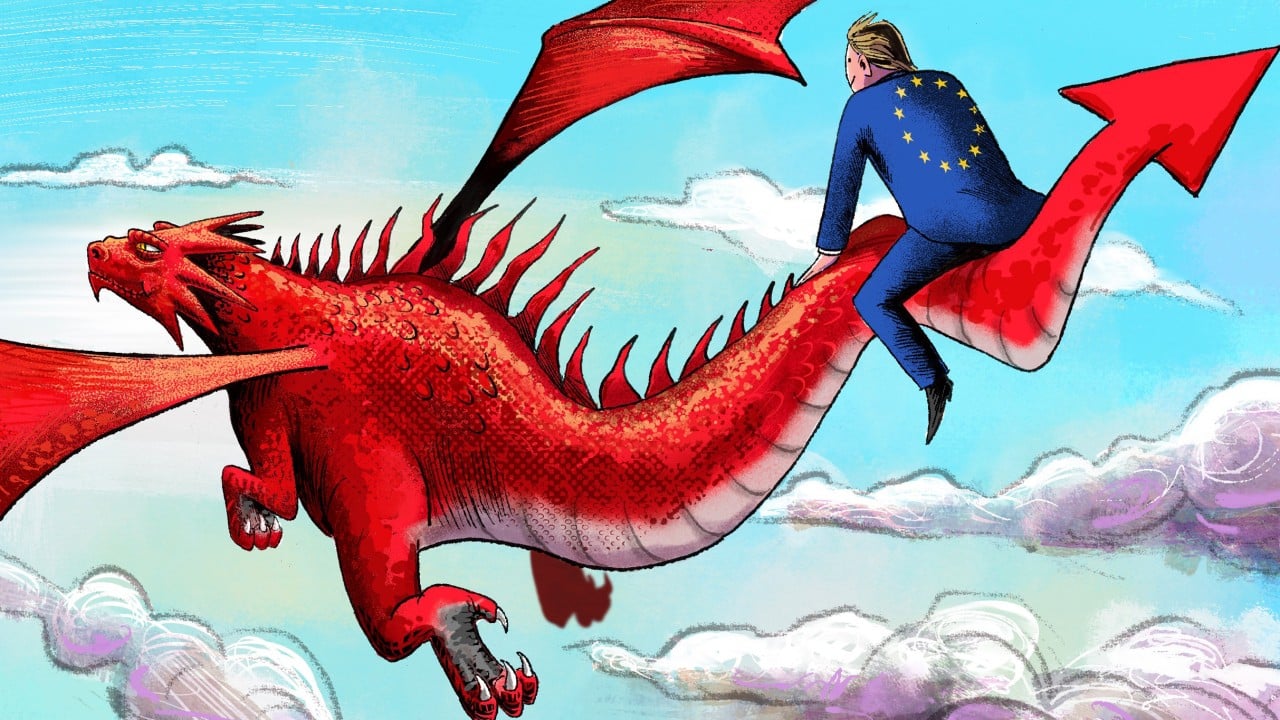
The current consensus among European trade theorists reads like a bedtime story for continentals who still think history moves at the speed of a Brussels committee meeting. The narrative is comforting: Europe, by positioning itself as China’s diplomatic and economic ally rather than its geopolitical adversary, can unlock an era of shared prosperity. It is an argument built on the cozy assumption that Beijing is looking for an equal partner to balance the scales against American hegemony.
It is completely, catastrophically wrong. You might also find this related coverage useful: The Border Toll Behind Trump Demanding Canadian Companies Relocate to the United States.
The idea that Europe can consciously choose to become China’s strategic "trade ally" ignores the fundamental architecture of modern state-directed capitalism. Beijing does not want an ally; it requires an economic outlet. Believing Europe can negotiate a balanced, prosperous partnership with a command economy facing a massive domestic overcapacity crisis is not statecraft. It is economic masochism.
The Naive Fantasy of Symmetric Trade
Proponents of the "ally, not adversary" school love to look at gross trade volumes and talk about mutual interdependence. They see the €700 billion-plus in annual bilateral trade and conclude that both sides have too much to lose to let friction ruin the relationship. As discussed in detailed articles by CNBC, the effects are significant.
This view completely misunderstands how the Chinese economic model functions. Under the current economic playbook, Beijing has deliberately suppressed domestic consumption in favor of massive, state-subsidized manufacturing capacity. This is not a temporary policy quirk; it is structural. When you build factories designed to supply the entire planet while keeping your own consumer base too constrained to buy the goods they produce, you must export the difference.
Europe is not being invited to a feast as an honored guest. It is being targeted as the world's largest consumer of last resort.
When a state-backed juggernaut dumps heavily subsidized electric vehicles, solar panels, and wind turbines into your market at prices that defy basic accounting logic, it is not "trade collaboration." It is industrial extraction. I have watched European industrial giants in the Rhineland spend years convincing themselves that joint ventures in Chengdu would yield long-term reciprocal market access, only to see their intellectual property systematically cloned and their market share erased within a decade. The illusion of partnership evaporates the moment the domestic Chinese alternative achieves scale.
Why the De-risking Middle Ground Is a Myth
European leaders love to deploy the phrase "de-risking, not decoupling" as if they have discovered a magical third way in international political economy. It sounds sophisticated in a press briefing. In practice, it is completely meaningless.
Let's dissect the mechanics of what "de-risking" actually means to a procurement officer or a supply chain director.
- The Component Trap: You decide to source your final assemblies from a European factory to look resilient. But where do the rare earth magnets come from? Where are the lithium-iron-phosphate cells processed? Where is the raw silicon ingot cast?
- The Capital Asymmetry: European companies operating in China are subjected to strict capital controls, mandatory technology transfers, and the unpredictable shadow of national security laws. Chinese state-linked firms operating in Europe enjoy the full protection of liberal legal systems, open capital markets, and public procurement tenders.
You cannot partially de-risk against a total economic strategy. Pretending you can selectively isolate critical dependencies while opening the floodgates to broader trade cooperation is like claiming a ship is only slightly vulnerable to a torpedo because the hole is confined to the engine room.
[European De-risking Model] -> Attempts to separate "strategic" vs. "commercial" goods
[Chinese Integration Model] -> Merges civil and military, state and commercial into one apparatus
Result: Intellectual and economic capture of the open system by the state-directed system.
The Overcapacity Mirage: What "People Also Ask" Gets Wrong
If you look at public forums and policy debates, the same flawed questions surface repeatedly. The premise is almost always upside down.
"Can't Europe use cheap Chinese green tech to accelerate its climate goals?"
This is the ultimate short-term trap. Buying artificially cheap, state-subsidized solar panels and batteries feels like a win for carbon-neutrality targets this quarter. But what happens when your entire domestic industrial base for renewable energy is bankrupt?
Imagine a scenario where the Western world relies entirely on a single geopolitical rival for the infrastructure of its energy transition. If Beijing controls the refining of 85% of the world’s rare earths and 70% of the lithium-ion battery manufacturing capacity, Europe has not achieved an energy transition. It has merely traded its dependency on Siberian gas for a total dependency on the supply chains of East Asia. That isn't progress; it's a strategic demotion.
"Shouldn't Europe act as a neutral bridge between Washington and Beijing?"
The idea of Europe as a geopolitical swing state sounds noble to diplomats who miss the Cold War era of non-aligned movements. But neutrality requires leverage. Europe’s current leverage is largely a fiction maintained by its past wealth.
Washington’s approach to China—defined by sweeping export controls like the October 2022 Bureau of Industry and Security regulations—is driven by a hard-nosed realization that economic security is national security. If Europe tries to play the neutral broker, it will find itself squeezed from both sides. The United States will restrict technology sharing with European firms out of fear of leakage to China, while Beijing will continue to exploit Europe's open markets without offering meaningful reciprocity. You do not become a bridge by lying down between two trucks; you just get run over.
The Industrial Reality Check
Let's look at the automotive sector, the crown jewel of European manufacturing. For thirty years, German automakers treated China as a bottomless cash machine. They traded their engineering expertise for access to a massive, rising middle class.
That game is finished.
Chinese domestic brands like BYD, Geely, and NIO did not just catch up; they skipped an entire generation of internal combustion engine technology and built a vertically integrated electric vehicle ecosystem that is five to seven years ahead of anything coming out of Stuttgart or Munich. The Chinese market is no longer a growth engine for European legacy brands; it is a graveyard for their margins.
Now, those same Chinese EV makers are moving into Europe. They are not coming to build factories that employ European workers at union wages; they are coming to capture market share using supply chains anchored deeply in provinces where labor and environmental regulations are secondary to state production targets. To call an alliance with an economic force designed to replace your primary export engine "prosperous" is a delusion of historic proportions.
The Hard Truth of Asymmetric Access
If Europe wants to see what a true "trade alliance" looks like with Beijing, it needs to look no further than the Comprehensive Agreement on Investment (CAI). Signed in late 2020 after years of grueling negotiations, it was hailed by European elites as a landmark victory for market access.
It was dead on arrival. The moment Europe levied minor, symbolic sanctions over human rights concerns, Beijing responded with sweeping, asymmetric counter-sanctions against European parliamentarians, think tanks, and diplomats.
The lesson was explicit, yet European policymakers still refuse to learn it:
In the Chinese state-capitalist framework, trade is never just trade. It is a tool of statecraft, a mechanism of leverage, and a weapon to be deployed the moment an interlocutor steps out of line politically.
To enter an alliance where one party views commerce as a mutual exchange of goods and the other views it as a vector for asymmetric political influence is to guarantee your own vassalage.
Stop Negotiating From a Position of Theoretical Wealth
Europe’s fundamental mistake is treating its economic position as an unassailable constant. Leaders act as if the continent's massive consumer market gives it permanent leverage. It does not.
Every year that Europe hesitates to build real, defensive economic barriers is a year its industrial base degrades. You cannot compete against a system that can underwrite multi-billion-dollar losses for state-owned enterprises indefinitely to capture foreign markets.
If Europe wants to survive the coming decades as a first-rate economic power, it must abandon the lazy consensus that a kinder, gentler approach will moderate Beijing’s behavior. It won't. The only language a highly centralized command economy respects is the language of hard limits, reciprocal barriers, and defensive industrial policy.
Stop trying to find a comfortable middle ground with a system designed to absorb your capabilities and replace your industries. Build walls, secure your own supply chains, and accept the reality that the era of globalized harmony is over. The alternative is not prosperity; it is piece-by-piece industrial liquidation.