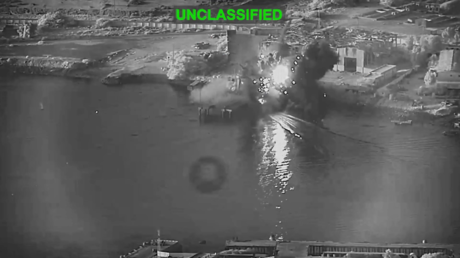
The illusion of a peaceful resolution in the Middle East just shattered completely. After a brief, fragile interim ceasefire that barely lasted a month, the United States launched its third consecutive night of intense airstrikes against Iranian military installations. President Donald Trump didn't mince words before the bombers took off, promising to hit them very hard. He made good on that threat. US Central Command confirmed that American aircraft, naval ships, and unmanned drones targeted air defense networks, coastal radar facilities, missile launch sites, and fast-attack naval craft along the Iranian coastline.
This isn't a minor border skirmish or a routine show of force. This is an all-out battle for control over the world's most vital economic choke point.
The immediate trigger for this week's rapid escalation came after Iranian cruise missiles struck two commercial oil tankers, the Mombasa and the Al Bahiyah, in the southern shipping lanes near Oman. One crew member died. Eight others were injured. Trump immediately declared the previous peace agreement dead, notified Congress that formal military hostilities had resumed, and ordered a full maritime blockade of Iran. To make things even more chaotic, the White House announced a stunning policy shift. The United States plans to seize administrative control of the Strait of Hormuz and slap a 20% tariff on all cargo passing through it.
If you think this is just another regional conflict isolated to the Persian Gulf, you're missing the bigger picture. The economic and geopolitical fallout from this war is already reaching your local gas station and altering global alliances in ways we haven't seen in decades.
The Collapse of the Sixty Day Truce
The current fighting marks a total breakdown of the 60-day interim deal signed back on June 17. That agreement was supposed to give diplomats room to breathe and negotiate a permanent end to the war that began in February 2026. Instead, both sides used the time to rearm, reposition assets, and wait for the other to blink.
Iran's top negotiator, Mohammad Bagher Ghalibaf, made his country's stance clear on social media, stating that the era of one-sided deals is officially over. Tehran claims the interim agreement gave them the right to manage and police traffic through the Strait of Hormuz. Washington saw that claim as an explicit threat to global shipping networks. When Iran began forcing commercial vessels to use specific shipping lanes near its rocky coast and demand official transit permits, a violent clash became inevitable.
The initial war broke out on February 28, 2026, when a combined US and Israeli air campaign killed several top Iranian figures, including Supreme Leader Ayatollah Ali Khamenei. The allies argued the pre-emptive strike was necessary to stop Iran's rapidly accelerating nuclear weapons program and force long-overdue regime change. Tehran didn't collapse. Instead, its military decentralized, launching waves of ballistic missiles and suicide drones against American bases in Iraq, Kuwait, and Bahrain. The current round of strikes shows that months of heavy bombing haven't broken Iran's capacity to fight back.
Inside the Target Zone
The third night of American airstrikes focused heavily on neutralizing Iran's asymmetric warfare capabilities. US Central Command focused its firepower on coastal artillery positions, mobile missile launchers, and drone command hubs scattered across southern Iran. State media in Tehran reported massive explosions near the port city of Bandar Abbas, as well as coastal blasts in Sirik and Bushehr province.
Bushehr houses Iran's primary nuclear power plant complex. While local news agencies claim the facility itself didn't suffer direct structural damage, conducting heavy airstrikes within miles of a nuclear reactor shows just how high the stakes have climbed. Explosions also rocked Abu Musa Island. This small patch of land in the middle of the gulf provides the literal backbone for Iran's physical dominance over the narrow shipping lanes.
The human toll is mounting fast on both sides. Internal data and human rights monitoring groups estimate that over 3,600 people have died in Iran since February, including a mix of military personnel and civilians caught in the crossfire. The United States has acknowledged at least 17 military fatalities and over 500 wounded. Israel has reported 40 soldiers and 28 civilians killed during the broader regional exchanges.
The Trillion Dollar Shipping Toll
The biggest shift in American strategy isn't the bombing itself. It's the economic blockade and the proposed transit fees. For decades, the global economy relied on the absolute freedom of navigation through international straits. The US Navy acted as the ultimate guarantor of that freedom, keeping lanes open for everyone without charging a dime.
Trump's new plan flips that global norm on its head. By declaring the United States the official guardian of the Strait of Hormuz and demanding a 20% tariff on all cargoes, the administration is treating an international waterway like a private toll road. European allies are already pushing back against the plan, warning that it violates maritime law and will throw global trade into deeper chaos.
The markets reacted instantly to the news. Brent crude oil prices surged by more than 9% in a matter of hours as traders realized the world's most critical energy artery was closing down again. Roughly 20% of the world's petroleum flows through this narrow body of water. A prolonged blockade means skyrocketing fuel prices, higher manufacturing costs, and a massive hit to global supply chains that are already struggling under the weight of this year's geopolitical shocks.
How This Impacts Global Security
The conflict isn't staying contained to Iranian soil. In response to the latest American strikes, Iranian-backed proxy groups launched retaliatory drone attacks against US military headquarters in Bahrain, which hosts the US Navy's Fifth Fleet. Sirens echoed across the island nation multiple times as air defense systems scrambled to intercept incoming threats. Neighboring Kuwait also went on high alert, with its military actively shooting down low-flying drones before they could strike localized targets.
This decentralized strategy makes Iran incredibly difficult to neutralize through airstrikes alone. You can't just destroy a single command center to stop the attacks. Tiny drone launch teams can operate out of civilian pickup trucks along hundreds of miles of rugged coastline. They can disappear into the mountains minutes after firing.
Next Steps for Global Trade and Energy Markets
With the interim ceasefire dead and the naval blockade officially going into effect, businesses and governments must adapt immediately to a highly volatile security environment.
Commercial shipping companies are already rerouting tankers away from the Persian Gulf. Avoiding the Strait of Hormuz means taking the long way around Africa, a detour that adds weeks to transit times and millions of dollars in extra fuel and insurance costs. If you manage a global supply chain or rely on imported commodities, you need to diversify your sourcing immediately. Expect energy volatility to persist for the remainder of 2026.
Diplomatic options are narrowing fast. Pakistan is currently attempting to mediate back-channel talks between Washington and Tehran, but these efforts face an uphill battle. Neither side wants to look weak. Trump has tied his political reputation to a total victory and the complete dismantling of Iran's regional influence. Meanwhile, the new Iranian leadership feels it has nothing left to lose, viewing the defense of the strait as a matter of national survival.
The coming days will determine whether this conflict boils over into a broader global war or forces both nations back to a highly uncomfortable negotiating table. For now, the bombs are still falling, and the global economy is paying the price.