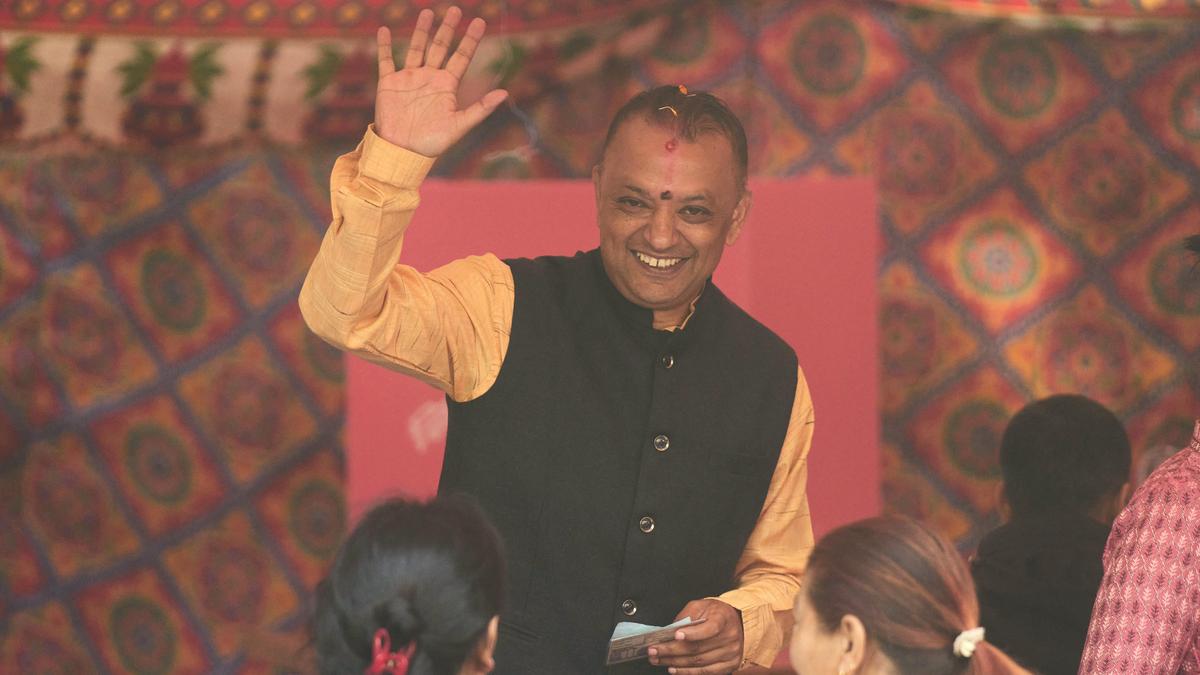
The long-standing gerontocracy of Nepal’s oldest political institution has finally hit a judicial brick wall. On April 17, 2026, the Supreme Court of Nepal delivered a verdict that effectively stripped Sher Bahadur Deuba of his final claim to the Nepali Congress (NC) throne, recognizing the insurgent faction led by Gagan Thapa as the party's official and legitimate leadership. This ruling ends three months of bitter legal warfare and administrative paralysis that saw two parallel committees claiming the "Tree" election symbol. By upholding the Election Commission's prior decision to validate the results of a mid-January special general convention, Justices Saranga Subedi and Nripdhwoj Niraula have done more than settle a technicality; they have sanctioned a generational coup.
The court’s decision is the final nail in the coffin for the Deuba establishment, which had argued that the special general convention—which saw the 49-year-old Thapa elected as president—was unconstitutional and held in bad faith. The bench dismissed these petitions, affirming that when 56 percent of party delegates demand a change in leadership after a central working committee's mandate expires, the law will not protect a leader who refuses to vacate the seat. Discover more on a connected topic: this related article.
The Mechanic of a Generative Coup
The friction within the Nepali Congress did not explode overnight. It was a slow-motion train wreck that began in late 2025. The 14th general convention's central working committee was set to expire in December, and Deuba, ever the survivalist, attempted to push the next general convention until after the March 5, 2026, elections. He wanted to control the ticket distribution—the ultimate currency of power in Nepali politics.
Thapa and his ally, Bishwaprakash Sharma, saw the trap. They knew that if Deuba controlled the candidate list for the 2026 polls, the reformist movement within the party would be suffocated for another five years. They forced a special general convention in mid-January, leveraging a clause in the party statute that allowed a majority of delegates to call for an emergency session. Additional analysis by USA Today highlights related views on this issue.
The resulting split was messy. For months, the party operated with two heads:
- The Thapa Faction: Held the majority of the grassroots delegates and secured recognition from the Election Commission.
- The Deuba Faction: Retained control of the physical party headquarters for a time and utilized "acting president" Purna Bahadur Khadka to issue parallel directives.
During the March 5 elections, the confusion reached a peak of absurdity. Proportional representation candidates ran under Deuba’s signature, while first-past-the-post candidates campaigned under Thapa’s. The result was a predictable electoral disaster, with the party securing a paltry 38 seats in the 275-member Pratinidhi Sabha.
Why the Old Guard Failed to Hold the Line
Deuba’s defeat in the courtroom is a reflection of his failure to read the room. For decades, the Nepali Congress has functioned as a patronage network where loyalty to the "establishment" was the only path to advancement. But the 2026 election cycle was different. The rise of independent movements and the youth-led disillusionment with traditional "big tent" parties meant the old tactics of stalling and backroom deals no longer worked.
The Supreme Court’s refusal to intervene on Deuba’s behalf suggests that the judiciary is increasingly wary of being used as a shield for internal party dysfunction. The justices noted that the party's internal democratic processes—specifically the will of the majority of representatives—took precedence over the procedural complaints of an outgoing president.
Thapa’s victory is not without its own baggage. Following the party's dismal performance in the March elections, he offered his resignation. It was a calculated move, one that he knew his newly formed central working committee would reject. They did. By offering to quit and being "forced" to stay, Thapa solidified his image as a leader who takes responsibility—a sharp contrast to Deuba, who has historically clung to power regardless of electoral outcomes.
The Purna Bahadur Khadka Standoff
The immediate fallout of the ruling is the fate of the remaining Deuba loyalists. Purna Bahadur Khadka, whom Deuba appointed as acting president in a desperate attempt to maintain a shadow government, now faces a disciplinary committee. The committee has demanded a clarification from Khadka regarding his continued use of the party letterhead to issue unauthorized statements.
Khadka has called the proceedings "ridiculous," but his defiance is now legally hollow. With the Supreme Court's verdict, any statement or directive issued by the Deuba-Khadka faction is legally non-binding. They are, for all intents and purposes, a private club with no authority over the official Nepali Congress machinery.
The ruling allows Thapa to move forward with the 15th general convention. This is the real prize. It will be the venue where the "Deuba chapter," as Thapa called it in January, is permanently closed and the party’s ideological framework is supposedly rebuilt for a younger, more skeptical electorate.
A Broken Party in a Shifted Landscape
While Thapa has won the legal right to the name and the symbol, he inherits a party in its weakest state in decades. The Nepali Congress is no longer the default choice for the middle class or the youth. The electoral defeat in March was not just a result of the leadership split; it was a rejection of a party that had become synonymous with stagnation.
Thapa’s challenge is to convert his "reformist" brand into actual policy. For years, he has been the party's most vocal critic from within. Now that he is the undisputed head, he can no longer blame the "establishment" for his failures. He is the establishment.
The path forward requires more than just winning a court case. The party's disciplinary committee is already sharpening its knives, and while purging the old guard might feel like progress, it risks alienating the significant portion of the party that still feels some residual loyalty to the Deuba legacy. Thapa must find a way to integrate the rank-and-file who didn't back him in January, or he will lead a "legitimate" party that is half the size of the one he sought to save.
The Supreme Court has cleared the path, but the rubble of the last three months still litters the ground. Thapa has the seal of the party; now he has to prove the party still has a reason to exist.