The air in Venice smells of salt, ancient stone, and an approaching storm. If you stand in the Giardini—the lush gardens that host the Biennale—you can usually hear the hum of a thousand different dreams. It is the Olympics of the soul. Every two years, nations plant their flags in the mud and attempt to prove that they possess the most profound vision of the human condition. But this year, the silence coming from the Russian Pavilion isn’t just an absence of sound. It is a scream.
Art is never just paint on a canvas or marble carved into a shape. It is a soft power, a subtle diplomatic dance that persists when politicians stop talking. Yet, the 59th Venice Biennale has become the site of a different kind of performance: a mass exodus. When the curators and artists representing Russia resigned, followed by the entire jury of the Russian Pavilion, they didn’t just quit a job. They severed a limb.
The Architect of a Collapse
Raimundas Malašauskas, the curator who walked away, didn’t do so because of a lack of talent or funding. He walked away because the ground beneath his feet had turned to glass. He spent years planning an exhibition that was supposed to bridge worlds, only to realize that the bridge was being used to transport tanks.
Consider the position of an artist caught in the gears of a geopolitical machine. Alexandra Sukhareva, the Russian artist who joined Malašauskas in resigning, found herself in a paradox. To exhibit her work under the official banner of a state currently engaged in an invasion would be to provide a veneer of normalcy to the abnormal.
Silence became the only honest medium left.
They quit. Just like that. The decision was swift, a sharp blade cutting through years of bureaucratic preparation and artistic labor. When a state pavilion goes dark, it isn't just an empty room; it is a physical manifestation of a nation becoming a ghost in the cultural world.
The Moral Calculus of the Jury
The shockwaves didn't stop at the artists. The jury members responsible for overseeing the Russian contribution realized that their presence was no longer a badge of merit, but a stamp of complicity.
Ethics in the art world are often treated as fluid, something to be discussed over expensive wine in a gallery opening. But there are moments when the fluidity hardens into a wall. The jury’s resignation was a collective realization that you cannot curate beauty while your sponsor is orchestrating destruction. They understood a fundamental truth that many try to ignore: art does not exist in a vacuum. It is funded by taxes, protected by laws, and promoted by governments.
When those governments violate the basic tenets of international law, the art they fund becomes a brand ambassador for a pariah. The jury members chose to lose their status rather than lose their souls.
A Precedent of Absence
This isn't the first time Venice has seen the shadow of war fall over its canals. During the 20th century, the Biennale survived world wars and the rise of fascism, but the stakes have shifted in the digital age. In the past, information moved slowly. Today, the images of bombed theaters in Mariupol reach the screens of curators in Venice in real-time.
The dissonance became unbearable.
How do you look at a conceptual installation about "memory" or "identity" when the state that paid for the installation is actively erasing the identity of a neighbor? You don't. You turn out the lights and lock the door.
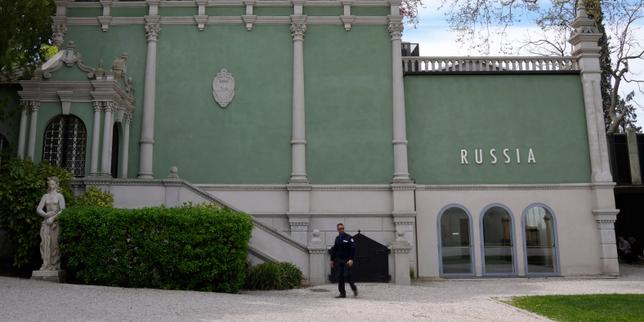
The Russian Pavilion is a grand, Russian-empire style building designed by Alexei Shchusev in 1914. It is meant to project strength and cultural continuity. Now, it stands as a tomb. Passersby don't stop to admire its architecture anymore; they stop to look at the boarded windows as if they are looking at a wound.
The Invisible Stakeholders
Beyond the famous names and the high-profile resignations, there is a secondary layer of human wreckage. Think of the assistants, the technicians, and the local Venetian workers who spent months preparing a show that will never open.
They are the invisible casualties of a cultural collapse.
In a small workshop near the Arsenale, a crate sits unopened. Inside is a piece of art that was meant to be the centerpiece of the Russian pavilion. It is now a legal and logistical nightmare. Who owns it? Who pays for its return? Does it even have a home to go back to? These are the questions that haunt the backrooms of the Biennale.
The resignations have created a vacuum that is being filled by a frantic, global conversation about the limits of cultural exchange. Some argue that art should be the last thing to go—that it is the only way to keep a window open into a closed society. Others, like the jury that walked out, argue that the window is actually a mirror, and the reflection it provides is too horrific to ignore.
The Geography of Protest
While the Russian Pavilion sits in darkness, the Ukrainian Pavilion has become a site of pilgrimage. The contrast is a physical lesson in power and vulnerability. Pavlo Makov, the artist representing Ukraine, had to flee Kharkiv with his family and his artwork in the trunk of a car.
The struggle to even get the work to Venice is part of the art now.
When you see the Ukrainian exhibition, you aren't just looking at a "fountain of exhaustion." You are looking at the resilience of a human being who refused to let their voice be silenced by the sound of sirens. The presence of Ukraine and the absence of Russia tells a story more powerful than any curated theme could ever hope to convey.
The Fragility of the Institution
The Venice Biennale is an institution built on the idea of the nation-state. Each country has its own house. It is a 19th-century concept trying to survive in a 21st-century reality. The mass resignation of the Russian team has exposed the structural flaw in this model: what happens when the house is owned by a landlord you can no longer tolerate?
The organizers of the Biennale are now forced to navigate a minefield. If they ban a country, they are accused of censorship. If they allow them to stay, they are accused of enabling war crimes. By resigning, the Russian artists and jury took the decision out of the institution's hands. They saved the Biennale from itself by removing the source of the friction.
But the cost is high.
We are entering an era of cultural decoupling. The "global village" of the arts is fracturing into walled gardens. The jury's resignation is a signal that the era of "neutral" art is over. Every brushstroke is now a political act. Every curator is a diplomat. Every silence is a statement.
The Echo in the Canals
Walking past the closed Russian Pavilion today feels like walking past a house where someone has died. There is a sense of mourning not for the state, but for the potential of what could have been. There were artists in Russia who wanted to speak to the world, who wanted to challenge their own government, who wanted to be part of a global dialogue.
Now, they are silenced, not by their own choice, but by the weight of their passport.
The jury understood that their resignation wouldn't stop the war. It wouldn't bring back the lives lost or rebuild the cities destroyed. But it was the only power they had. They refused to be the background music to a tragedy.
As the sun sets over the Venetian lagoon, the green shutters of the Russian Pavilion remain tightly closed. There is no line of tourists waiting to get in. There are no critics scribbling notes. There is only the lapping of the water against the stone and the heavy, uncomfortable realization that art cannot save us from ourselves if we aren't willing to protect the humanity that makes art possible in the first place.
The pavilion stands empty, a monument to the moment when the world decided that some things are more important than the show going on.