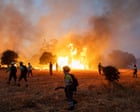
Europe is burning, and the official narrative is a comforting lie.
Every single summer, television screens fill with the exact same theater of defeat. Helicopters dip clumsily into the Mediterranean, dropping bucketfuls of seawater onto infernos that laugh at the gesture. Politicians stand in crisp white shirts against ash-gray backgrounds, lamenting record-breaking temperatures, dry winds, and the wrath of an angry climate. They tell us we are fighting an unprecedented war against nature, and that the only solution is more funding, more aircraft, and more sirens.
It is absolute theater. And it is keeping us blind.
The lazy consensus in every major newsroom is that modern Europe is simply too hot and too dry to stop these blazes, and that emergency services are doing everything humanly possible against overwhelming odds.
They are not. In fact, the prevailing emergency response model is actively making the catastrophe worse.
I have spent decades watching governments throw billions of euros at reactive suppression while ignoring the structural mechanics of how landscapes actually burn. We are treating symptoms with ever-larger hoses while the underlying pathogen multiplies.
The Core Fallacy of Total Suppression
Let us define the fundamental misunderstanding driving current policy: fire suppression is not fire prevention.
For the past century, forest management agencies across the European Union have operated under an unwritten dogma: every fire must be put out immediately, completely, and at all costs. Environmental ministries treat every flame as an existential failure.
This policy of total exclusion has turned millions of hectares of European woodland into ticking time bombs.
When you suppress natural, low-intensity fires year after year, you do not prevent fires. You merely defer them. You stockpile fuel. Dead timber, dense underbrush, and ladder fuels accumulate layer by suffocating layer. Nature operates on a strict ledger; the fuel consumed by small, frequent fires will eventually be consumed. If you deny the ecosystem its small fires for decades, you guarantee that when a spark finally catches—via lightning, a discarded cigarette, or agricultural negligence—the accumulated biological debt comes due all at once.
The record-breaking weather across the EU is not the root cause of these mega-fires. It is merely the match. The bomb was built by decades of bureaucratic risk-aversion and misguided ecological preservation.
The Equipment Trap
Governments love buying hardware. A water-dropping Canadair aircraft costs tens of millions of euros, looks incredible on the evening news, and gives politicians a tangible prop for press conferences.
It also provides a false sense of security.
Air tankers are a tactical band-aid. They cannot change the laws of physics. When relative humidity drops into the single digits and wind speeds exceed gale force, aerial firefighting is largely performative. Water evaporates before it hits the canopy, or the wind shears the drops away from the target zone entirely.
Yet, Brussels and national capitals continue to shovel resources into the reactive end of the pipeline. They treat firefighting like a military invasion, flying in battalions of personnel from unaffected nations to battle walls of flame that defy human intervention.
Imagine a scenario where a major city's fire department decided that instead of building fire codes, installing sprinklers, or clearing hazardous buildings, they would simply wait for buildings to catch fire and invest exclusively in buying larger ladder trucks. You would call them insane. Yet that is precisely how Europe manages its forests.
The Bureaucratic Paralysis of Controlled Burns
The counter-intuitive truth that nobody in power wants to admit is that we need more fire, not less.
The only proven method for neutralizing mega-fires is the deliberate, controlled application of low-intensity fire during the off-season. Prescribed burns clear out the dense understory, consume dead surface litter, and create natural firebreaks that stop high-intensity crowns from forming when summer heat arrives.
Why aren't we doing this at scale? Bureaucracy and cowardice.
Environmental regulations across the EU are designed by urban bureaucrats who view nature as a static museum exhibit rather than a dynamic, evolving system. To these regulators, a controlled burn looks messy. It produces smoke. It risks public backlash if a shift in wind causes a prescribed fire to escape its perimeter.
Consequently, foresters who know the science are trapped in a web of liability. It is safer for a public official to let a forest accumulate forty years of catastrophic fuel loads—knowing they can blame climate change if it explodes—than to authorize a prescribed burn that might invite local political fallout if a single acre gets scorched out of turn.
We have criminalized the very tool required for survival.
Dismantling the Adaptation Myth
Whenever these seasonal disasters peak, officials pivot to the word adaptation. They talk about shifting tree species, creating better early-warning sensor networks, and training more ground crews.
While these measures have marginal utility, they miss the brutal reality of landscape ecology. You cannot adapt your way out of a fuel glut. No amount of digital sensor arrays or evacuation apps will save a pine monoculture planted too densely in a Mediterranean microclimate when a dry easterly wind kicks up.
The structural flaw in current EU policy is its refusal to integrate rural populations and traditional land-use economies back into the equation. For centuries, Mediterranean landscapes were managed through low-intensity grazing, small-scale forestry, and localized wood-harvesting. Goats and sheep ate the brush that now feeds crown fires. Small landowners cleared the undergrowth because their livelihoods depended on it.
Modern conservationist policy largely evicted humans from the woods, creating protected areas that were abandoned to wild overgrowth. We traded active, messy human stewardship for hands-off preservation, and nature responded by reclaiming the territory with violence.
The Uncomfortable Trade-Offs
Let us be entirely transparent about the downside of the contrarian approach. Embracing a philosophy of managed fire and aggressive thinning is politically toxic.
Prescribed burning means deliberate smoke in the air during tourist seasons. It means occasionally watching pristine tracts of woodland deliberately scorched under controlled conditions. It means accepting localized, short-term ecological disruption to prevent continent-wide devastation.
It requires politicians to explain complex ecological principles to an electorate conditioned on simple, emotional narratives of good versus evil, nature versus humanity.
Most leaders lack the spine for it. They prefer the theater of emergency response because despair is easier to monetize politically than preventative discipline.
The Real Fix
If Europe wants to stop running this tragic script every summer, the playbook must be inverted entirely.
Cut the budget for reactive aerial fleets by thirty percent. Redirect those billions into localized, year-round mechanical thinning and aggressive, wide-scale prescribed burning programs managed by local forestry experts, not distant compliance officers.
Decentralize forest management. Return stewardship rights to the rural communities who actually live on the land, rather than micro-managing every hectare from government desks in capital cities.
And finally, stop blaming the weather for what poor policy built. The climate is shifting, yes, but the fuel load is our choice.
Stop waiting for the rain. Pick up the match, clear the brush, and accept that managing nature means working with fire, not hiding from it.