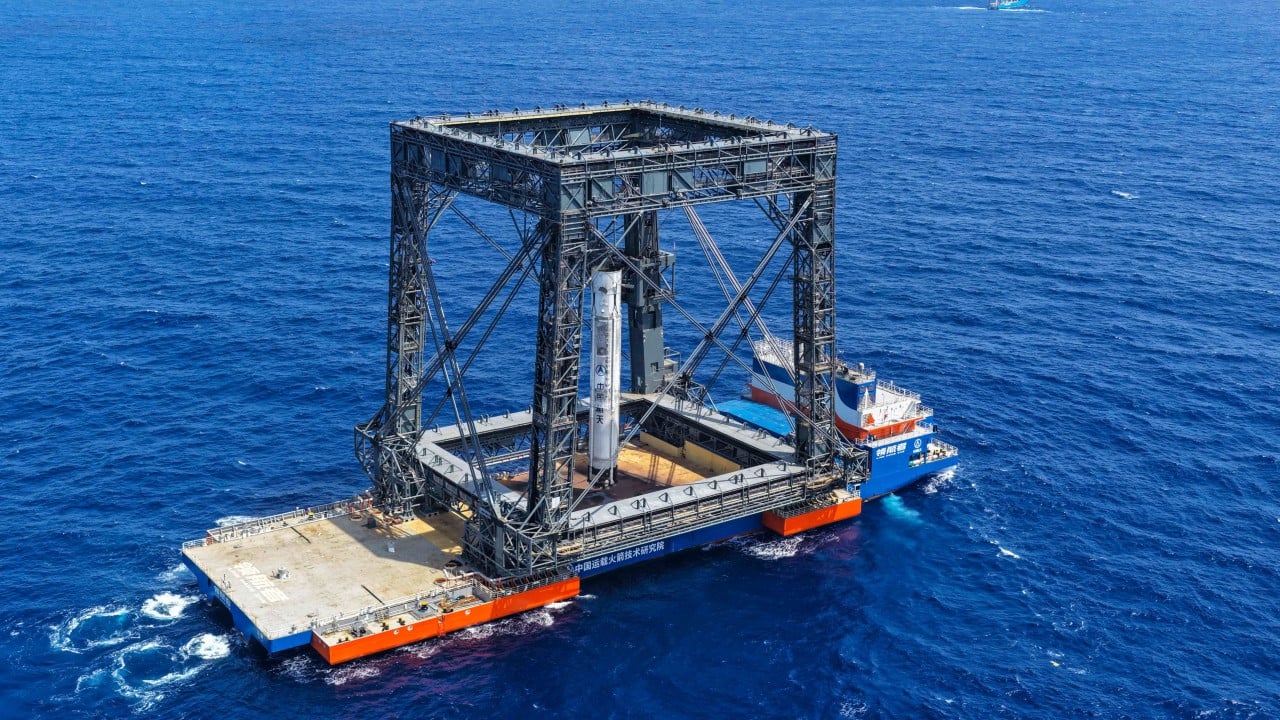
China’s successful recovery of a liquid-fueled rocket stage onto a marine vessel fundamentally alters the unit economics of regional orbital lift. While land-based vertical landing requires vast, unpopulated downrange corridors or complex boost-back maneuvers that consume significant propellant reserves, sea-based recovery optimizes the vehicle's payload capacity by aligning the landing platform with the natural ballistic trajectory of the launch. This operational shift transfers the primary engineering constraint from rocket propulsion limits to maritime structural engineering, specifically placing the spotlight on domestic shipbuilders capable of manufacturing highly specialized, dynamically positioned recovery vessels.
Evaluating this milestone requires moving beyond nationalistic milestones and analyzing the mechanical and economic frameworks that govern maritime aerospace recovery.
The Propellant Penalty and Geographic Constraints
Every kilogram of propellant reserved for an orbital vehicle's return is a kilogram stripped from its maximum revenue-generating payload capacity. This trade-off is governed by the Tsiolkovsky rocket equation:
$$\Delta v = v_e \ln \frac{m_0}{m_f}$$
In a standard land-based recovery configuration where the first stage performs a "boost-back" burn to return to the launch site, the vehicle must retain enough structural mass and propellant ($m_f$) to cancel its forward momentum and reverse its vector.
For coastal launch sites like Wenchang Space Launch Site in Hainan, or inland sites like Jiuquan, Xichang, and Taiyuan, land-based recovery introduces two distinct system bottlenecks:
- Inland Launch Hazards: Inland sites drop spent stages over inhabited zones. To safely land these stages on land, vehicles must execute complex steering maneuvers over domestic territory, increasing risk profiles and regulatory overhead.
- Coastal Boost-Back Penalties: Launching eastward from Hainan over the ocean means a return-to-launch-site (RTLS) maneuver requires a massive $\Delta v$ expenditure to combat the Earth's rotational assist.
Sea-based recovery eliminates the boost-back burn. The rocket follows a natural parabolic arc, deploying its landing legs precisely where gravity and initial velocity dictate. By placing a mobile landing platform at this downrange intercept point, operators recover up to 20% to 30% of the payload capacity that would otherwise be sacrificed in an RTLS flight profile.
The Three Pillars of Maritime Recovery Infrastructure
A successful ocean recovery relies on three highly integrated systems: the marine vessel's hydrodynamic stability, the localized environmental attenuation mechanics, and the automated securing infrastructure.
1. High-Precision Dynamic Positioning (DP-3)
The recovery vessel cannot rely on traditional anchoring systems; it must maintain a fixed geospatial coordinate in open water despite wind, wave action, and current forces. This requires a Class 3 Dynamic Positioning System (DP-3), which features full redundancy across generators, thrusters, and control computers.
- Bus-Tie Separation: The vessel’s electrical grid must be split into independent networks so that a short circuit or generator failure on one side cannot disable the thrusters on the other.
- Sensor Fusion: The system continuously processes inputs from differential GPS, laser-based ranging sensors, and inertial measurement units (IMUs) to predict wave-induced surge, sway, and yaw, executing micro-adjustments via azimuth thrusters.
2. Kinetic Attenuation and Deck Thermal Management
A descending rocket stage represents a massive concentration of kinetic and thermal energy. The landing deck must act as both a shock absorber and a heat shield.
- Ablative and Refractory Coatings: The deck surface experiences temperatures exceeding 1,500°C during the final touchdown burn. Domestic shipbuilders must deploy specialized steel plates backed by active water-cooling channels or passive refractory tiling to prevent the deck plates from warping. Warping destroys the structural flatness required for subsequent landings.
- Active Ballast Compensation: As the rocket touches down, its weight is transferred to the deck instantly. The vessel’s ballast system must rapidly shift water to counteract the sudden localized load, preventing the ship from developing a list that could cause the tall, top-heavy rocket stage to tip over.
3. Robotic Securing Systems
Once the stage settles onto the deck, the ocean environment introduces immediate risk. Residual propellant, high winds, and swell can slide the vehicle across the deck.
The integration of automated securing robots—frequently referred to in Western contexts as "octograbbers"—is critical. These low-profile, tracked remote vehicles crawl underneath the rocket engine section immediately after touchdown. They mechanically lock onto the rocket’s hold-down points and weld or hydraulically clamp themselves to the deck, securing the stage without requiring human deck crews to enter a hazardous zone filled with high-pressure gases and volatile hypergolic or cryogenic residues.
The Domestic Shipbuilding Supply Chain Factor
The pivot to sea-based recovery shifts the capital expenditure from aerospace manufacturing to heavy marine infrastructure. China’s domestic shipbuilding sector, led by conglomerates like China State Shipbuilding Corporation (CSSC), possesses an unmatched scaling advantage that changes the economics of this transition.
Traditional aerospace firms face long lead times when custom-ordering bespoke marine platforms. Chinese commercial launch entities can tap into an existing modular shipbuilding pipeline optimized for mega-containerships and advanced offshore oil drilling rigs.
This industrial crossover yields specific structural advantages:
[Offshore Oil Rig Supply Chains] ---> Semi-Submersible Hull Designs ---> High Wave-Height Tolerance
[Commercial Cargo Manufacturing] ---> Low-Cost Mass Steel Fabrication ---> Scale Advantages for Fleets
[Heavy Port Machinery Sectors] ---> Advanced Deck Crane Infrastructure ---> Automated Recovery Tools
By leveraging semi-submersible hull designs originally perfected for offshore oil exploration, shipbuilders can create landing platforms that sit lower in the water column. This design minimizes the impact of surface waves, allowing recovery operations to proceed in higher sea states (e.g., Sea State 4 or 5) than would be possible with a standard flat-bottomed barge.
Structural Risks and Operational Bottlenecks
While the economic benefits of sea-based recovery are clear, the strategy introduces distinct operational failure modes that do not exist in terrestrial environments.
- Marine Corrosion and Salt-Fog Intrusion: Rocket engines rely on tight tolerances, reusable valves, and complex avionics. Exposure to highly corrosive marine air during the transit back to port degrades specialized alloys and electrical connectors. This accelerates the refurbishing cycle timeline, offsetting some of the cost savings achieved through reuse.
- The Turnaround Time Paradox: A land-based stage can theoretically be towed to a hangar, inspected, and restacked within days. A sea-recovered stage is bound by maritime transit speeds. If a recovery vessel must travel 500 kilometers back to port at a standard speed of 12 knots (approximately 22 km/h), the transit alone adds more than 22 hours of idle time per launch, not including the time required for securing, safing, and clearing customs or port protocols.
- Logistical Vulnerability to Weather Windows: Terrestrial launches are constrained by ionospheric and upper-level wind conditions. Sea recoveries add an entirely separate layer of weather dependencies: wave height, surface wind speeds at the landing zone, and localized storm systems along the return route. A launch may be completely viable from the pad, yet scratched because the recovery vessel cannot safely maintain its station in rough seas downrange.
Strategic Allocation of Recovery Assets
To maximize the return on investment for these maritime assets, commercial and state-backed entities must avoid treating recovery vessels as single-use platforms for specific rocket families. The optimal strategic play requires treating the recovery fleet as shared regional infrastructure.
The vessels must be engineered with modular deck interfaces capable of accepting multiple rocket diameters and landing leg configurations. By standardizing the tie-down hardpoints and automated robot systems across different launch providers, a single vessel stationed in the South China Sea or East China Sea can support a high-frequency launch cadence from multiple entities. This approach drives down the fixed amortization costs of the vessel per launch, accelerating the path to true economic reusability across the entire domestic space sector.