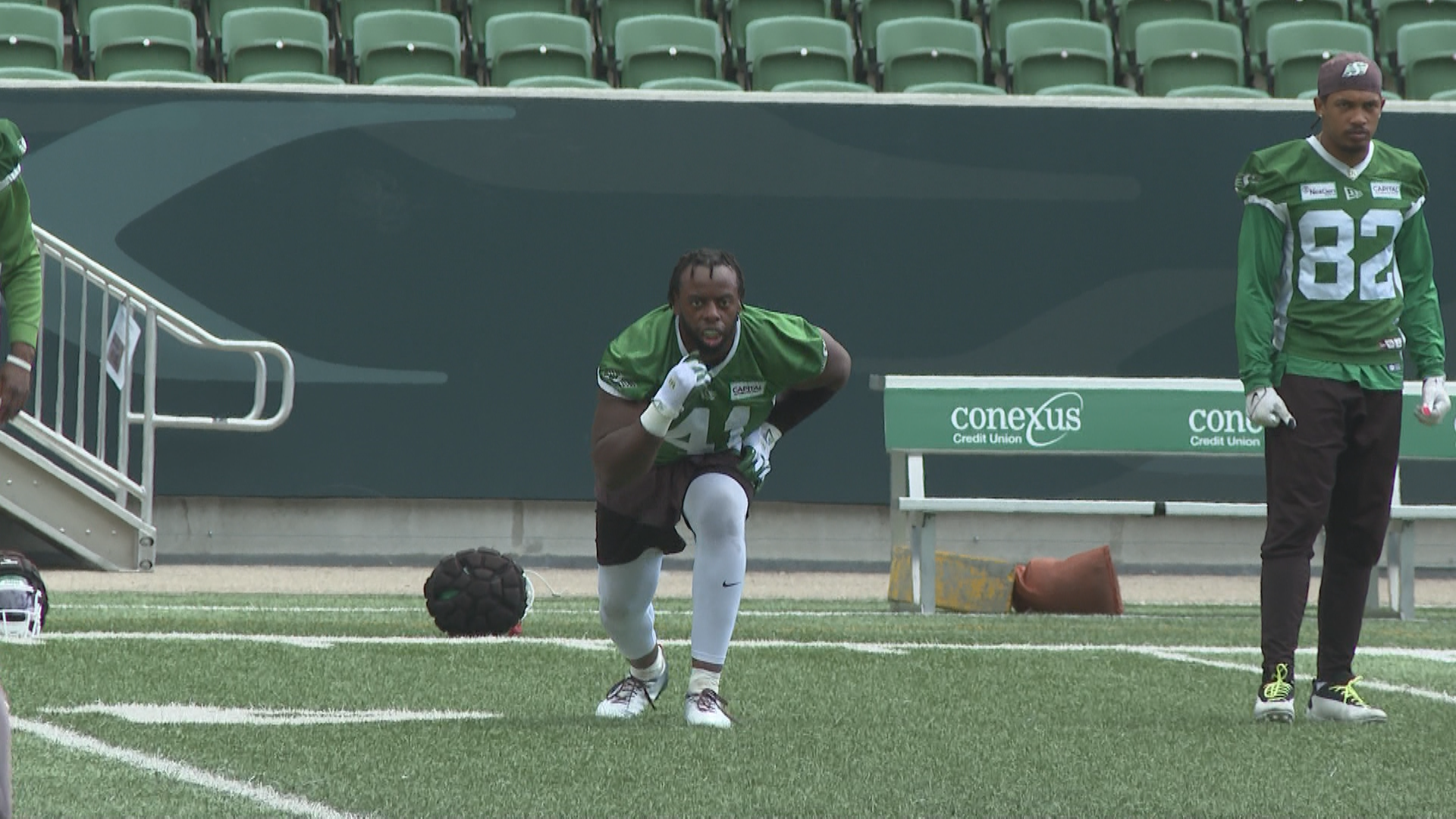
Roster continuity serves as the foundational architecture of sustained competitive advantage in professional sports leagues governed by hard salary caps. While casual metrics prioritize visible offensive productivity—such as passing yards, rushing volume, and targets—the structural stability of a franchise depends on low-overhead, high-efficiency labor. The retention of fullback Albert Awachie by the Saskatchewan Roughriders across nine seasons and 100 franchise appearances illustrates a broader mechanism of professional sports asset optimization: the strategic prioritization of institutional memory over transactional talent acquisition.
Understanding how a non-statistical asset survives multiple regime changes, coaching philosophical shifts, and injury cycles requires breaking down the core economic and athletic variables governing roster engineering. Longevity at the absolute margins of a sports roster is never accidental; it is an optimized response to regulatory constraints, positional scarcity, and phase-of-play mechanics.
The Tri-Pillar Model of Fringe Roster Preservation
Surviving a multi-year tenure in professional gridiron football without elite box-score metrics requires an elite execution profile across three specific structural pillars:
- National Player Optimization Metrics: In specialized leagues with strict demographic constraints like the Canadian Football League (CFL), domestic assets who can execute highly physical, multi-phase assignments represent the highest premium in roster construction.
- Cap-Space Efficiency Ratios: Maximizing the spending power directed toward elite, variable-outcome positions (such as quarterback or edge rusher) requires minimizing the financial footprint of mandatory supporting roles without creating structural performance drops.
- Special Teams Play-Execution Density: Roster spots 25 through 45 must deliver high-velocity, high-impact blocks and open-field tackles, absorbing the physical degradation of kick coverage so star players remain insulated from injury.
When a single asset checks all three boxes over a 100-game horizon, the franchise secures an extreme return on investment by eliminating the operational friction and search costs associated with annual talent replacement.
The Mechanics of National Status Arbitrage
To evaluate the true value of an asset like a 6-foot-3, 225-pound domestic fullback, one must analyze the roster compliance framework. The system dictates a mandatory distribution of National (domestic) versus American players within the active lineup.
A National asset capable of matching the physical profile of an American linebacker or defensive end at the point of attack acts as a structural lever. When a coach can position a highly physical domestic player at fullback or tight end, it releases an active roster spot elsewhere, allowing the front office to deploy an American pass-catcher or offensive tackle. This dynamic converts a low-yardage offensive asset into a high-yield strategic asset.
The value is calculated not by the individual's direct yardage production, but by the performance variance of the American player enabled elsewhere on the field.
The Fullback Cost Function and Asset Stabilization
In the modern passing era, the standard fullback position is often viewed as an archaic remnant of run-heavy schemes. However, specialized analytics reveal that the position has evolved into a hybrid protective unit. The modern fullback's operational mandate spans three distinct functional disciplines:
- Lead Block Trajectory Management: Decelerating second-level defenders in the A and B gaps to establish a clean runway for primary ball carriers.
- Pass Protection Variable Recognition: Functioning as an emergency check-down blocker capable of diagnosing disguised blitzes and absorbing bull-rushes from interior defensive linemen.
- Pre-Snap Motion Deception: Forcing defensive coordinators to account for an extra gap in the run fit, thereby limiting their ability to drop safeties into deep coverage zones.
The economic cost function of this position favors prolonged veteran retention over rookie development. A rookie fullback lacks the analytical pattern recognition needed to instantly decipher moving front-seven alignments. A veteran who has logged thousands of snaps within the same organization reacts reflexively, reducing pre-snap communication errors to zero.
The Anatomy of Play-Action Deception
The tactical utility of an experienced fullback is magnified during play-action passing sequences. When the fullback aggressively fills the interior gap during a simulated run, the opposing linebackers must commit downhill to fill their assigned run lanes. This reaction opens up a passing window directly behind them.
[Defensive Line]  <-- Engaged by Offensive Line
    [Linebackers] <-- Committing Downhill due to Fullback Insert
-------------------------------------------------------
  [Passing Window] <-- Created by Linebacker Displacement
This structural movement cannot occur if the fullback hesitates or fails to sell the block with authentic physical violence. The data demonstrates that while an individual asset may record fewer than ten receptions over an entire competitive season, their presence on the field alters the spatial coverage maps of the defense, directly boosting the team's yards-per-play average on passing downs.
Special Teams Execution and the Physics of Impact
A foundational reality of sustaining a 100-game career while operating primarily outside the starting offensive group is absolute mastery of special teams. The coverage units—specifically kickoff and punt coverage—are governed by extreme physics. Athletes accelerate across 40 to 50 yards of open space, culminating in high-velocity collisions that demand precise angles of approach and specific tackling mechanics.
The performance profile of a core special teams asset relies on a combination of specific spatial and physical attributes:
- Lane Discipline Retention: Resisting the natural impulse to chase the ball carrier laterally, which preserves the integrity of the containment net and prevents cutback explosive plays.
- Shedding Blockers on the Move: Utilizing hand-fighting techniques to defeat blockers while maintaining top-end tracking speed.
- Spatial Tracking and Angle Calculations: Calculating the precise intersection point between the returner’s vector and the coverage lane under shifting atmospheric and field conditions.
The physical strain of these plays causes high annual turnover on special teams units. An asset capable of enduring this attrition over nine seasons demonstrates elite physical durability and highly refined technical execution.
The longevity of an athlete in this ecosystem is maintained by reducing redundant movements and utilizing leveraged body positioning to minimize the sheer force absorbed during impact.
Institutional Memory as an Operational Buffer
Every professional sports organization faces cyclical staff turnover. Head coaches, offensive coordinators, and general managers cycle through franchises at a rapid rate. This structural volatility routinely derails the development of young players who must constantly unlearn and relearn complex playbook nomenclature.
Under these conditions, a long-tenured veteran serves as an informal extension of the coaching staff within the locker room and meeting spaces. When a franchise transitions through strategic resets, the presence of a 100-game veteran provides a stabilizing cultural anchor.
This asset possesses the historical context of the organization's standards, bridging the gap between management’s objectives and player execution.
Quantifying the Micro-Value of Veteran Stability
The value of this internal alignment is observed during high-leverage situations, such as late-game short-yardage conversions or sudden-change scenarios following a turnover.
When a young roster begins to exhibit panic or communication breakdowns, the veteran asset enforces alignment discipline, stabilizes pre-snap positioning, and ensures the team executes the core play design. This operational insurance policy does not show up on a standard fantasy football spreadsheet, but it directly correlates with winning percentages in one-possession games.
Roster Vulnerabilities and the Single-Asset Dependency Trap
While celebrating a 100-game milestone highlights the advantages of continuity, a rigorous analytical framework must also address the latent structural risks inherent in long-term fringe roster reliance. Relying heavily on a single veteran asset to anchor specialized units introduces clear operational vulnerabilities.
The first limitation is age-related physical regression. An asset entering the twilight of a decade-long career inevitably experiences a decline in raw linear speed and explosive recovery metrics. If the front office fails to run a parallel developmental program for a younger domestic replacement, a sudden injury to the veteran can cause an immediate, catastrophic drop-down in special teams execution quality.
The second limitation is the salary inflation cycle. As an unheralded veteran accrues seniority and tenure milestones, their baseline compensation demands naturally escalate due to collective bargaining agreements or accumulated leverage. This creates an organizational bottleneck where a role optimized for minimum-wage efficiency begins consuming premium cap space, forcing difficult roster trade-offs in other critical departments.
The Strategic Playbook for Long-Term Roster Engineering
To maximize the performance yield of an active roster while navigating stringent salary caps and demographic player requirements, front offices must treat fringe longevity as a deliberate system rather than a matter of luck. Organizations should execute the following operational protocols to replicate this level of roster stability:
- De-link Compensation from Seniority in Support Roles: Structure veteran contracts for special teams and blocking assets around performance-tied incentives and roster bonuses rather than high base-salary guarantees, ensuring cap efficiency remains intact.
- Implement a Continuous Shadow-Roster Pipeline: Draft or sign at least one domestic rookie every two seasons with an identical physical profile to the veteran asset, allowing them to absorb institutional knowledge while providing immediate low-cost backup depth.
- Deploy Analytics for Structural Impact Mapping: Evaluate non-statistical players using advanced tracking data—such as block-win rates, lane compliance percentages, and pre-snap adjustment accuracy—rather than traditional box-score metrics.
The definitive reality of professional gridiron football is that championship windows open and close based on an organization’s ability to maximize its return on marginal assets. Securing 100 games of high-level, low-maintenance utility from a single domestic asset represents a masterclass in risk mitigation and roster engineering. Franchises that master this calculation ensure their foundational floor remains elite, allowing their high-priced star assets the operational platform needed to secure championship outcomes.