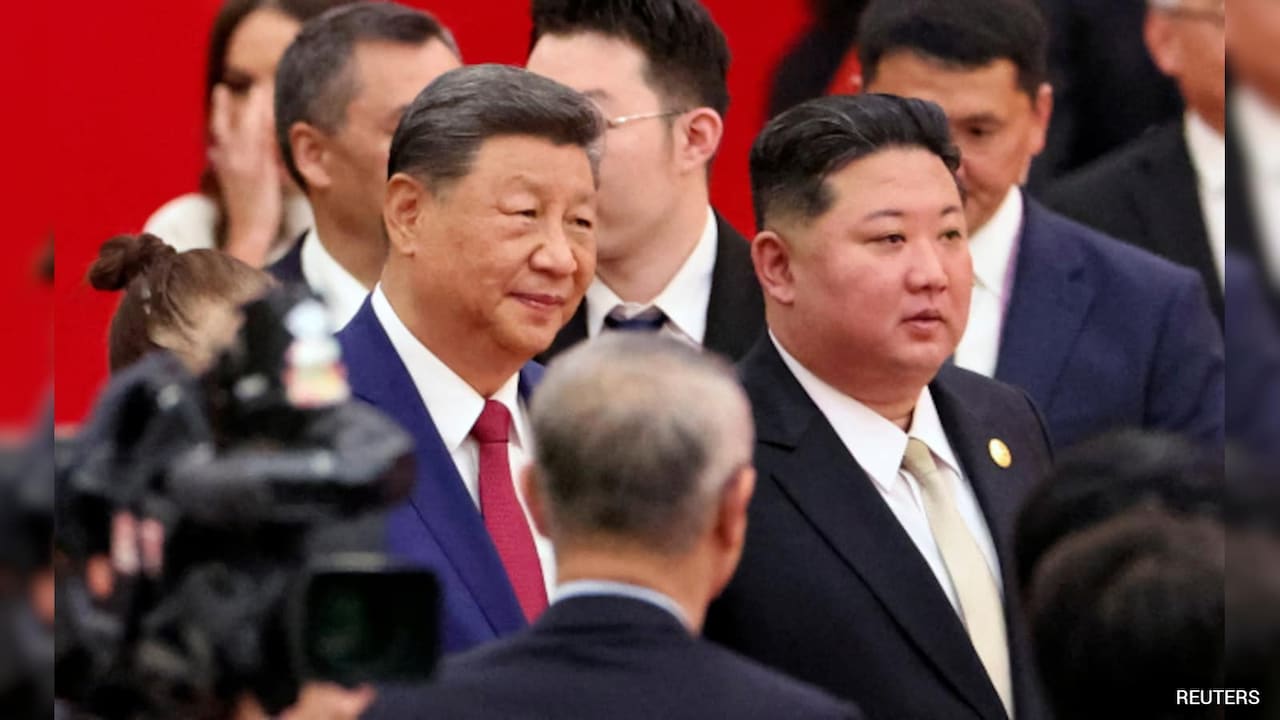
The heavy red drapes of the Great Hall of the People do more than muffle the sound of the Beijing traffic outside. They swallow history. When the doors click shut, the silence is absolute, heavy with the weight of absolute power. Two men sit across a polished mahogany table. On one side, Xi Jinping, deliberate, expansive, carrying the burden of a nation striving to reshape the global order. On the other, Kim Jong Un, watchful, sharp, leading a isolated state that has turned survival into a high-stakes art form.
This is not just another diplomatic photo opportunity. It is a quiet collision of survival and ambition.
To understand why this meeting matters, look past the formal handshakes and the perfectly choreographed military honors. The real story plays out in the spaces between the words, in the economic lifelines stretching across the Yalu River, and in the unspoken anxieties of two leaders bound by geography but separated by their ultimate goals.
The Weight of the Border
Picture a small trading town along the freezing banks of the Talu River. A merchant, let us call him Lao Chen, watches a line of green trucks rumble across the Friendship Bridge into North Korea. For decades, men like Chen have been the true barometer of geopolitics. When the trucks carry grain and fuel, the room in Beijing is calm. When the trucks stop, the chill from Pyongyang is felt instantly.
China is North Korea’s economic lung. Without Beijing, the isolated regime cannot breathe. Over ninety percent of North Korea's trade flows through Chinese hands. Yet, this relationship is far from a warm brotherhood. It is a marriage of absolute necessity, built on a shared border and a deep, historical distrust of Western influence in Asia.
Xi Jinping views the Korean Peninsula through the lens of stability. A collapse in Pyongyang means chaos on China’s northeastern frontier. It means millions of refugees. Worse, for Beijing, it could mean a unified Korea aligned with the United States, placing American troops right at the Chinese border. To prevent this, China keeps its neighbor on life support. But life support is not the same as approval.
The Price of Ambition
Kim Jong Un is not content to be a buffer state. Over the last decade, Pyongyang has transformed itself from a struggling post-Cold War relic into a nuclear-armed wild card. Every missile test that rattles Tokyo and Washington also sends ripples of unease through Beijing.
Consider the delicate balance Xi Jinping must maintain. Beijing wants to challenge global order, but it requires predictability to fuel its economic engine. A rogue neighbor testing intercontinental ballistic missiles disrupts that predictability. It gives the United States a perfect justification to increase its military presence in East Asia, deploying advanced missile defense systems and naval fleets closer to Chinese shores.
The tension in the room during these meetings is palpable. Xi requires compliance; Kim demands respect.
The strategy is a complex dance of leverage. China uses its economic leverage—the oil pipelines, the food aid—to keep North Korea from crossing absolute red lines. Meanwhile, North Korea uses its strategic position to remind Beijing that a volatile Pyongyang is far more dangerous to China than a nuclear one.
The Shifting Global Board
The world outside the Great Hall is changing rapidly. The war in Ukraine has created new, unpredictable alliances. Pyongyang’s recent moves to supply ammunition and military hardware to Moscow have shifted the calculations. Suddenly, Kim Jong Un has another major power vying for his attention.
This introduces a new layer of anxiety for Beijing. Xi Jinping prefers to be the sole gatekeeper to North Korea. If Pyongyang can secure fuel and technology directly from Russia, China’s leverage weakens. The meeting in Beijing is an effort to reassert that dominance, to remind Kim that while Moscow can offer immediate transactions, only Beijing can guarantee long-term survival.
For the ordinary citizen watching from Seoul, Tokyo, or Washington, the stakes are deeply personal. The decisions made behind these closed doors dictate whether the next year will be marked by provocative missile launches or a quiet return to diplomatic maneuvering. It affects defense budgets, international trade routes, and the daily sense of security for millions of people living under the shadow of the peninsula's unresolved conflict.
Beyond the Handshake
When the final statements are read to the press, they will speak of traditional friendship, regional stability, and mutual cooperation. These are the scripted lines of diplomacy, designed to project unity to a watchful world.
But the true outcome of the meeting will be visible in the weeks to come, not in the state media reports, but on the ground. It will be seen in the volume of cargo crossing the Friendship Bridge. It will be seen in the presence or absence of sudden missile tests in the Sea of Japan.
The two men will leave the room, their motorcades disappearing into the Beijing dusk. The red drapes will be drawn again, hiding the empty chairs and the polished table where the fate of millions was quietly weighed, balanced, and decided.