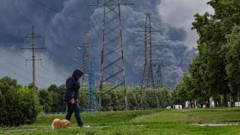
The mainstream media is suffering from a severe case of optical illusion. When a drone slams into an oil refinery on the outskirts of Moscow, the immediate, lazy reaction from Western analysts is to declare a psychological breakthrough. They claim the war is finally "coming home" to ordinary Russians, that the Kremlin's domestic stability is fracturing, and that the energy grid is on the verge of collapse.
It is a comforting narrative. It is also entirely wrong.
I have spent two decades analyzing energy infrastructure logistics and supply-chain vulnerabilities. If you think a few charred distillation columns in Kapotnya are going to force a macroeconomic pivot or spark a popular uprising, you do not understand how oil refining works, nor do you understand the brutal math of Soviet-era infrastructure. The consensus view confuses dramatic footage with strategic efficacy. The reality is far colder: these attacks are expensive tactical distractions that achieve the exact opposite of their intended geopolitical goals.
The Myth of the Vulnerable Giant
To understand why these strikes fail to move the needle, you have to look at the physical architecture of a facility like the Moscow Refinery. These are not fragile modern tech hubs; they are sprawling, brutalist industrial fortresses built during the Cold War. They were literally engineered to survive conventional bombardment.
When a drone carrying a 50-kilogram payload hits a refinery, it creates a spectacular fireball. It dominates the morning news cycle. But structurally? It is the equivalent of a BB gun hitting a dump truck.
Refineries are highly modular. The critical component usually targeted is the atmospheric distillation unit (AVT)—the tall tower where crude oil is split into various fractions like gasoline and diesel. Yes, if you hit an AVT, that specific line goes down. But major Russian refineries have multiple redundant processing units. Taking out one unit drops capacity by 15% or 20% for a few weeks, it does not zero it out.
Furthermore, the domestic Russian energy market has massive built-in cushions. Russia produces roughly double the amount of gasoline and diesel than its domestic population actually consumes. The surplus is exported to global markets. When a refinery is damaged, Russia does not run out of fuel for its tanks or its citizens; it simply reduces its export volume. The domestic market remains entirely insulated. The only entity feeling the pinch is the balance sheet of the specific oil firm, which is quickly subsidized by state energy funds anyway.
The Counter-Intuitive Economics of Energy Destruction
Let us look at the financial mechanics that the consensus completely ignores. Basic economic theory dictates that when you decrease supply while demand remains constant, prices rise.
By launching highly publicized drone strikes on Russian refining capacity, the West unintentionally triggers a mechanism that stabilizes Russian revenue. When European traders see headlines about burning Russian oil infrastructure, global oil and refined product benchmarks spike.
Imagine a scenario where a strike successfully knocks out 5% of Russia's refining capacity. If the resulting global panic pushes the price of crude and diesel up by 10%, Russia ends up making more money on its remaining 95% of exports than it did before the strike. We are effectively subsidizing the Kremlin’s repair budgets by creating artificial scarcity that drives up global energy margins.
I have watched Western governments attempt to use sanctions and infrastructure disruption as economic blunt instruments for years. It almost always backfires because the global energy market is a fluid, adaptive organism. When you block or damage one node, the flow simply re-routes through shadow fleets, ship-to-ship transfers in the Mediterranean, and third-party refiners in India and China who buy the discounted crude, refine it, and sell it right back to Europe.
The Psychological Miscalculation
The core argument of the competitor piece—and the broader media consensus—is that bringing the war to Moscow’s doorstep will break the domestic social contract. The theory goes that once Muscovites see smoke on the horizon, they will demand an end to the conflict.
This reveals a profound ignorance of wartime psychology.
Historically, collective punishment or the threat of suburban destruction does not demoralize a population; it solidifies their hostility toward the attacker. It validates the state's propaganda narrative that the nation is under existential threat. When a drone explodes near a residential district or a local refinery in Moscow, ordinary citizens do not think, "We should withdraw our troops." They think, "We need better air defense, and we need to hit back harder."
The psychological effect is not a fracture; it is a consolidation. By focusing on high-profile, visually stunning targets near the capital, the strategy prioritizes internet virality over actual military utility.
PAA Dismantled: What Actually Matters?
If you look at the common questions floating around public debate, the premise is almost always flawed.
Flawed Question: Will drone strikes on Moscow refineries stop the Russian military machine?
Brutal Reality: No. The Russian military uses a fraction of the country's total fuel production. Even if 40% of Russian refining capacity were vaporized tomorrow, the state would prioritize the military logistics chain over civilian gas stations. The tanks will always have diesel. The civilian commuters in St. Petersburg are the ones who would face rationing, which only fuels domestic anger against the West.
Flawed Question: Can Russia replace the specialized Western equipment damaged in these strikes?
Brutal Reality: The consensus says no because of sanctions on high-tech components like catalysts and specialized pumps. The reality I see on the ground is that Chinese engineering firms have spent the last four years rapidly reverse-engineering and supplying these exact industrial components. What used to take six months to source from Germany now takes six weeks to ship from Shanghai. It is a game of whack-a-mole that Russia is winning through supply-chain adaptation.
The Actionable Pivot: Stop Chasing Fireballs
If the goal is genuine strategic disruption rather than PR victories, the targeting methodology must shift entirely away from downstream refining infrastructure.
Instead of hitting sprawling refineries that can isolate damage, the focus should be on hyper-specific, irreplaceable nodes in the upstream transport network. Specifically, the electrical substations powering the massive pipeline pumps deep in the Russian interior.
Crude oil cannot move from Siberia to the ports without massive, highly specialized pumping stations. These stations run on localized electrical grids. If you destroy a distillation tower, they can bypass it or fix it with Chinese parts. If you destroy the custom-built, high-voltage transformers that power the oil pipelines, the entire basin shuts down at the source. No oil moves. No oil gets exported. The wellheads themselves freeze up and suffer permanent geological damage.
But that strategy does not produce massive, cinematic fireballs on the Moscow ring road. It happens silently, thousands of miles away in the frozen taiga, far from the lenses of smartphone cameras.
We are wasting finite, high-tech loitering munitions on industrial theater. The Moscow refinery strikes are a masterclass in tactical vanity—they look brilliant on social media, they satisfy the urge for immediate retaliation, but they leave the structural foundations of the adversary's war economy completely untouched. Stop celebrating the smoke. Start looking at the machinery underneath.