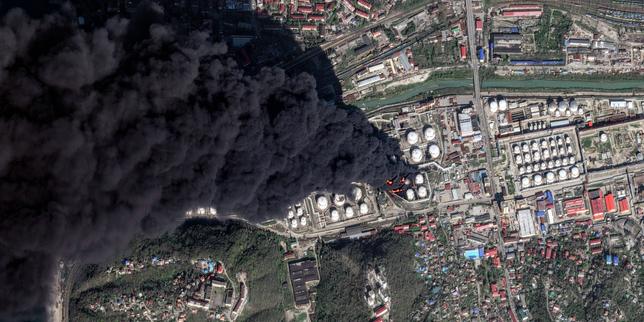
The media is obsessed with tactical fireworks. Every time a Ukrainian drone clips a Russian oil refinery or drifts across a Baltic border into Latvia, the commentary machine spins up the same predictable narrative. They tell you Russia’s infrastructure is crumbling. They tell you the economic chokehold is tightening. They tell you that a few high-tech asymmetric strikes are fundamentally shifting the calculus of the war.
They are wrong. They are falling for the optical illusion of modern warfare. Discover more on a related issue: this related article.
Watching a refinery burn makes for great television. It provides a comforting illusion of progress to Western observers who want to believe that complex, grinding conflicts can be solved by clever drone telemetry and targeted economic sabotage. Having analyzed defense supply chains and sanction evasion networks for years, I can tell you the reality on the ground is far colder, far more frustrating, and entirely disconnected from the mainstream consensus.
The Western analysis of these events is fundamentally flawed because it applies peacetime economic logic to a war economy. If you want to understand why Russia isn’t collapsing under the weight of these headlines, you have to stop looking at the smoke and start looking at the plumbing. Further analysis by The New York Times explores related views on this issue.
The Refinery Mirage: Why Broken Distillation Towers Don't Stop Tanks
The current media obsession revolves around Ukrainian drone strikes disabling Russian oil refining capacity. The narrative claims that by hitting primary distillation units, like the AVT-6 complexes, Ukraine is starving the Russian military of fuel and bleeding the Kremlin of cash.
This ignores the structural mechanics of global energy markets.
When a drone damages a refinery, it does not magically vanish the crude oil that was supposed to go into it. Russia simply redirects the raw crude. Instead of exporting refined diesel or gasoline, they export unrefined oil to nations perfectly willing to process it for them. India, China, and a host of intermediaries buy the discounted crude, refine it, and often sell it right back to the global market—sometimes even back to Europe under rewritten manifests.
Consider the internal logistics. The Russian military does not buy its fuel from commercial gas stations in Moscow. It draws from massive, insulated state reserves that are prioritized above all civilian economic activity. To actually starve a military of fuel via infrastructure strikes, you cannot just damage a dozen refineries; you have to completely sever the domestic transport network. Russia possesses over 200,000 kilometers of rail track and an incredibly redundant pipeline system built during the Cold War specifically to withstand sustained bombardment.
Furthermore, replacing a damaged distillation tower is not an impossible task. While Western sanctions theoretically block the export of specialized refining components, the global black market for industrial hardware is vast and efficient. Components route through Dubai, pass through central Asian logistics hubs, and arrive at Russian facilities within months. The civilian population might face localized gas price spikes, but the state budget and the military supply line remain insulated. Treating a temporary dip in refining capacity as a strategic turning point is a fundamental misunderstanding of industrial resilience.
The Baltic Drone Panic Is a Feature, Not a Bug
When a Russian drone veers off course and crashes in Latvia, the immediate reaction from the defense establishment is a mix of panic and bureaucratic hand-wringing. Pundits scream about NATO's Article 5, border integrity, and the imminent escalation of the conflict.
This panic plays directly into the Kremlin's hands. These incursions are rarely accidental navigation errors, nor are they the prelude to a conventional invasion of the Baltics. They are calculated, low-cost stress tests designed to expose the friction points within Western air defense networks.
Every time a drone crosses into NATO airspace, it forces a decision chain:
- Do regional commanders fire a million-dollar Patriot missile at a ten-thousand-dollar piece of flying plastic?
- Do they hold fire and risk looking weak, eroding public confidence in the alliance?
- How quickly do local governments communicate with NATO headquarters before a political consensus is reached?
By allowing these drones to wander across borders, Russia maps the electronic signatures of Western radar systems that activate to track them. They gather invaluable data on response times, command hierarchies, and political risk tolerance.
The mainstream news reports these incidents as signs of Russian sloppiness or desperation. In reality, they are cheap intelligence-gathering operations. The West treats these provocations as isolated crises, scrambling to issue strongly worded diplomatic statements, while the adversary treats them as routine diagnostics.
The Myth of Total Isolation
We are told repeatedly that Russia is an international pariah, cut off from the global economy. This claim relies on a eurocentric view of geography. The reality is a massive, decentralized reconfiguration of global trade.
When Western microchip manufacturers pulled out of the Russian market, the supply chains didn't die; they simply grew longer. A chip manufactured in East Asia that used to ship directly to St. Petersburg now travels from Taiwan to a distributor in Turkey, then to a shell company in Kazakhstan, before finally crossing a porous land border into a Russian missile assembly plant.
This is not a theoretical vulnerability. It is a documented reality of modern global commerce. The components powering Russian reconnaissance drones and cruise missiles are packed with off-the-shelf Western components because the globalized electronics market is too complex to police. You cannot effectively sanction an item that can be bought in bulk on commercial e-commerce platforms and shipped in a suitcase.
The downside to acknowledging this truth is uncomfortable: it means admitting that the economic tools the West relies on to avoid direct military conflict are largely performative. They raise the cost of doing business for the adversary, yes, but they do not stop the production lines.
Dismantling the "Victory Just Around the Corner" Premise
The core flaw in the current news cycle is the desperate search for a silver bullet. The public is constantly fed a diet of specific technological or tactical developments that are supposed to end the war. First, it was Western main battle tanks. Then it was long-range missile systems. Now it is the systematic destruction of energy infrastructure.
Wars of attrition are not won by clever hacks or viral video clips of burning infrastructure. They are won by industrial volume, mobilization capacity, and sheer political will.
To believe that a campaign of drone strikes on refineries will force a nuclear-armed state to abandon a core geopolitical objective is fantasy. It assumes the adversary has the same breaking point as a Western democracy sensitive to fluctuating fuel prices and negative press coverage. A war economy operates under a different set of physics. Inflation, supply shortages, and infrastructure damage are accepted as baseline costs, not political crises that force a surrender.
Stop looking at the spectacular explosions on social media as evidence of a strategic shift. They are tactical pinpricks on a massive, slow-moving beast that has already adapted to the pressure. The current strategy of relying on asymmetric pinpricks and economic sanctions isn't breaking the machine; it is merely teaching it how to survive in a hostile world.
The West needs to stop celebrating minor tactical victories and realize it is facing an adversary that has fully transitioned into a permanent wartime footing, entirely unbothered by the opinion of the global consensus. Turn off the live blogs. Look at the industrial output numbers. That is where the war is actually being decided.