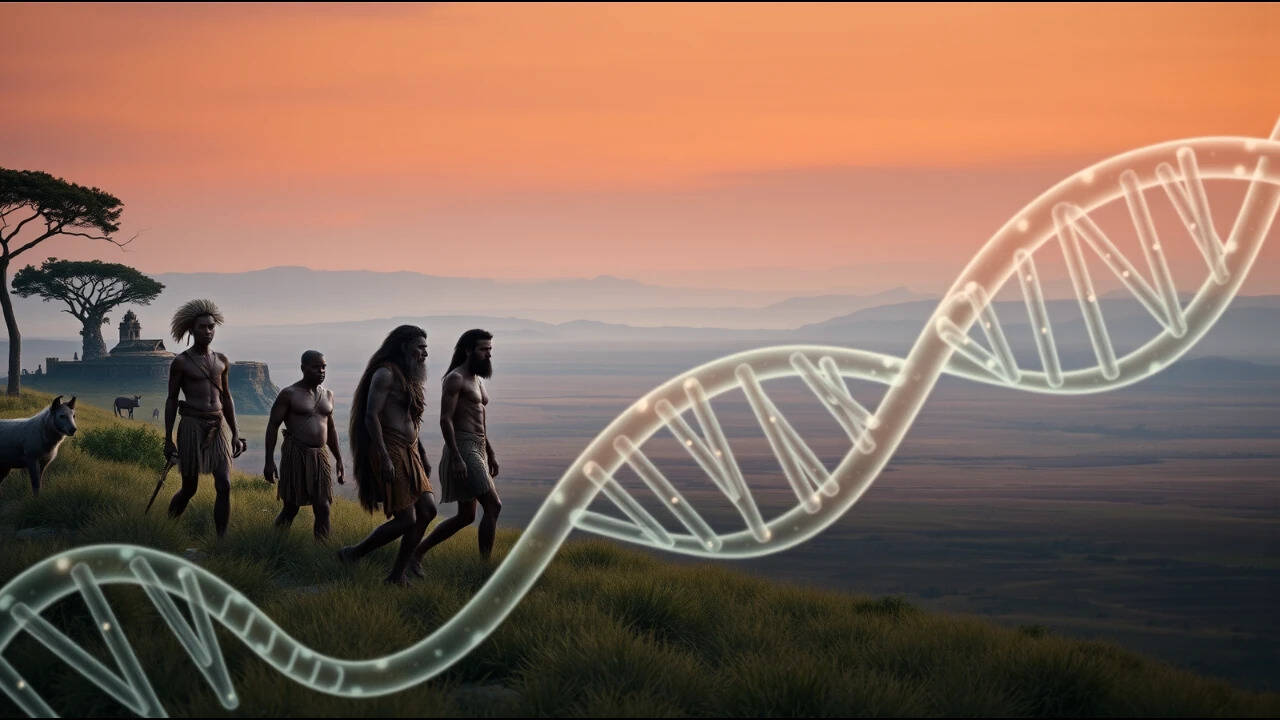
Your genome isn't just a simple instruction manual. It's an ancient archaeological dig site. For years, scientists assumed human history was a neat, linear tree. We were wrong. Modern genomes contain genetic ghosts. We share space with two ghost lineages that left their DNA inside our chromosomes long before our ancestors walked out of Africa.
Stop thinking of human evolution as a straightforward march from apes to us. It was a messy, chaotic series of interbreeding events between different hominin populations. When geneticists look closely at modern DNA, they find statistical anomalies. Pieces of code don't match Neanderthals or Denisovans. They belong to completely unknown hominin branches that science hasn't officially named yet.
The Problem with the Out of Africa Story
For decades, anthropology textbooks taught a simple narrative. Homo sapiens evolved in Africa, packed their bags, and replaced every other archaic human they bumped into without mixing. That clean story died the moment genetic sequencing became cheap enough to check real DNA.
Neanderthal ancestry showed up in non-African populations first. Then Denisovan DNA turned up thick in Oceania and parts of Asia. Now, computational biologists are pulling apart the remaining stray signals. They are finding stretches of genetic material that belong to archaic humans who branched off hundreds of thousands of years earlier.
Think about what this means for a second. We didn't just conquer the globe by ourselves. We survived and populated the planet by absorbing our cousins.
Finding Ghosts in the Machine
How do you find a human species that left zero fossils? You look at statistical shadows.
Researchers built complex demographic models to analyze patterns of genetic variation in living populations. When a chunk of DNA from an extinct group integrates into a modern genome, it looks different from the surrounding sequence. Over thousands of years, recombination breaks these segments down. By measuring the length and frequency of these archaic fragments, algorithms can estimate when the interbreeding happened and how distant the ghost population was.
One of these ghost lineages likely split from our ancestors around 300,000 years ago. Another left its mark primarily in African populations, suggesting that ancient interbreeding happened on the continent long before the major migrations.
Why the Fossil Record is Lying to You
Fossils are rare. Flesh and bone rot, acidic soils destroy teeth, and entire continents remain undersampled by paleontologists.
If you relied solely on bones sitting in museum drawers, you would think human history was thoroughly mapped out. You would be wrong. Central Africa and tropical Asia are terrible at preserving DNA and bones. Most of what we know about human origins comes from cold European caves or high-altitude Siberian sites like Denisova Cave.
DNA acts as a ghost detector. It tells us who was actually hanging out and mating, even if they never left behind a single skull or stone tool.
What These Lost Lineages Gave Us
Interbreeding wasn't just a quirky footnote in human history. It shaped our survival.
When modern humans migrated into new environments, they faced pathogens, high altitudes, and changing climates they weren't adapted to. Instead of waiting millions of years for random mutations to save us, our ancestors cheated. They picked up ready-made survival kits through mating with archaic populations who had lived in those regions for millennia.
- Neanderthal alleles helped boost our immune systems against Eurasian viruses.
- Denisovan genes allowed modern Tibetans to thrive in thin, high-altitude air.
- Ghost lineages likely contributed immune system defenses and metabolic tweaks we are only beginning to understand.
Evolution is practical. It takes whatever works. Our ancestors stole survival tools from every hominin they crossed paths with.
Moving Past Linear Evolution
The obsession with finding a single "missing link" is dead. There was never a single chain. There was a braided stream of populations that split, wandered off, met up again, and swapped genes before merging into the tapestry of modern humanity.
Every time a new algorithm scans a human genome, the tree looks more like a bush tangled in barbed wire. We carry the echoes of extinct populations in every cell of our bodies.
Check your own assumptions about human uniqueness. We are walking museums of ancient biodiversity, shaped by species that time tried to erase.