The efficacy of a British State Visit is contingent upon the alignment of institutional inertia and executive intent. When these two forces diverge—as they do in the current structural relationship between the United Kingdom’s constitutional monarchy and a second Trump administration—the ceremonial "soft power" of the Crown encounters a hard limit. The assumption that the prestige of a King Charles III visit can "salvage" or even fundamentally pivot UK-US relations ignores the shift from a consensus-based Atlanticism to a transactional, populist bilateralism. This visit will likely result in high-value optical assets (photographs and ceremonial footage) but will fail to mitigate the structural stressors of trade tariffs, defense spending pressures, and divergent geopolitical priorities.
The Decoupling of Soft Power and Policy Outcomes
Traditional British diplomacy operates on the "Prestige-Influence Hypothesis," which suggests that providing a high-status platform for a foreign leader builds personal rapport that translates into policy concessions. This model is outdated. The current US executive branch prioritizes Tangible Reciprocity over Symbolic Affinity.
The mechanics of this failure can be mapped across three distinct frictions:
- Protocol Rigidity vs. Policy Fluidity: The British monarchy is governed by strict neutrality and long-term continuity. In contrast, the Trump administration’s foreign policy is characterized by disruption and rapid re-negotiation. The King cannot negotiate trade terms; he can only provide the environment for them. If the underlying economic incentives (such as the UK’s stance on digital services taxes or agricultural standards) remain static, the environment provided by the Palace becomes a sunk cost.
- The Transactional Barrier: The "Special Relationship" has historically relied on shared intelligence and defense integration. However, the current "America First" doctrine treats these as commodities rather than commitments. A royal dinner does not alter the cost-benefit analysis of a 10% or 20% universal baseline tariff.
- Ideological Incongruence: King Charles III’s lifelong advocacy for environmental sustainability and global climate frameworks (the "Terra Carta" initiative) creates a fundamental friction with an administration that has historically prioritized fossil fuel expansion and withdrawn from the Paris Agreement. This creates a risk where the host’s core messaging actively contradicts the guest’s core policy, neutralizing the "warmth" the visit is intended to generate.
The Strategic Constraints of Constitutional Monarchy
To understand why the King is a blunt instrument in this specific scenario, one must analyze the Constitutional Bottleneck. The King acts on the advice of his Government (the Foreign, Commonwealth & Development Office). This means the King is a messenger without the power to adjust the message.
- The Credibility Gap: If the UK government remains aligned with European regulatory standards or maintains a specific stance on China that differs from Washington’s, the King’s hospitality is perceived not as a bridge, but as a distraction.
- The Optics of Asymmetry: A State Visit is the highest honor the UK can bestow. Deploying it early in a term suggests a position of diplomatic "demand" rather than "supply." In a transactional framework, the party that initiates the high-value gesture early often loses leverage in subsequent negotiations.
The Economic Reality: Tariffs and Trade Blocks
The primary friction point in the upcoming UK-US cycle is the threat of universal tariffs. The UK’s economic health is tied to its service exports and specialized manufacturing, both of which are highly sensitive to US protectionism.
The logic that a royal visit could secure a "carve-out" or a Free Trade Agreement (FTA) fails to account for the Section 232 and Section 301 frameworks of US trade law. These are legislative and executive tools that respond to trade deficits and perceived unfair practices. The US Trade Representative (USTR) operates on data-driven metrics of domestic industry protection, not the sentimentality of the Windsor lineage.
The UK’s refusal to align with US demands on food standards (chlorinated chicken and hormone-treated beef) remains the "poison pill" of any FTA. Since the King cannot concede on food standards—a power held by Parliament and influenced by a sensitive domestic farming lobby—the State Visit becomes a high-cost exercise in avoiding the actual elephant in the room.
Defense Spending and the NATO Variable
The UK currently spends roughly 2.3% of its GDP on defense, with a roadmap to reach 2.5%. While this exceeds the NATO 2% minimum, it may not satisfy an administration that views the 2% floor as a "failed metric" and instead looks at the total contribution relative to the US burden.
The State Visit serves as a reminder of the UK’s role as a "Tier 1" ally, but this status is being devalued by the shift toward the Indo-Pacific. The UK’s "tilt" to the Indo-Pacific, evidenced by AUKUS, is the only area where structural alignment exists. However, AUKUS is a bureaucratic and military-industrial pact; it does not require, nor is it significantly accelerated by, the pomp of a State Visit.
The Risk of Domestic Polarization
A State Visit by a polarizing US President forces the British government into a defensive posture domestically. The "Cost of Diplomacy" here is not just financial, but political capital.
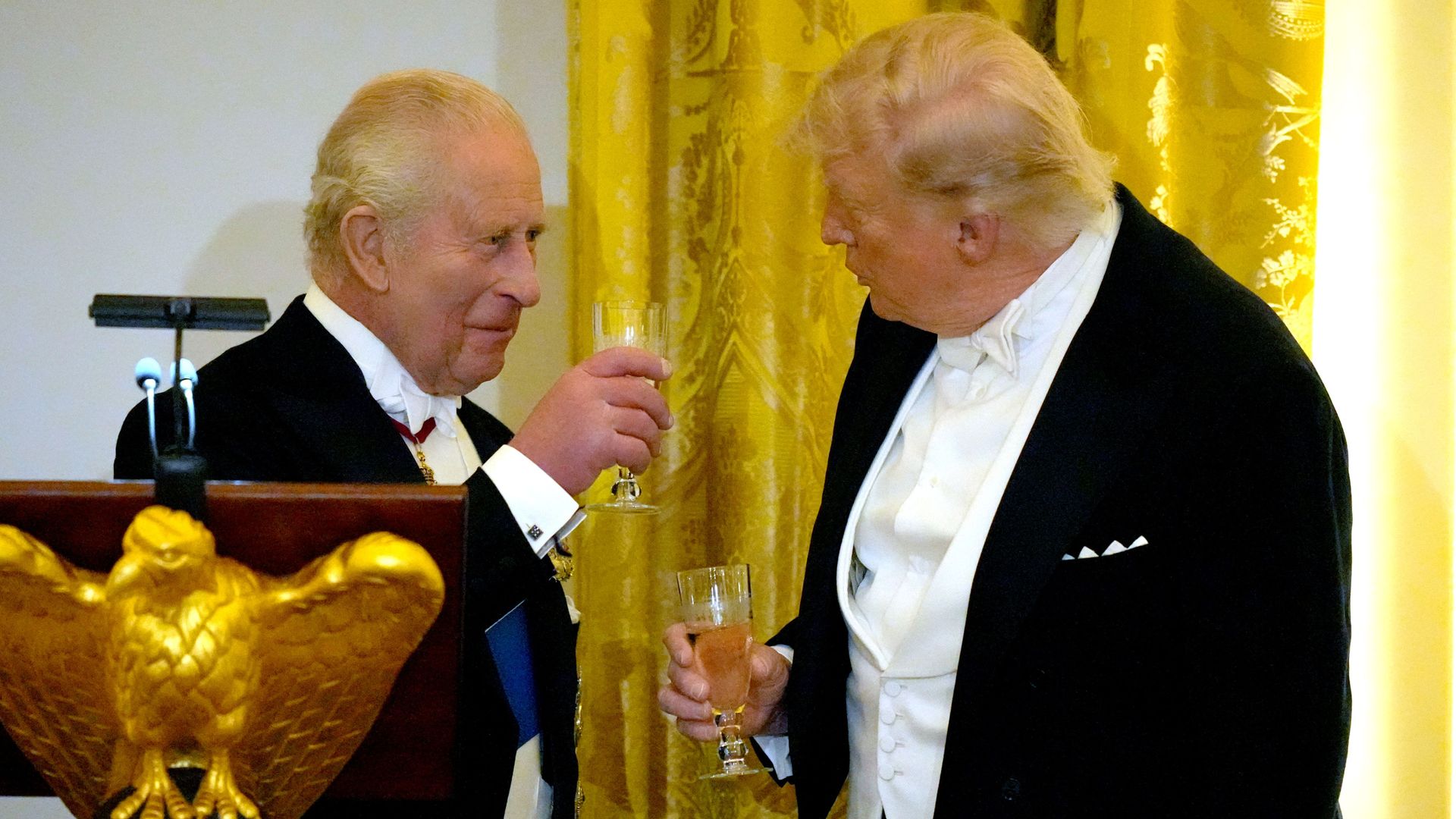
- Public Dissent: Massive protests are a statistical certainty. This creates a visual dichotomy: the King and the President in a gold carriage, surrounded by police cordons and protestors. Instead of projecting "stability" and "unity," the visit projects "estrangement" and "tension."
- The Parliament Factor: The Speaker of the House of Commons and the various party leaders have the power to deny or complicate an address to both Houses of Parliament. If the King’s guest is denied the Westminster platform, the visit is truncated, signaling a fractured British state.
The Predictive Modeling of Diplomatic Utility
If we quantify the utility of the visit ($U$) as a function of Policy Concessions ($P$), Economic Gain ($E$), and Domestic Stability ($S$), minus the Political Cost ($C$), the equation for this specific visit trends toward zero or negative:
$$U = (P + E + S) - C$$
Where:
- $P$ is low because the King cannot negotiate.
- $E$ is low because trade barriers are structural, not personal.
- $S$ is low due to inevitable domestic protests.
- $C$ is high due to the potential alienation of European allies who view the UK’s "courting" of Trump as a betrayal of continental security interests.
Strategic Redirection: What Actually Moves the Needle
If the objective is to secure the UK’s position in a shifting global order, the reliance on the Monarchy is a misallocation of resources. The "Special Relationship" requires a Technocratic Realignment rather than a Symbolic Reaffirmation.
- Sub-National Diplomacy: Engaging with US Governors and state legislatures to secure state-level trade memorandums (MoUs), which bypass the gridlock of Washington and the volatility of the White House.
- Industrial Integration: Focusing on the "interoperability" of the UK and US defense-industrial bases (DIB). This is a language the current administration understands: jobs, manufacturing, and shared technological dominance.
- Security Burden Sharing: Moving beyond the 2% GDP metric to provide specific, high-value capabilities in the North Atlantic and the High North, areas where the US wants to reduce its footprint.
The British government must treat the State Visit as a ceremonial checkbox rather than a strategic pivot. The King provides the "theatre of state," but the actual "statecraft" must happen in the windowless rooms of the Treasury and the Ministry of Defence, where the variables are numbers, not titles. The King’s visit cannot salvage a relationship that is being fundamentally redefined by the death of the post-Cold War consensus.
The UK should proceed with the visit to avoid the slight of a "non-invitation," but it must simultaneously harden its economic defenses. This involves diversifying trade dependencies toward the CPTPP and maintaining a pragmatic, "cold-eyed" relationship with the EU. The era where a royal smile could grease the wheels of a trade deal is over; the new era is one of hard-coded interests and ruthless prioritization. The strategic play is to use the visit to satisfy the ego of the executive while offering zero substantive concessions on British sovereign interests, effectively using the Monarchy as a shield for a more protectionist and self-interested UK foreign policy.