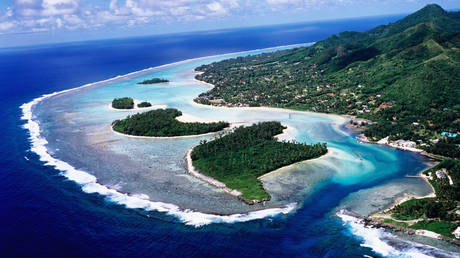
The water in the South Pacific does not just look blue. It looks heavy. When you stare out past the reef from the edge of Rarotonga, the ocean drops away into an absolute, midnight blackness that swallows light and history whole. For generations, that darkness was just a mystery, a sacred expanse the ancestors navigated by reading the stars.
Now, men in dark suits from Washington and Beijing look at that exact same darkness and see a periodic table.
They see manganese. They see cobalt. They see nickel and copper. Millions of tons of it, sitting five thousand meters below the surface, resting quietly on the seabed like cobblestones on an ancient, forgotten highway. These are the stones that civilized society needs to build batteries, smartphones, and electric vehicles. They are the hidden mechanics of the green transition. And suddenly, the Cook Islands—a nation with a population smaller than a crowded football stadium—finds itself sitting on the most valuable real estate on earth.
A new American diplomat arrives in the region with clear marching orders. The mandate is straightforward: secure those stones before someone else does. To the policymakers in Washington, this is a matter of national security, a race to ensure the supply chains of tomorrow do not belong entirely to geopolitical rivals. But on the ground, where the salt air corrodes even the toughest steel, the equation looks entirely different.
The Weight of Five Thousand Meters
Consider Papa Aron. He is a hypothetical composite of the men who have fished these waters for forty years, but his anxieties are entirely real. He sits on a wooden crate near the harbor, repairing a net with hands that look like driftwood. If you ask him about the critical minerals that have brought American envoys to his doorstep, he does not talk about geopolitical dominance or the stock price of electric car manufacturers. He talks about the mud.
"When you stir up the bottom of a bucket," he says, squinting out toward the horizon, "the water stays cloudy for a long time. Now imagine a bucket that is five kilometers deep."
The technical term for what lies down there is polymetallic nodules. Over millions of years, metals dissolved in seawater slowly collected around tiny fragments of shell or shark teeth, growing at a rate of just a few millimeters every million years. They are quiet, dark, and old. To harvest them, massive mining ships must lower heavy tracked vehicles to the ocean floor, vacuum up the rocks, separate them from the sediment, and pump the slurry back to the surface.
The companies backing these ventures promise that the process is cleaner than tearing down a rainforest in Indonesia or digging an open-pit mine in the Congo. They point to the lack of human communities on the seabed. There are no villages to displace five thousand meters down. There are no rivers to poison.
But the uncertainty is what keeps people awake in the quiet Pacific nights. Marine scientists admit that we know less about the deep ocean floor than we do about the surface of Mars. The ecosystems down there operate in slow motion. The organisms that live among the nodules have evolved in an environment where nothing changes for millennia. A single plume of displaced sediment, drifted along by deep-ocean currents, could smother life across hundreds of square miles.
The American strategy relies on convincing the Cook Islands that Western partnership offers a safer, more transparent path to exploiting these resources than the alternatives. It is a sales pitch wrapped in the language of environmental stewardship and shared democratic values. But it is a sales pitch nonetheless.
The Envoy and the Island
When a world superpower sends a high-level representative to a small island nation, the air changes. The meetings happen in air-conditioned rooms where the colonial-era architecture meets modern security protocols. The language used is polished, precise, and clinical.
The envoy talks about building resilient supply chains. They talk about strategic partnerships and economic diversification. They acknowledge the sovereignty of the Cook Islands, nodding politely as local leaders speak of their cultural obligation to protect the Moana—the ocean that defines their existence.
Yet, beneath the diplomatic courtesies lies a intense urgency. The United States realized late that it had fallen behind in the race for the materials that will power the next century. For years, Western nations watched as other global powers quietly secured mining rights, built processing plants, and formed alliances across the global south. Now, Washington is playing catch-up, and the Cook Islands' Exclusive Economic Zone represents a massive, untapped reserve.
The irony is thick enough to choke on. The nations most vulnerable to rising sea levels caused by carbon emissions are now being asked to sacrifice their ocean floors to provide the materials that will theoretically stop those emissions. It is a cruel bargain.
The local government faces an agonizing choice. The revenue from deep-sea mining could fund schools, modernize hospitals, build coastal defenses against violent storms, and secure the financial independence of the nation for generations. Without it, the economy remains dangerously dependent on tourism—a fickle industry that can vanish overnight, as it did during the global lockdowns of the early 2020s.
"We are tired of being poor people sitting on a gold mine," a local pro-mining advocate might tell you over a cup of coffee in Avarua. "Everyone wants us to preserve the ocean for the good of the planet, but the planet isn't paying our medical bills."
The View from the Reef
To understand the true stakes, you have to leave the diplomatic offices and stand where the waves break against the coral. The reef is a living barrier that protects the islands from the raw, crushing power of the open ocean. It is loud. The sound of the Pacific hitting the coral is a constant, low-frequency rumble that forms the background track to daily life.
The ocean here is not just a resource; it is an extension of the self. In the traditional worldview, the sea is a highway that connects islands, not a void that separates them. Every fish caught, every current read, is part of a living memory.
When foreign corporations arrive with promises of minimal impact and high-tech monitoring, they are asking for trust that has rarely been earned in the history of the Pacific. From the nuclear testing in Bikini Atoll to the phosphate mining that left Nauru a hollowed-out shell, the region is scarred by the promises of distant superpowers who needed something from the islands and left nothing but ruin behind.
The current diplomatic push tries to break that pattern by offering genuine partnership. The United States promises to invest in local scientific capacity, to ensure that the Cook Islands have the tools to monitor their own waters, and to guarantee that the financial rewards remain in the hands of the people. It sounds different this time. The language is humbler.
But the machine of global industry has its own momentum. Once the contracts are signed and the massive mining vessels drop their anchors, the power dynamic shifts inevitably toward the people who hold the capital.
The real question is whether any nation, no matter how cautious or culturally grounded, can control a gold rush once it begins. The demand for these minerals is not going to drop. Every time someone buys a new device or plugs in an electric car, the pressure on the deep ocean increases by a fraction of a millimeter.
The Unseen Horizon
The diplomatic cars eventually drive back to the airport. The envoy flies away to report back to Washington, leaving behind a trail of press releases and signed memoranda of understanding. The island returns to its natural rhythm, the heat settling over the tarmac as the sound of the waves reclaims the air.
The decision now rests with the people of the Cook Islands and their leaders. They are balancing the immediate, tangible needs of their children against a profound duty to an ecosystem they cannot see, floating miles beneath the waves.
This is not a simple story of corporate greed versus pristine nature, nor is it a straightforward tale of geopolitical triumph. It is a tragedy of necessity. The world needs the stones to save itself from its own sky, and a small community in the middle of the vastest ocean on earth must decide how much of their deep, silent world they are willing to give away to pay for it.
Papa Aron rolls up his net. The sun is setting, turning the heavy water from blue to a dark, bruised purple. He looks at the horizon where the mining ships may one day sit, silhouetted against the fading light. The ocean has survived everything else humanity has thrown at it over the millennia, but it has never had to face a world that needs it this badly.