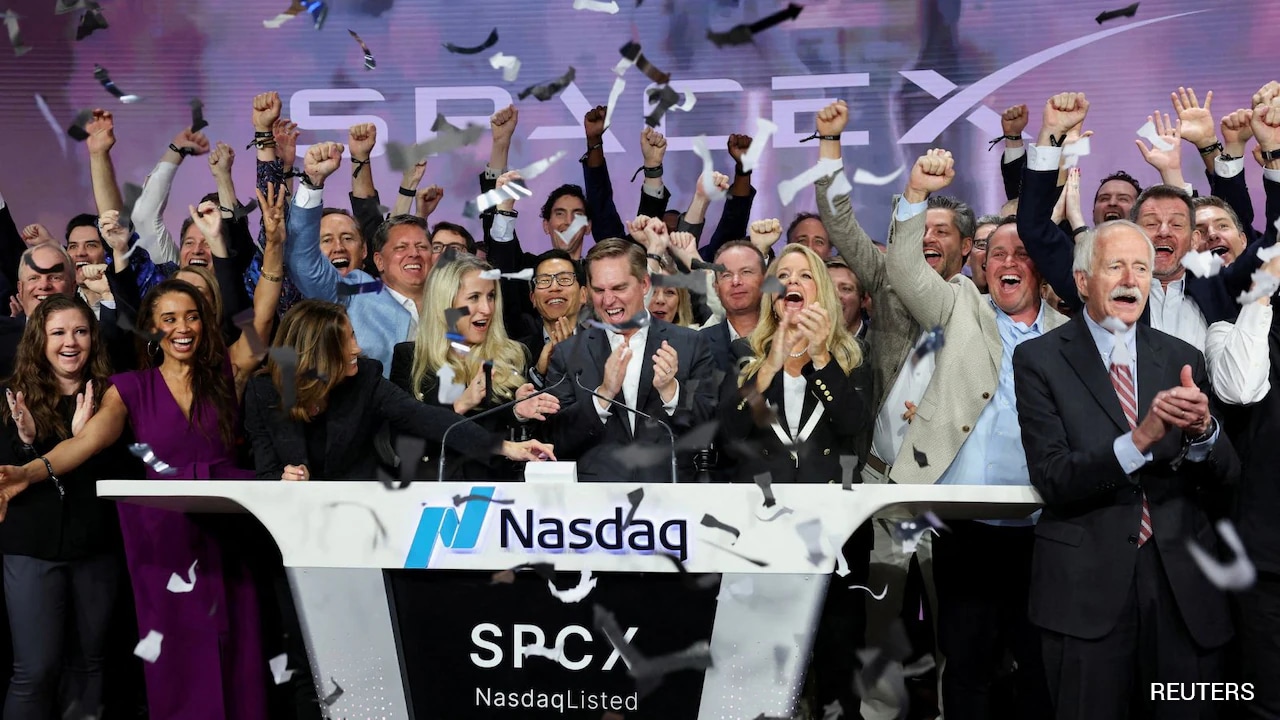
The transition from the "Magnificent Seven" to "MANGOS" (Meta, Anthropic, Nvidia, Google, OpenAI, SpaceX) marks a structural shift in equity valuation frameworks, moving from consumer attention monetization to capital-intensive intelligence and infrastructure. Institutional portfolios face a dual disruption: the sudden public listing of asset-heavy megastructures like SpaceX at a $2 trillion valuation, and the immediate necessity to value pre-revenue or heavily loss-making foundational AI firms within standard public indices. Evaluating this transition requires discarding superficial acronyms and mapping the capital constraints, index tracking mechanics, and operational dependencies that dictate how these six entities interact.
The core vulnerability of previous market shorthand, such as FAANG or the Magnificent Seven, was the assumption of structural permanence based on trailing cash flows. MANGOS introduces a different financial profile: a basket split between cash-generative legacy digital monopolies and deeply unprofitable, capital-intensive infrastructure firms. Analyzing this basket requires isolating the specific microeconomic mechanisms driving each asset class and identifying the hidden operational choke points within the group.
The Bifurcated Economics of the Basket
The MANGOS framework binds six companies with fundamentally incompatible cost functions and capital structures. To evaluate their collective market impact, they must be divided into two distinct operational classes: Cash Engines and Capital Sinks.
+-------------------------------------------------------------------------+
|                           THE MANGOS BASKET                             |
+-------------------------------------------------+-----------------------+
| CASH ENGINES                                    | CAPITAL SINKS         |
| (Meta, Google, Nvidia)                          | (OpenAI, Anthropic,   |
|                                                 |  SpaceX)              |
+-------------------------------------------------+-----------------------+
| • High Free Cash Flow Generation                | • Substantial CapEx   |
| • High Operating Margins                        |   Requirements        |
| • Subsidize Ecosystem via Compute Procurement   | • Historically        |
|   and Cloud Infrastructure                      |   Loss-Making         |
+-------------------------------------------------+-----------------------+
The Cash Engines: Meta, Alphabet, Nvidia
These three entities serve as the liquidity foundations of the modern equity market. Meta and Alphabet generate massive free cash flow through high-margin, ad-supported digital monopolies. Nvidia operates as the primary capital extractor of the current cycle, turning the capital expenditure of every other tech giant into gross margins exceeding 75%. Their inclusion in the bundle is justified by their role as liquidity providers and foundational compute hosts.
The Capital Sinks: OpenAI, Anthropic, SpaceX
The remaining three firms represent a departure from historical tech-monopoly profiles at the time of index inclusion. OpenAI and Anthropic operate with structural cost imbalances where the marginal cost of compute and model training routinely matches or outpaces early enterprise subscription revenues. SpaceX, despite its $2 trillion market debut, entered the public arena after posting a net loss of $4.94 billion in 2025.
The financial relationship between these two groups is entirely circular. Meta and Alphabet consume Nvidia hardware to deploy AI systems. OpenAI and Anthropic secure billions in capital to procure compute capacity from hyper-scalers, which in turn flows back to Nvidia. SpaceX acts as the physical layer, deploying the orbital infrastructure (Starlink) essential for edge compute and global data distribution.
Index Inclusion Mechanics and Free-Float Anomalies
The primary error in assuming MANGOS will immediately replicate the index dominance of the Magnificent Seven lies in a misunderstanding of float-adjusted capitalization rules. Wall Street indices like the S&P 500 and the Nasdaq 100 do not weigh companies based on headline valuation; they weigh them based on the dollar value of shares available for public trading.
- The S&P 500 Profitability Rule: Standard & Poor’s requires a company to show cumulative profitability over the most recent four quarters, alongside a positive reading in the most recent quarter, for index consideration. Because SpaceX entered the public markets carrying multi-billion dollar net losses, it is structurally excluded from the S&P 500 indefinitely. Passive exchange-traded funds (ETFs) tracking the S&P 500 cannot purchase the stock, preventing the automatic institutional capital inflows that fueled the Magnificent Seven.
- The Nasdaq 100 Fast-Track Protocol: Unlike the S&P, the Nasdaq exchange accommodates early-stage, capital-intensive firms by permitting fast-track inclusion based on market capitalization, regardless of near-term earnings parameters. Nasdaq 100 tracking funds are required to purchase SpaceX shares upon its index debut, creating an immediate divergence in performance between the two major tracking indices.
- The Free-Float Bottleneck: SpaceX debuted with an initial public float estimated at just 5% of its total equity, with the remaining 95% closely held by insiders, founders, and private equity vehicles. Similarly, early public structures for OpenAI and Anthropic point to restricted initial floats to prevent extreme retail volatility.
This creates a severe structural bottleneck. A company valued at $2 trillion with a 5% free float impacts a float-adjusted index exactly like a $100 billion company with a 100% free float. The index weight is suppressed. Institutional capital cannot achieve meaningful beta exposure to these names through passive vehicles, forcing a reliance on active, high-turnover thematic funds.
Strategic Counter-Dependencies within MANGOS
The MANGOS framework is not a harmonious ecosystem; it contains deep, structurally antagonistic dependencies that threaten to cannibalize the margins of its own members. The most critical point of friction lies between the foundational model developers and the compute/infrastructure providers.
The Compute Arbitrage Trap
OpenAI and Anthropic are structurally dependent on the hardware cycles of Nvidia and the cloud infrastructures of Alphabet and Microsoft (the latter notably absent from the MANGOS acronym but deeply embedded in its operational reality). The cost function for a foundational model developer is defined by the following relation:
$$C_{\text{total}} = C_{\text{training}} + C_{\text{inference}}$$
As model parameters scale, $C_{\text{training}}$ increases non-linearly. Simultaneously, $C_{\text{inference}}$ scales linearly with user adoption. Because neither OpenAI nor Anthropic owns semiconductor fabrication facilities or proprietary energy grids, they operate at the mercy of Nvidia’s pricing power. Meta and Alphabet can subsidize their internal AI development through core digital advertising revenue. OpenAI and Anthropic possess no such internal subsidy, making their long-term margin profiles highly volatile.
The Starlink and Hyperscaler Collision Course
SpaceX's Starlink network represents the physical transport layer for the next iteration of cloud architecture. By providing low-Earth orbit (LEO) high-bandwidth connectivity, Starlink bypasses terrestrial telecom monopolies. However, as edge computing demands rise, SpaceX faces an operational crossroad. It must either partner with Alphabet and Meta to host containerized data centers at Starlink ground stations, or build competing sovereign infrastructure.
If SpaceX chooses to develop independent edge-compute facilities powered by proprietary energy solutions, it transforms from an infrastructure partner into a direct capital competitor to Alphabet and Meta for enterprise data workloads.
Portfolio Risks and Asset Allocation Strategy
For institutional allocators, treating MANGOS as a unified asset class introduces unacceptable structural risk. The group displays an uncharacteristic level of concentration risk combined with unhedged operational variables.
+-------------------------------------------------------------------------+
|                       MANGOS RISK EXPOSURE MATRIX                       |
+-------------------+--------------------+--------------------------------+
| COMPANY           | PRIMARY RISK SPEC  | INSTITUTIONAL MITIGATION PATH  |
+-------------------+--------------------+--------------------------------+
| Meta / Alphabet   | Ad-Spend Cycle /   | Shift allocation to traditional|
|                   | Regulatory Antitrust| value defensive sectors during |
|                   |                    | macro downturns.               |
+-------------------+--------------------+--------------------------------+
| Nvidia            | CapEx Digestion    | Utilize options overlays; limit|
|                   | Phase              | absolute exposure to 8% of tech|
|                   |                    | book.                          |
+-------------------+--------------------+--------------------------------+
| OpenAI /          | Model Commodity-   | Access via private secondary   |
| Anthropic         | ization / Churn    | markets or convert to direct   |
|                   |                    | hyper-scaler equity.           |
+-------------------+--------------------+--------------------------------+
| SpaceX            | Free-Float         | Direct long-term sovereign/    |
|                   | Illiquidity        | endowment mandate; bypass      |
|                   |                    | passive indices.               |
+-------------------+--------------------+--------------------------------+
The primary tactical play requires separating portfolio exposure into two distinct sleeves:
- The Free Cash Flow Sleeve: Retain concentrated positions in Nvidia, Alphabet, and Meta to capture the immediate capital deployment of the AI investment cycle. These positions should be weighted according to standard float-adjusted metrics, using options overlays to mitigate the inevitable CapEx digestion phase when hyper-scalers slow hardware procurement.
- The Frontier Venture Sleeve: Allocate to SpaceX, OpenAI, and Anthropic strictly through active capital vehicles that account for low-float volatility and index exclusion. Institutional capital must price these assets not as stable public equities, but as highly liquid, late-stage venture positions with long-duration capital return profiles.
The immediate tactical requirement for risk managers is to monitor the Nasdaq 100 rebalancing schedules. As SpaceX, OpenAI, and Anthropic enter the index via fast-track protocols, passive tracking funds will be forced to sell down existing mega-cap tech positions to clear capital space for the new inclusions. This creates predictable downward pressure on older tech tranches, offering a structural entry point for active managers seeking to reweight their core technology holdings.