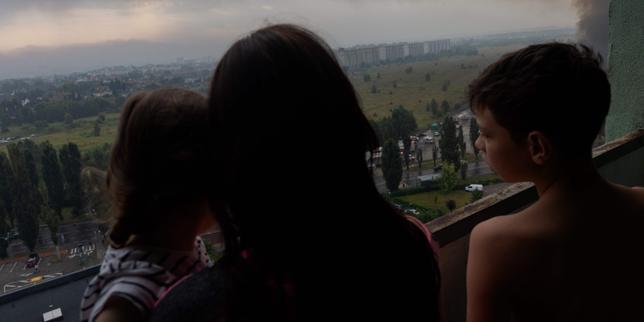
The kitchen clock does not tick anymore. It hums, then sighs, then falls into a final, heavy silence that feels heavier than the plaster falling from the ceiling.
Outside, the air smells of frozen iron and old smoke. It is late evening in the Dnipropetrovsk oblast, a region of Ukraine where steel mills once breathed fire and sunflower fields stretched out like golden oceans. Now, the horizon is a bruised purple, punctuated by the jagged silhouettes of shattered transformers and twisted high-voltage pylons. More than 120,000 households are currently swallowed by an abrupt, brutal blackout.
No switch flickers. No refrigerator hums. Just the quiet scrape of a match against a matchbox.
Consider Maria, a hypothetical resident whose daily reality mirrors thousands of real families enduring these targeted Russian assaults. She strikes a sulfur match, lighting a single yellow stub of paraffin wax on her kitchen table. The flame struggles against the draft leaking through windowpanes taped in thick, protective crosses. Her breath fogs in the air. In a matter of minutes, the temperature inside the apartment begins its relentless descent toward the freezing outdoor reality.
This is not merely a loss of convenience. Modern life relies on an invisible, humming nervous system of electrons. When that system is severed by incoming munitions, the consequences cascade through every layer of human survival.
Water pumps stop. Without electricity, municipal supply lines fail, leaving apartment buildings silent and dry. Elevators freeze mid-shaft. Hospitals rely on roaring diesel generators, praying the fuel reserves hold out against the next air raid siren.
The Anatomy of Winter Warfare
Strategy in modern conflict has evolved beyond the front-line trenches. It reaches deep into the living rooms, maternity wards, and basements of civilian centers. By systematically targeting electrical substations in industrial hubs like Dnipropetrovsk, the objective shifts from tactical military engagement to a war of attrition waged against human endurance.
Darkness is a weapon.
When the power grid fails, communication stutters. Cell towers run on backup batteries that have a finite lifespan, ticking down like a digital hourglass. Families separated across towns lose the ability to send a simple, reassuring text: I am alive. Anxiety fills the vacuum left by the dead screens.
Yet, within this manufactured gloom, human resilience asserts itself in small, stubborn ways.
Down the hallway, neighbors gather in a ground-floor corridor. Someone has dragged out a camp stove powered by a small propane canister. A communal pot of water begins to heat, hissing softly. They share stories, tea poured from a battered thermos, and the quiet comfort of shared body heat. The cold is immense, but solidarity is a stubborn warmth.
The Cost Beyond the Numbers
Statistics strip human suffering down to neat, digestible digits. One hundred and twenty thousand. It sounds abstract. A metric on a nightly news ticker.
Look closer.
Each number is a kitchen where a child tries to finish homework by candlelight. Each number is an elderly diabetic whose insulin requires refrigeration. Each number is a baker trying to knead dough in the freezing dark, knowing that tomorrow morning, the neighborhood will need bread.
The infrastructure of Dnipropetrovsk was built by generations of hands—welded, wired, and maintained through decades of peace and hardship. To watch it bloom into sparks and black smoke under the weight of an artillery barrage is to watch history violently unravel.
Repair crews wait just beyond the perimeter, shivering in heavy coats, drinking instant coffee from paper cups. They know the rhythm by now. The strike hits. The power dies. The sirens wail a warning to stay clear. And then, the moment the all-clear sounds, they move in with cranes, cables, and copper wire to stitch the bleeding grid back together.
They work in the freezing dark, guided by flashlights strapped to their foreheads, hunting for breaks in the line like surgeons operating in a blackout.
The flame on Maria’s candle flickers, melting down toward her fingers. Outside, the distant, low thud of an anti-air defense system reminds everyone that the night is far from over. But somewhere down the street, a spark flies from a welder's torch as the repair teams fight to bring the light back home.