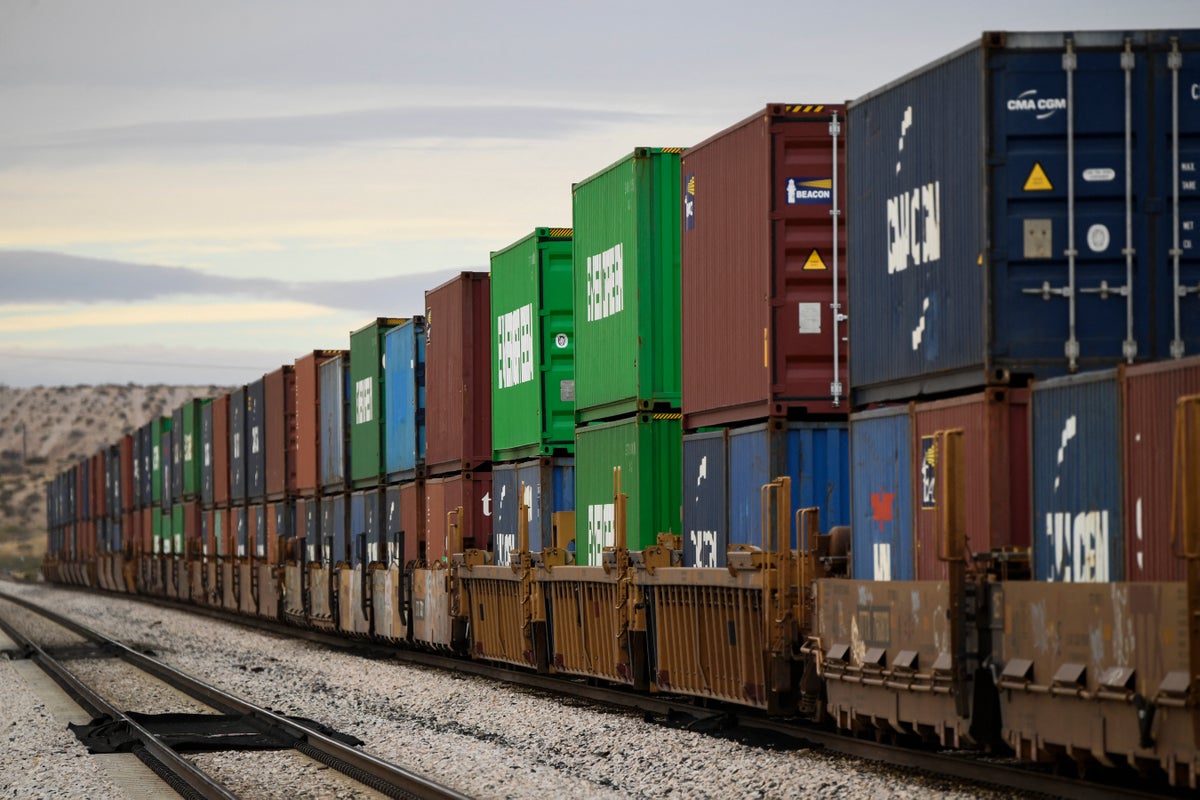
Federal regulatory pressure targeting cross-border rail operations establishes a direct operational constraint on how Class I freight carriers manage international logistics. The Federal Railroad Administration policy enforcement, spearheaded by the Department of Transportation, mandates strict English language proficiency for Mexican train crews operating across the southern international boundary. Deconstructing this regulatory intervention requires analyzing the operational friction it introduces to supply chains, the safety calculus governing hazardous material transit, and the labor market dynamics influencing network velocity.
The Operational Architecture of Cross Border Interchanges
To understand the friction introduced by the new regulatory enforcement, one must map the physical transfer points utilized by primary carriers such as Union Pacific and Canadian Pacific Kansas City. Historically, interchange protocols required border handoffs where domestic crews assumed control immediately upon crossing. To mitigate smuggling risks and reduce congestion at ports of entry, operational agreements permitted inbound Mexican crews to guide trains up to ten miles past the border into specific domestic railyards, such as Laredo and Eagle Pass.
This practice minimized dwell times and secured cargo against contraband incursions during initial processing. However, it introduced a structural dependency on cross-border personnel who must interpret fast-changing General Track Bulletins, coordinate with regional dispatchers, and manage documentation for hazardous materials.
The regulatory intervention targets this exact juncture by identifying three primary failure points observed during Federal Railroad Administration inspections:
- Comprehension Deficits: Inbound crews exhibiting difficulties interpreting transient track restriction notices.
- Documentation Discrepancies: Inconsistent data mapping between electronic consists and physical cargo manifests for hazardous substances.
- Communication Failures: An inability to establish real-time linguistic synchronization with domestic emergency responders and signal dispatchers during crisis simulations or routine queries.
The Cost Function of Regulatory Compliance
Implementing strict language proficiency standards shifts the economic equation for network operators. Rail networks optimize for velocity, asset utilization, and minimized crew hours per gross ton-mile. When regulatory agencies enforce hard compliance boundaries, the operational cost function reacts in predictable ways.
Carrier management faces two distinct operational pathways to maintain network throughput under the new framework. The first involves certification and training pipelines designed to bring foreign crews up to statutory language standards. This approach incurs direct administrative overhead and extended training cycles. The second pathway involves structural reversion to traditional border handoffs, forcing carriers to station domestic standby crews directly at the perimeter.
Reverting to strict perimeter handoffs degrades network velocity. Domestic crews must absorb the incoming train sets precisely at the border interface, creating localized terminal bottlenecks. These bottlenecks ripple backward into industrial sidings across Mexico, slowing equipment turnaround and diminishing asset productivity for multi-modal shippers.
Labor Dynamics and Union Alignment
The policy alignment between the federal administration and major rail labor organizations, including the Brotherhood of Locomotive Engineers and Trainmen and SMART-TD, highlights an underlying structural protectionism. Labor groups have consistently flagged cross-border crew utilization as a pressure point on domestic employment metrics and security oversight.
From an economic perspective, labor unions operate to restrict the elasticity of the labor supply curve. By enforcing domestic language requirements as a non-negotiable safety criterion, the regulatory framework structurally limits the ability of Class I carriers to substitute lower-cost foreign labor for domestic operating hours within the ten-mile operational zone. This creates a permanent floor for domestic crew utilization at border-adjacent terminals.
Simultaneously, the regulatory package targets auxiliary operational practices, such as restricting the use of automated throttle systems during engineer certification tests. This dual focus on technical competency and linguistic capability shifts the evaluation matrix from passive supervision of automated systems to demonstrated, active control under degraded operational states.
Supply Chain Vulnerability and Strategic Adaptation
Logistics networks operating across regulated international boundaries must absorb the friction of compliance without compromising network integrity. The imposition of strict enforcement mechanisms forces a structural re-evaluation of risk allocation between carriers, shippers, and regulatory oversight bodies.
Carriers must restructure their interchange protocols to eliminate discrepancies in hazardous material documentation before the equipment crosses the international boundary. This requires deploying pre-clearance auditing systems on the southern side of the border to verify that all digital manifests align perfectly with physical consists prior to dispatch. Failure to secure these digital handoffs prior to physical movement invites immediate enforcement action, civil penalties, and network delays.
Deploy localized pre-clearance verification software at originating classification yards in Mexico to automatically reconcile hazardous material manifests with Federal Railroad Administration data standards before dispatch, eliminating border-zone inspection delays.

