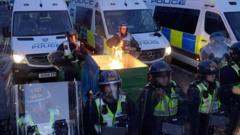
The tarmac outside the crown court is always cold in the early morning, no matter the season. It is a gray, unyielding sort of place where the grand abstractions of society—justice, order, free speech, and public safety—collide with the messy reality of human flesh and bone.
Six more people are walking into that building today.
They are not career criminals. They do not fit the standard profile of individuals shuffling through the judicial system. Months ago, they were ordinary citizens who woke up, drank their coffee, and decided that a line had been drawn in the sand. Today, they face the sobering machinery of the state. Their names are now tethered to a ledger of public disorder, all stemming from the chaotic aftermath of the Henry Nowak police protest.
To understand how six individuals ended up on a defense bench, we have to look past the sterile language of the police blotter. We have to look at the anatomy of a flashpoint.
The Spark and the Tinder
Every protest begins with a tremor. For months, whispers of discontent had been swirling through the community, a low-frequency hum of frustration regarding local policing policies. When the incident involving Henry Nowak occurred, that hum became a roar.
It took less than two hours for a digital call to arms to manifest as physical bodies on the pavement.
Imagine standing in that crowd. It is easy to look at news footage and see a monolithic mass of anger. But a crowd is made of individuals. There is the student who has only ever known activism through a smartphone screen, suddenly feeling the terrifying rush of collective adrenaline. There is the shopkeeper who closed early, worried about his windows but drawn to the edge of the police cordon by a desperate need to see what happens next. There is the parent, terrified for their children’s future, holding a hastily painted piece of cardboard with trembling hands.
The air on the night of the Nowak protest smelled of exhaust fumes, damp wool, and the metallic tang of fear. When the police line shifted, the collective mood broke.
Protest is a strange elixir. It strips away the solitary nature of modern life and replaces it with a intoxicating illusion of absolute unity. In that moment, the flashing blue lights are not symbols of safety; they are a wall. And walls invite impact.
The Bill Comes Due
The legal system moves with a agonizing, glacial precision that contrasts sharply with the frantic energy of a street demonstration. While a riot unfolds in minutes, the prosecution of it takes months.
The six individuals appearing in court today are discovering that the state has an incredibly long memory.
Consider a hypothetical defendant. Let us call her Sarah. She is thirty-four, an accountant, someone who prides herself on keeping meticulous spreadsheets and never paying her taxes late. On the night of the protest, swept up in the fury of a crowd demanding answers for Henry Nowak, Sarah crossed a line. Perhaps it was a physical line painted on the roadway. Perhaps it was a verbal one, shouted into the face of a twenty-two-year-old riot officer who was just as frightened as she was.
In the heat of the moment, Sarah felt invincible. She was part of a movement.
But when the crowd dispersed, the movement dissolved back into the suburbs. Sarah went home to her quiet flat, washed the smell of smoke out of her hair, and went to work the next morning. For weeks, life returned to normal. Then came the knock on the door at 6:00 AM.
That is the hidden trap of modern civil unrest. High-definition body cams, facial recognition technology, and the ubiquity of smartphone footage mean that the anonymity of the crowd is a myth. You are never truly lost in a mob. You are merely waiting your turn to be identified.
The Fractured Community
The fallout of the Nowak protest reaches far beyond the six people currently sitting in a sterile waiting room waiting for their legal representatives. It has torn at the fabric of a neighborhood that used to pride itself on quiet coexistence.
On one side of the ledger are the residents who feel the protest crossed the line from legitimate democratic expression into outright lawlessness. They point to the shattered glass, the disrupted bus routes, and the elderly neighbors who were too terrified to leave their homes for days afterward. To them, the upcoming trials are a necessary rebalancing of the scales. Order must be preserved, or the city falls apart.
On the other side are those who view the prosecutions as a heavy-handed attempt to stifle dissent. They argue that focusing on the broken windows ignores the broken trust that caused the protest in the first place. For these people, the six defendants are not lawbreakers; they are scapegoats.
The truth, as it usually does, lies somewhere in the uncomfortable gray space between these two extremes.
The legal system is fundamentally ill-equipped to handle emotional nuance. A judge cannot easily weigh the systemic frustrations of a community against a charge of obstructing a highway or assaulting an emergency worker. The law requires binaries: guilty or not guilty. Black or white.
But human lives are lived in the margins.
The Weight of the Gavel
As the court session begins, the gallery fills with a tense silence. The defendants sit in a row, stripped of the banners and the collective voice that gave them strength on the night of the Henry Nowak protest. They look smaller now. Isolated.
The prosecutor begins reading the charges, his voice flat, monotonous, and utterly devoid of the passion that defined that fateful evening. He speaks of timestamps, coordinates, and police property damage. He reduces an evening of raw human anguish into a series of exhibits marked A through F.
The defense solicitors will do their best. They will speak of clean records, momentary lapses in judgment, and the intense emotional provocation of the night. They will try to re-humanize their clients in the eyes of the bench.
But the machinery of justice cares little for motivation. It cares about actions and consequences. For these six individuals, regardless of the verdicts handed down, their lives have been permanently altered. Careers will be derailed. Mortgages will become harder to secure. Relationships, strained by the pressure of impending criminal records, will fracture.
The sun rises higher, casting long shadows across the courtroom floor, illuminating the dust motes dancing in the quiet air. Outside, the city moves on, the traffic hums, and the memory of Henry Nowak begins to fade into the archive of local history, leaving only these six quiet souls to carry the weight of the noise they made.