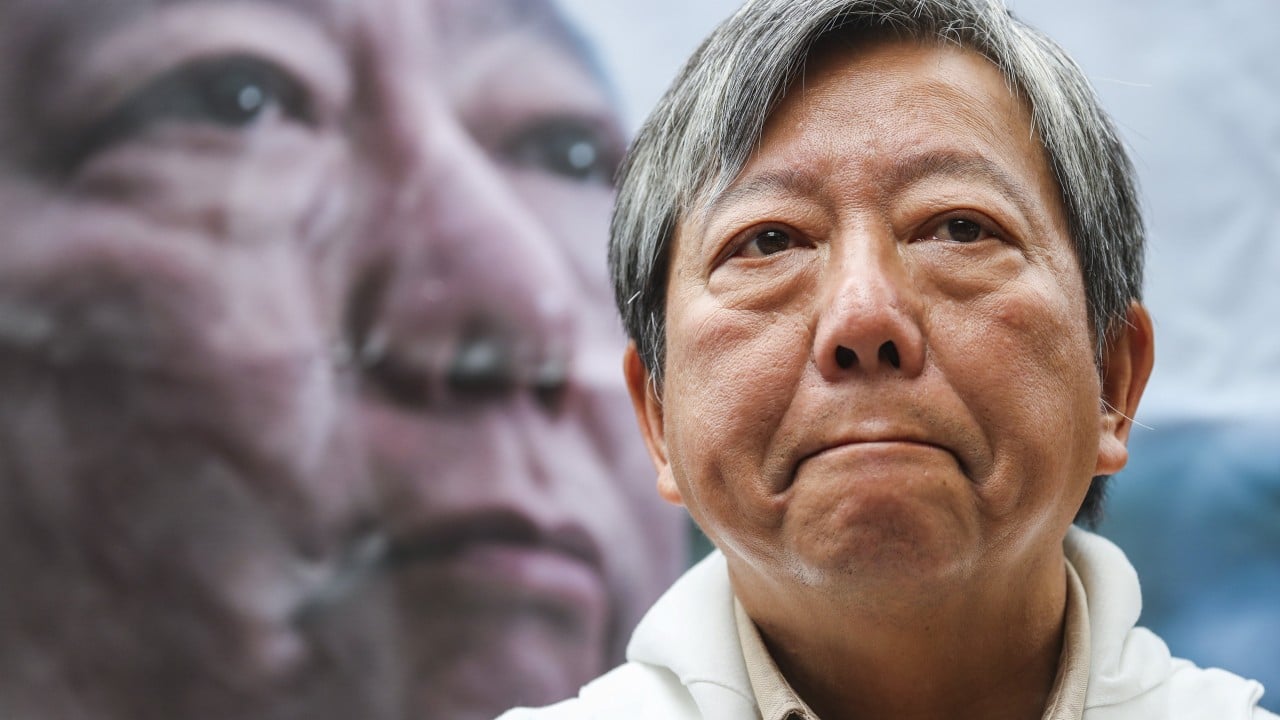
The internal friction of the Chinese legal system is best understood through the lens of "Constitutional Synchronicity"—the degree to which the ruling party's operational mandates align with the written text of the state’s foundational law. When activists, such as those involved in the Tiananmen vigils, face trial, their defense often shifts from a plea for leniency to a structural critique of the state's legal architecture. The core of this defense rests on a singular logical tension: the contradiction between Article 1 of the Constitution, which establishes the leadership of the Communist Party, and Article 35, which guarantees citizens the right to assembly and demonstration.
The Dual-Track Legal Framework
The Chinese judiciary operates on a dual-track system that creates a predictable bottleneck for political expression. Understanding this framework requires distinguishing between the Statutory Layer and the Operational Layer.
- The Statutory Layer: This includes the Constitution of the People's Republic of China (PRC). Article 35 is frequently cited by defendants as a blanket authorization for public vigils. From a purely textualist perspective, the right to "procession and demonstration" is an enumerated power of the citizenry.
- The Operational Layer: This involves the Criminal Law and the Law on Assemblies, Processions, and Demonstrations (LAPD). These statutes introduce "administrative hurdles"—such as the requirement for police permits—that functionally nullify the constitutional right in any context deemed sensitive.
When an activist argues that "one-party rule contradicts the constitution," they are performing a "Constitutional Review" from the dock—a process that does not formally exist in the Chinese judicial system. Unlike the U.S. Supreme Court, the PRC courts do not have the power of judicial review to strike down laws that conflict with the Constitution. Instead, that power resides with the Standing Committee of the National People's Congress (NPCSC).
The Cost Function of Political Non-Compliance
For the state, the prosecution of a vigil organizer is not merely about a single event; it is a calculation of the Systemic Maintenance Cost. The state views unauthorized assemblies through three primary risk vectors:
- The Scalability Risk: A small vigil represents a low immediate threat but establishes a "precedent of tolerance" that lowers the barrier for larger, potentially destabilizing movements.
- The Narrative Risk: By arguing that the Party's monopoly on power is unconstitutional, the defendant moves the discourse from "policy disagreement" to "existential legality." This forces the court to either ignore the constitutional argument or provide a ruling that implicitly subordinates the Constitution to the Party Charter.
- The Precedential Risk: If a judge were to acknowledge the supremacy of Article 35 over the LAPD, it would create a legal loophole that could be exploited by various labor, environmental, or social interest groups.
The defendant’s strategy relies on the Paradox of Legitimacy. If the state claims to rule by law (yifa zhiguo), it must adhere to its own supreme document. If it ignores its document to protect its power, it signals that the law is a tool of convenience rather than a binding set of rules. This creates a reputational tax that the state must pay in the international arena and among domestic intellectuals.
Deconstructing the Article 1 vs. Article 35 Conflict
The logic of the prosecution typically rests on the 2018 amendment to the PRC Constitution. Before 2018, the "leadership of the Communist Party" was primarily mentioned in the Preamble. The amendment moved this language into the main body of Article 1.
The Hierarchical Subordination Mechanism
The legal mechanism used to resolve the conflict between the right to protest (Art. 35) and the Party’s leadership (Art. 1) is "Hierarchical Subordination." In this logic, Article 1 is the "Ground Norm." Any exercise of rights under Article 35 that threatens the status of Article 1 is, by definition, an unconstitutional act. Therefore, the activist's argument—that one-party rule is unconstitutional—is viewed by the court as a logical impossibility, because the Party is the author and the protector of the Constitution itself.
The Efficiency of the "Subversion" Charge
The charge of "Subversion of State Power" or "Inciting Subversion" serves as a catch-all variable that absorbs constitutional friction. By framing the activist's words as an attempt to "overthrow the socialist system," the prosecution bypasses the specific rights-based arguments.
The state’s evidentiary requirements for subversion are often based on the Impact of Communication rather than the Intent of the Actor. If a speech about the Constitution reaches a threshold of public engagement that threatens social "harmony," the content of the speech becomes secondary to its disruptive potential. The trial becomes a theater of "Boundary Reinforcement," where the primary objective is to signal to the public where the current limits of acceptable discourse reside.
The Strategic Shift in Defense Arguments
Modern activists have shifted their defense tactics from "Mitigation" to "Documentation." They recognize that an acquittal is statistically improbable in political cases. The goal of the "Unconstitutional" argument is to create a historical and legal record that challenges the internal logic of the state.
- Logic of the Defense: "I am not violating the law; I am upholding the highest law, which the state is currently violating."
- Logic of the Prosecution: "The state’s interpretation of the law is the only valid application; therefore, your interpretation is an act of subversion."
This creates a "Zero-Sum Legal Encounter." There is no middle ground or compromise because the dispute is over the source of sovereignty: does it reside in the written text of the Constitution or in the Party's leadership?
Identifying the Bottleneck in International Legal Criticism
External observers often critique these trials for lacking "due process." However, this critique misses the structural reality that the Chinese system defines "due process" as the correct application of administrative procedures, not the protection of individual rights against the state.
The bottleneck for international legal pressure is the Principle of Non-Interference. The Chinese legal system is designed to be "Closed-Loop," meaning it does not recognize external legal standards (such as the Universal Declaration of Human Rights) as superior to domestic statutes. Consequently, referencing international law in a domestic trial provides moral leverage but zero legal traction.
The Operational Reality of the Trial Environment
The trial of a high-profile activist is a high-density information environment. Every word spoken by the defendant is analyzed by the state for "contagion potential." This explains the use of closed-door sessions or limited public access. The state is managing the Information Elasticity of the trial. If the defendant’s arguments about the Constitution were allowed to circulate freely, they might find resonance with a broader demographic that feels the law does not protect their interests in civil disputes or property rights.
The legal defense of constitutionalism is effectively an attempt to "Stress Test" the judiciary. By forcing a judge to rule against a constitutional right, the activist highlights the gap between the state's rhetoric of "Rule of Law" and the reality of "Rule by Law."
Strategic Recommendation for Legal Analysis
The most effective way to analyze the trajectory of these trials is to track the Evolution of Judicial Interpretations issued by the Supreme People's Court. These interpretations often act as the "Patch Notes" for the legal system, closing the gaps that activists exploit.
Future analysis should focus on:
- The Frequency of Constitutional Citations: Does the state begin to use Article 1 more frequently to shut down Article 35 defenses?
- The Modification of Criminal Procedure: Are there new rules limiting the ability of defense lawyers to raise constitutional arguments during political trials?
- The Digital Footprint of the Trial: How aggressively does the state censor the specific "Unconstitutional" argument compared to general news of the arrest?
The movement toward "Total Law" in China suggests that the friction between the Party and the Constitution will not be resolved through reform, but through the further absorption of legal institutions into the administrative arm of the Party. Investors and political analysts must treat the Chinese Constitution not as a guarantee of rights, but as a map of the state's ideological priorities. The activist’s trial is the point where that map meets the reality of the terrain.