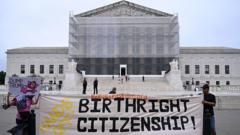
The stability of the American citizenship regime rests on the 1898 precedent established in United States v. Wong Kim Ark, which solidified the doctrine of jus soli—citizenship by right of the soil. Current executive maneuvers to challenge birthright citizenship via the Supreme Court do not merely represent a policy shift; they represent an attempt to trigger a structural realignment of the Fourteenth Amendment’s Citizenship Clause. This strategy operates on the hypothesis that the phrase "subject to the jurisdiction thereof" contains a consensual requirement rather than a purely geographic one. Analyzing this challenge requires deconstructing the legal mechanics of the Fourteenth Amendment, the historical constraints of judicial precedent, and the operational friction of implementing such a radical shift in administrative law.
The Jurisdictional Fault Line
The debate over birthright citizenship hinges on the interpretation of the Fourteenth Amendment’s opening sentence: "All persons born or naturalized in the United States, and subject to the jurisdiction thereof, are citizens of the United States and of the State wherein they reside." The current legal consensus, spanning over a century, treats "subject to the jurisdiction" as a geographic and legal fact. If you are physically present and bound by U.S. laws, you are under its jurisdiction.
The counter-argument, which the executive branch seeks to elevate to the Supreme Court, posits a "consensualist" theory of citizenship. Under this framework, jurisdiction is not merely physical presence but a mutual political allegiance. Proponents of this view argue that:
- The Alienage Exception: Just as children of foreign diplomats are excluded from birthright citizenship because their parents owe no allegiance to the U.S., children of those in the country without legal authorization should be similarly categorized.
- The Partial Jurisdiction Theory: Being subject to the laws of a country (territorial jurisdiction) is distinct from being subject to the political sovereignty of that country (political jurisdiction).
- The Intent of 1866: The framers of the Fourteenth Amendment intended to provide citizenship to formerly enslaved persons, not to the children of temporary or unauthorized inhabitants.
This creates a binary choice for the Supreme Court: uphold the status quo of territoriality or pivot toward a model of citizenship based on the status of the parent.
The Mechanics of Judicial Intervention
For the Supreme Court to hear arguments on this matter, a specific sequence of legal triggers must occur. The executive branch cannot simply "show up" to argue a theoretical point. There must be an active case or a direct executive order that creates a "case or controversy" under Article III of the Constitution.
The likely path involves an Executive Order directing agencies to stop issuing Social Security numbers or passports to children born in the U.S. to undocumented parents. This would immediately trigger a lawsuit from affected families, moving through the appellate system at an accelerated pace. The Supreme Court’s decision to grant certiorari (a review of the case) would signal a willingness to revisit Wong Kim Ark.
The weight of stare decisis—the principle of following precedent—is the primary obstacle. In Wong Kim Ark, the Court ruled that a child born in San Francisco to Chinese citizens (who were then legally barred from becoming U.S. citizens themselves) was a U.S. citizen at birth. Overturning this would require the Court to find that the 1898 ruling was "egregiously wrong" from the start, a high bar that the current conservative majority has applied in other landmark reversals.
The Structural Impact on Administrative Systems
If the Supreme Court were to narrow the scope of the Citizenship Clause, the resulting administrative friction would be unprecedented. The U.S. currently utilizes a decentralized system of birth registration. State-level departments of health issue birth certificates based on the fact of birth within a hospital or jurisdiction.
A shift in the definition of citizenship would require these departments to verify the legal status of parents before certifying a child's citizenship. This introduces several layers of operational complexity:
- Verification Latency: Hospitals and state registrars are not equipped to interface with federal immigration databases (e.g., SAVE or E-Verify) in real-time.
- The Problem of Mixed-Status Families: If one parent is a citizen and the other is not, the legal standing of the child remains clear under current statutory law (Title 8, Section 1401), but the administrative burden of proof shifts to the individual.
- Retroactivity and Statelessness: A ruling that applies retroactively would create a class of "de-naturalized" individuals, while a prospective ruling would create a permanent underclass of residents who are neither citizens of the U.S. nor necessarily recognized by their parents' home countries.
The cost of building an infrastructure capable of vetting the citizenship status of nearly 3.6 million annual births would represent a significant expansion of the federal bureaucracy, contradicting the stated goals of administrative streamlining often championed by the same actors pushing for the citizenship change.
Fiscal and Economic Consequences
The economic argument for birthright citizenship centers on labor market integration. Citizenship provides a clear path to professional licensing, federal employment, and tax compliance. Removing this path alters the long-term human capital projections of the United States.
- Labor Mobility: Non-citizens face significant restrictions on geographic and professional mobility. A large cohort of non-citizen residents would create a rigid labor market, reducing the economy's ability to respond to regional shifts in demand.
- Tax Base Stability: Citizens are more likely to participate in formal banking and long-term investment (e.g., homeownership). The uncertainty of legal status discourages long-term capital deployment.
- Social Safety Net Pressure: While non-citizens are generally barred from most federal benefits, the lack of a path to citizenship increases the likelihood of long-term economic marginalization, which places an indirect burden on state-level emergency services and infrastructure.
Comparative International Frameworks
The United States is an outlier among developed nations in its adherence to unrestricted jus soli. Most European and Asian nations utilize jus sanguinis (right of blood), where citizenship is inherited through parents.
- France: Transitioned from a pure jus soli system to a "manifestation of will" system, where children born to foreign parents must apply for citizenship between the ages of 13 and 18, provided they meet residency requirements.
- United Kingdom: Ended unrestricted birthright citizenship in 1983. Now, at least one parent must be a British citizen or "settled" in the UK for the child to acquire citizenship at birth.
The U.S. executive’s push is essentially an attempt to align American law with these restrictive international models. However, the U.S. is unique in that its citizenship definition is anchored in the Constitution, whereas in most other nations, it is governed by simple statute. This makes the U.S. system significantly harder to change but also makes the stakes of a Supreme Court intervention much higher.
The Strategy of Judicial Presence
The President’s intent to attend Supreme Court arguments personally is a move designed to maximize the political salience of the issue. In the history of the Court, it is exceedingly rare for a sitting President to attend oral arguments. This serves two functions:
- Signaling Priority: It communicates to the judicial branch that the executive views this not as a routine legal dispute, but as a fundamental question of national sovereignty.
- Public Narrative Control: It frames the legal proceedings as a high-stakes confrontation between the executive's mandate and the "entrenched" legal bureaucracy.
The presence of the President does not legally influence the justices, who operate under life tenure and are insulated from direct executive pressure. However, it increases the pressure on the Solicitor General’s office to deliver a flawless textualist argument that satisfies the originalist leanings of the Court’s majority.
The Risks of Originalist Overreach
The conservative majority on the Supreme Court has prioritized "original public meaning" when interpreting the Constitution. For those seeking to end birthright citizenship, the originalist argument is their greatest asset—and their greatest liability.
The 39th Congress, which drafted the Fourteenth Amendment, debated the inclusion of children of Chinese immigrants and "Gypsies" (the term used at the time). Senator Lyman Trumbull, a key architect of the amendment, explicitly stated that "subject to the jurisdiction" meant "not owing allegiance to anybody else" and "being subject to the complete jurisdiction of the United States."
Opponents of birthright citizenship seize on "not owing allegiance to anybody else" to argue that children of foreigners are excluded. Supporters point out that the amendment was ultimately passed with the knowledge that it would grant citizenship to the children of non-citizens, as evidenced by the intense opposition from senators who feared exactly that outcome.
If the Court adopts a narrow originalist view, it must reconcile why the 1866 Congress didn't explicitly exclude children of those in the country illegally—a concept that, admittedly, did not exist in its modern form because there were virtually no federal immigration restrictions at the time.
Strategic Forecast
The executive branch’s strategy will likely unfold in three phases:
- Administrative Trigger: An executive action will be issued to create the legal conflict required for court intervention.
- The "Consensualist" Brief: The Department of Justice will file a brief arguing that the Fourteenth Amendment was never intended to be a universal birthright grant but a corrective measure for a specific historical injustice (slavery).
- The Judicial Litmus Test: The goal is to force a 5-4 or 6-3 ruling that narrows the definition of "subject to the jurisdiction."
Even if the Supreme Court declines to overturn Wong Kim Ark, the move serves to solidify a new legal frontier. By forcing the Court to engage with the consensualist theory, the executive creates a platform for future legislative efforts or a potential constitutional amendment. The immediate play is not just about winning a case; it is about shifting the "Overton Window" of what is considered settled law regarding American identity.
The ultimate vulnerability for the executive lies in the text itself. The word "All" in "All persons born" is an absolute. To qualify it based on the parent's status requires a level of judicial activism that the current Court frequently claims to abhor. The resulting friction between originalist theory and the plain text of the amendment will be the decisive factor in whether the U.S. maintains its centuries-old tradition of jus soli or moves toward a status-based citizenship model.