The salt spray off the coast of central Vietnam tastes different now. It carries something heavier than just brine and old memory. Walk down to the docks in Da Nang or speak with the fishermen who guide their wooden vessels out into the slate-gray swells of the South China Sea, and you will hear a quiet, persistent worry. They are not talking about typhoons or shifting fish stocks. They are talking about the horizon.
Farther out, beyond the sight of the casual tourist drinking iced coffee on the beach, the water is changing shape. You might also find this related coverage interesting: Overshoot Economics Why Temporary Climate Breaches Demand Asymmetric Capital Allocation.
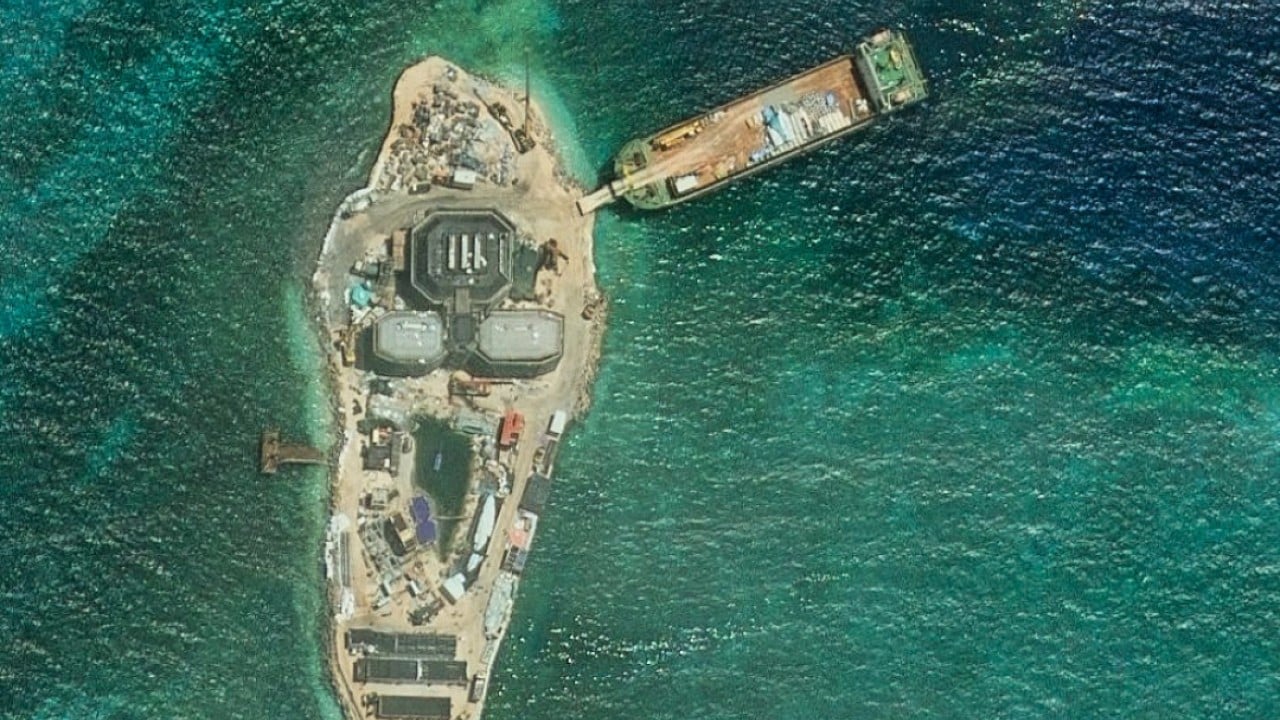
Consider a hypothetical fisherman named Van, whose family has coaxed a living from these waters for three generations. (Note: Van is a composite archetype, representing the thousands of coastal residents whose livelihoods are tethered to these contested tides.) When Van steers his boat toward traditional fishing grounds near the Spratly or Paracel archipelagos, he is no longer just dodging weather patterns. He is navigating a slowly tightening ring of artificial land. Dredgers, massive and relentless, have been pumping sand over living coral reefs for years, turning submerged shallows into fortified military outposts equipped with runways, radar domes, and deep-water ports.
To look at a satellite map of this transformation is to witness a slow-motion architecture of pressure. For Vietnam, a nation with over three thousand kilometers of coastline and an economy deeply intertwined with maritime trade and offshore energy, this creeping militarization is not a distant geopolitical abstraction. It is an existential tightening. As highlighted in recent reports by TIME, the results are widespread.
The numbers tell a stark story of imbalance. While Vietnam has quietly reinforced its own outposts—adding modest defensive capabilities, dredging minor harbors, and extending runways where geography permits—its efforts are dwarfed by the sheer scale of the island-building campaign conducted by its northern neighbor. We are watching a slow-motion transformation of global commons into sovereign fortresses. Dredging vessels churn millions of tons of sediment, anchoring geopolitical claims into the very floor of the sea.
Why does this matter to the person sitting thousands of miles away, scrolling through headlines over breakfast? Because the South China Sea is the jugular vein of global commerce. Roughly a third of all global shipping passes through these waters. Trillions of dollars in goods, from microchips to crude oil, traverse these routes daily. When one power asserts unilateral control over the chokepoints and sea lanes through architectural dominance, the cost of everything from a smartphone to a gallon of gasoline hangs in the balance.
For Hanoi, the strategic calculus is agonizing. Push back too aggressively, and risk sparking a kinetic conflict against a vastly superior military adversary. Stay too quiet, and watch the maritime boundaries erode until Vietnamese fishermen are treated as trespassers in their own traditional waters.
Diplomacy remains the primary shield. Vietnam has leaned heavily on multilateral forums, working through the Association of Southeast Asian Nations to forge a cohesive regional response, while simultaneously diversifying its international partnerships. Tokyo, Washington, New Delhi—capitals that once felt distant—now share regular diplomatic traffic with Hanoi. Coast guard cooperation agreements and defense pacts are quietly signed in wood-paneled rooms. Yet, treaties and diplomatic notes do little to stop a concrete mixer from pouring cement onto a contested reef under the cover of a humid night.
The vulnerability is palpable. I remember standing on a pier in Cam Ranh Bay years ago, listening to a retired naval officer speak about the sea not as a barrier, but as a bridge that had been weaponized. His voice was devoid of panic; it carried that heavy, weathered fatigue of men who have spent their lives studying maps that change faster than the ink can dry. He pointed out toward the open expanse, gesturing to the invisible lines drawn on nautical charts. "A country can lose a war without a single shot being fired," he said. "Sometimes, you just lose the space to move."
That is the quiet crisis unfolding off the coast of Vietnam. It is a war of attrition waged with dredgers, concrete, and radar signals. The islands rising from the water are not merely strategic assets; they are physical manifestations of a changing world order, where might increasingly dictates geography.
As the sun dips below the horizon, painting the Vietnamese coast in hues of bruised purple and gold, the silhouettes of cargo ships and fishing boats trace the dark water. They move through a sea that is becoming smaller, more crowded, and infinitely more dangerous. The concrete islands continue to grow, grain by grain, ton by ton, while the rest of the world looks the other way.


