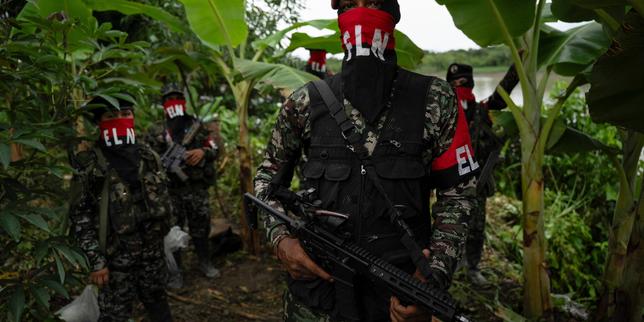
The mass abduction of 39 people in Colombia by the National Liberation Army (ELN) marks a dangerous escalation that directly threatens the government's flagship "Total Peace" initiative. This large-scale operation, confirmed by military sources, demonstrates that despite ongoing diplomatic talks, the guerrilla group continues to use civilian leverage as a primary strategic tool. For a nation attempting to transition away from decades of internal conflict, this incident exposes the profound disconnect between high-level negotiations in foreign capitals and the brutal reality on the ground in rural Colombia.
The crisis did not happen in a vacuum. It represents a calculated pressure tactic by a fragmented insurgency testing the resolve of a state desperate for historical legacy.
The Strategy Behind Mass Abduction
Guerrilla warfare relies on asymmetric leverage. When the ELN detains dozens of citizens simultaneously, it is not an isolated criminal act; it is a sophisticated political maneuver designed to dictate terms at the negotiating table.
For decades, the group has utilized kidnapping to fund its operations and project power over disputed territories. By executing a mass abduction of this scale, the ELN signals to the military that it maintains operational control over key corridors, regardless of troop deployments. The government faces an agonizing dilemma. A heavy-handed military rescue risks civilian lives, while prolonged inaction erodes public trust and makes the administration look weak.
The ELN operates as a decentralized federation of regional fronts. This structure complicates peace talks significantly. Even if the central command enters into a temporary ceasefire agreement in Havana or Caracas, regional commanders—such as those leading the powerful Northern or Western war fronts—often act independently to protect their local economic interests, which include extortion, illegal mining, and drug trafficking corridors.
The Mechanics of Rural Control
To understand how 39 people can vanish in a single operation, one must examine the geography of Colombia's neglected periphery. In regions like Chocó, Arauca, and Catatumbo, the state exists only as a flag and an occasional patrol.
- Geographical Isolation: Dense jungle canopy and complex river networks allow armed groups to move large numbers of captives quickly without detection.
- Intelligence Networks: The ELN utilizes a vast network of civilian informants, known as milicianos, who monitor military movements and identify targets for extortion or abduction.
- Institutional Absence: Local judiciaries and police forces are underfunded, outgunned, and frequently intimidated into silence.
When the military arrives after the fact, the logistics of a search operation are nightmarish. Troops must navigate terrain littered with improvised explosive devices (IEDs) while attempting to gather actionable intelligence from a terrified local population that knows the soldiers will eventually leave, but the guerrillas will stay.
The Collapse of Negotiating Leverage
The administration's current approach to negotiation relies heavily on carrots with very few sticks. By granting political recognition to the ELN early in the process, the government yielded its strongest cards without securing verifiable guarantees regarding civilian safety or the cessation of hostilities.
Historically, successful peace processes in Latin America required a balance of military pressure and diplomatic flexibility. The current framework lacks that balance. The ELN understands that the executive branch has staked its entire political reputation on delivering peace agreements. Consequently, the guerrillas perceive every government concession as a sign of vulnerability, prompting them to push the boundaries of what the state will tolerate.
"A ceasefire that only protects uniform-wearing combatants while leaving the civilian population at the mercy of extortion and kidnapping is not peace; it is a capitulation of state sovereignty."
This fundamental flaw in the negotiation framework has alienated the urban middle class and galvanized political opposition. As public outrage grows over the plight of the 39 captives, the political space for the government to offer future concessions—such as transitional justice or political participation for guerrilla leaders—is rapidly evaporating.
Economic Motivations Over Political Ideology
While the ELN maintains a veneer of Marxist-Leninist ideology, its day-to-day operations are driven by cold, hard economics. The cost of maintaining thousands of active fighters is astronomical.
Funding the Insurgency
| Revenue Source | Operational Impact | Risk Level to Group |
|---|---|---|
| Kidnapping & Extortion | Provides immediate liquid cash for logistics | High political cost, low operational risk |
| Illegal Gold Mining | Secures long-term territorial dominance | Moderate military targeting |
| Cocaine Taxing | Finances heavy weaponry and international supply chains | High risk of international law enforcement friction |
When international pressure or law enforcement crackdowns choke off drug routes or illegal mining operations, the group routinely reverts to kidnapping to fill its treasury. The abduction of 39 individuals represents a massive cash infusion through anticipated ransom demands, masked under the guise of political detention. It is a business model that has sustained the group for over sixty years, and they have no structural incentive to abandon it unless the costs of maintaining it become prohibitively high.
The Broken Promises of Territorial Peace
The communities bearing the brunt of this violence were promised a dividend of security that never materialized. In the wake of the 2016 peace accord with the larger FARC guerrilla movement, a power vacuum emerged in rural Colombia. The state failed to occupy the vacated territories effectively.
The ELN, alongside various dissident factions and criminal syndicates like the Clan del Golfo, rushed in to claim the abandoned infrastructure of criminality. For the average rural farmer, indigenous leader, or local merchant, the actors changed, but the extortion rackets and fear remained identical. This latest mass kidnapping is the logical conclusion of a state policy that prioritized signing documents over establishing physical security and institutional presence in the countryside.
Redefining the Rules of Engagement
The current strategy is unsustainable. If the state wishes to salvage any semblance of authority and protect its citizenry, it must fundamentally alter its approach to the ELN.
First, future negotiation rounds must be strictly conditioned on the immediate, unconditional release of all hostages and a verifiable halt to the practice of kidnapping. Continuing to talk while citizens are held in jungle camps delegitimizes the entire democratic process.
Second, the military posture must shift from reactive patrolling to proactive disruption of the ELN's economic lifelines. This requires targeted financial intelligence operations to freeze the assets of the front organizations and intermediaries that launder the proceeds of extortion and illegal mining.
Finally, international guarantors—including nations that have historically hosted or supported these peace talks—must be forced to publicly condemn these violations of International Humanitarian Law. Remaining silent or offering mild expressions of concern while civilians are used as political pawns makes these international actors complicit in the normalization of terror. The Colombian state cannot outsource its constitutional duty to protect its people to foreign diplomats who do not have to live with the consequences of a empowered, unchecked insurgency.

