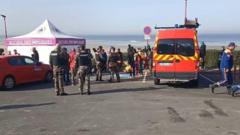
The water in the English Channel does not care about borders. It is a blind, rhythmic weight, pressing against the French coastline with a temperature that turns human skin into a map of blue ice within minutes. At 2:00 AM, there is no horizon. There is only the sound of the surf—a low, predatory hiss—and the frantic scraping of plastic against sand.
Four people died this morning.
They weren't just "migrants" or "statistics" or "casualties of a crossing attempt." They were individuals with lungs that burned for air and hearts that thrashed against their ribs until the salt water won. They died in the pitch black, surrounded by the smell of cheap gasoline and the screams of sixty others who were suddenly realizing that a thin layer of PVC is no match for the gravity of the sea.
The Weight of the Invisible
To understand why people get onto a boat that looks like a child’s toy, you have to understand the physics of desperation. Imagine a hypothetical young man named Elias. He isn't a ghost; he is a twenty-four-year-old who remembers the smell of fresh bread in a bakery in Khartoum. He has a degree he can’t use and a family that sold everything—the jewelry, the land, the very future of his younger siblings—to put him on a plane, then a truck, then a forest floor in Wimereux.
Elias is standing on the beach. He sees the boat. It is overcrowded, sagging in the middle, and the engine is a coughing, rusted relic.
He knows it is dangerous. He isn't stupid. But the danger behind him is a certainty, while the danger in front of him is a gamble. In his mind, the English Channel isn't a body of water. It is a wall. And on the other side of that wall is the only version of himself that is allowed to exist.
When the French police arrive with sirens and tear gas, the desperation turns into a stampede. This is where the tragedy often begins—not in the deep water, but in the frantic crush of the shallows. People don't just fall off these boats; they are pushed by the sheer mass of human hope trying to squeeze into a space meant for twelve, now holding seventy.
The boat yesterday didn't hit a rock. It didn't explode. It simply surrendered to the weight.
The Arithmetic of the Abyss
We talk about "stopping the boats" as if we are discussing a plumbing issue. We use words like "deterrence" and "border security" to distance ourselves from the reality of a body floating face down in the surf. But the math of the Channel is unforgiving.
The distance between Calais and Dover is roughly twenty-one miles. On a clear day, you can see the White Cliffs. They look close enough to touch. They look like a promise. But the Channel is one of the busiest shipping lanes on the planet. Massive tankers, three blocks long, churn the water into a chaotic mess of wakes and swells. A small inflatable boat is invisible to their radar. To a tanker captain, hitting a migrant dinghy feels like hitting a piece of driftwood.
They don't even hear the sound.
Consider the thermal shock. If you fall into water that is 10°C, your body undergoes an immediate, involuntary gasp reflex. If your head is underwater when that happens, you inhale a pint of brine. Your vocal cords spasm. You cannot scream for help because your throat has locked shut to keep the ocean out of your lungs.
This morning, four people went through that exact biological horror. One was an adolescent. A child, really. Someone who should have been worrying about an exam or a crush, instead finding out how quickly the light goes out when the cold takes hold.
The Business of the Shoreline
Behind every tragedy is a ledger. The smugglers who organize these crossings are not "travel agents" for the displaced. They are predators who have turned human misery into a high-margin commodity. They charge thousands of dollars for a seat on a death trap. They tell the passengers that the crossing will take two hours. They tell them the British Coast Guard will pick them up the moment they hit the halfway mark.
They lie.
The smugglers stay on the beach. They push the boat off, pocket the cash, and vanish into the dunes. They don't care if the engine fails two miles out. They don't care if the floorboards snap. For them, the transaction is complete the moment the boat is no longer touching French soil.
We see the political fallout in London and Paris. We hear the debates about "pull factors" and "safe legal routes." But while the politicians argue in rooms with heated floors, the reality on the ground is a brutal cycle of cat-and-mouse. When one beach is guarded, the smugglers move to a more dangerous, rocky outcrop. When the police seize the high-quality inflatables, the smugglers switch to cheaper, thinner materials that are even more likely to tear.
The tighter the security, the higher the risk. The higher the risk, the more the smugglers charge. The only thing that remains constant is the body count.
The Ghost in the Machine
There is a profound silence that follows a boat sinking. After the shouting stops and the helicopters move on, the shoreline returns to its natural state. The waves wash up the debris: a single wet sneaker, a waterlogged smartphone, a scrap of a life jacket that wasn't actually buoyant.
These objects tell a story that the official reports miss. The smartphone, now dead, contains the last messages sent to a mother in Erbil or a sister in Kabul. "We are going now. Pray for us."
Those messages remain unread, or worse, they remain as the last point of contact before a lifetime of wondering. For every person confirmed dead, there are dozens more who simply disappear into the gray. The families back home don't get a body to bury. They get a silence that never ends.
The world watches this happen week after week. We have become accustomed to the headlines. "Four Dead." "Six Dead." "Two Missing." The numbers have lost their teeth. They no longer bite into our conscience. We treat it like the weather—an unfortunate, seasonal occurrence that is someone else’s problem to solve.
But the problem isn't the water. The problem isn't even the boats.
The problem is the fundamental realization that for a significant portion of the human population, the risk of drowning in a dark, cold sea is more attractive than the reality of staying where they are. Until we address that specific, haunting truth, the Channel will continue to be a graveyard.
As the sun rose over the French coast today, the tide brought in the remnants of the struggle. The blue plastic of the boat was tangled in seaweed. A few miles away, another group was already gathered in the woods, huddling for warmth, waiting for the wind to die down. They saw the news. They know about the four who died.
They are going to try anyway.
The ocean is waiting. It doesn't need to be cruel. It only needs to be there, cold and indifferent, as the next fragile boat slides into the surf.