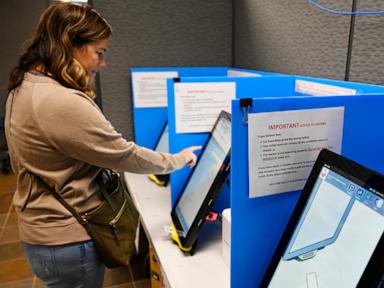
Imagine standing in a drafty school gymnasium at midnight. The fluorescent lights hum. Your feet ache through thin-soled shoes. Around you, a dozen neighbors are staring at stacks of paper, their eyes blurring over thousands of handwritten checkmarks. Every tick of the clock feels heavy. This is not Washington D.C., with its gleaming servers and secure server rooms. This is the gravel-roads reality of local American democracy. It is slow. It is human. And right now, it is the center of a quiet, furious storm in Georgia.
For the past few seasons, a specific and controversial method of counting votes has been hanging over Georgia’s elections. The state’s lawmakers are suddenly sprinting to dismantle it before the next major ballot is cast. To the outside observer, it looks like standard bureaucratic maneuvering. It looks dry. But peel back the dense layer of legislative jargon, and you find a deeply human struggle over trust, time, and how we prove a collective truth.
The Friction of the Hand Count
To understand why Georgia is about to ban a specific vote-counting method, we have to look at the human cost of counting by hand. Consider a hypothetical election official named Clara. Clara has managed a small precinct for twenty years. She knows how the copy machine jams. She knows who brings the best donuts. She also knows that humans are beautifully flawed creatures.
When you ask Clara to count ten apples, she will do it flawlessly. Ask her to count ten thousand paper ballots—each crammed with dozens of complex races, from president down to county coroner—and the human brain begins to misfire.
Hypothetically, after nine hours of staring at paper, Clara’s eyes skip a line. A "yes" looks like a "no." A smudge of blue ink looks like an intentional vote. This is not malice. It is biology.
The core issue facing Georgia lawmakers stems from a push by certain factions to mandate hand-counting for all ballots, a method that critics argue is inherently prone to these exact human errors. State officials recently realized that mandating an all-hand-count system creates an administrative nightmare. It introduces a massive margin of error, delays results for days or weeks, and costs small counties money they simply do not have.
The state’s current legislative push is a direct reaction to this vulnerability. Lawmakers are moving swiftly to explicitly ban local election boards from independently implementing hand-count rules that conflict with state law. They want the machines to do the heavy lifting of the initial tally, leaving humans to audit and verify.
The Machine in the Room
We live in an era where we trust machines to fly our planes and manage our life savings, yet we deeply distrust them to count our votes. It is a striking paradox.
An optical scanner does not get tired. It does not drink coffee or suffer from a midnight headache. It processes a ballot in a fraction of a second, translating physical ink into a digital data point. But a machine lacks soul. You cannot look an optical scanner in the eye and ask if it is telling the truth.
That lack of eye contact is where the rot of suspicion sets in. When a computer spit out a total in the past, voters accepted it. Now, that silence feels ominous to many. The push for hand-counting did not come from a desire for efficiency; it came from a desperate, agonizing hunger for certainty. People wanted to see their neighbors holding the paper. They wanted to see the physical proof.
But the physical proof carries a steep price tag. During recent pilot programs and mock counts across the country, the data revealed a harsh truth. Hand counts of multi-race ballots take up to three times longer than machine counts, and the discrepancy rates between human counters are drastically higher than the error rates of calibrated scanners.
Georgia’s lawmakers looked at those numbers and saw a trainwreck waiting to happen in November. If a single large county delayed its results by four days due to a chaotic hand-counting process, the entire nation’s trust would evaporate in the gap. Silence breeds conspiracy. Speed, when accurate, protects peace.
The Legislative Scramble
This week, the state capitol building is loud with the sound of hurried footsteps. Legislators are trying to draft a permanent fix to lock down the rules of the game. The urgency is palpable because the clock is ticking down to the next election cycle.
The challenge is not just writing the law; it is navigating the delicate politics of election integrity. On one side are the traditionalists and skeptics who feel that any move away from physical, human-verified counting is a surrender to the black box of technology. On the other side are the pragmatists—including many local election directors who are actually responsible for running the show—who warn that a mandated hand count would cause the entire system to collapse under its own weight.
Consider what happens next if the legislature fails to find a clean fix. Local boards might try to pass their own rogue rules, creating a patchwork system where a vote in one county is counted entirely differently than a vote in the neighboring county. That is a recipe for constitutional chaos.
The fix being debated aims to standardize the process: utilize high-speed optical scanners for the initial, rapid count to ensure the nation gets timely results, but back that up with strict, mandatory, and transparent post-election audits. It is an attempt to marry the tireless accuracy of the machine with the vital oversight of the human being.
The Fragility of the Paper
We often treat democracy as if it is an architectural monument, carved from granite, capable of regular endurance against any storm. It is not. It is much more like an intricate piece of clockwork, held together by the shared belief that the rules are fair.
When you change how votes are counted, you are not just changing a technical protocol. You are altering the emotional contract between the citizen and the state.
If Clara stays in that gym until 4:00 AM, exhausted and weeping from the stress of a forced hand count, the system has failed her. If a voter stays up until dawn watching a screen, wondering why a county has only reported twelve percent of its total, the system has failed them, too.
The lawmakers in Georgia are discovering that fixing an election law is easy on paper, but incredibly difficult in practice. They have to build a system that is robust enough to withstand intense scrutiny, yet simple enough for an ordinary citizen to trust. They are hunting for a middle ground that seems to shrink by the hour.
The hum of the gymnasium lights will return soon. The tables will be set up. The paper ballots will be stacked high. Whether those stacks will be fed into a quiet, efficient scanner or counted one by one by the trembling fingers of exhausted neighbors depends entirely on the words being debated in committee rooms this very week. The stakes are not abstract. They are sitting in boxes, waiting to be read.