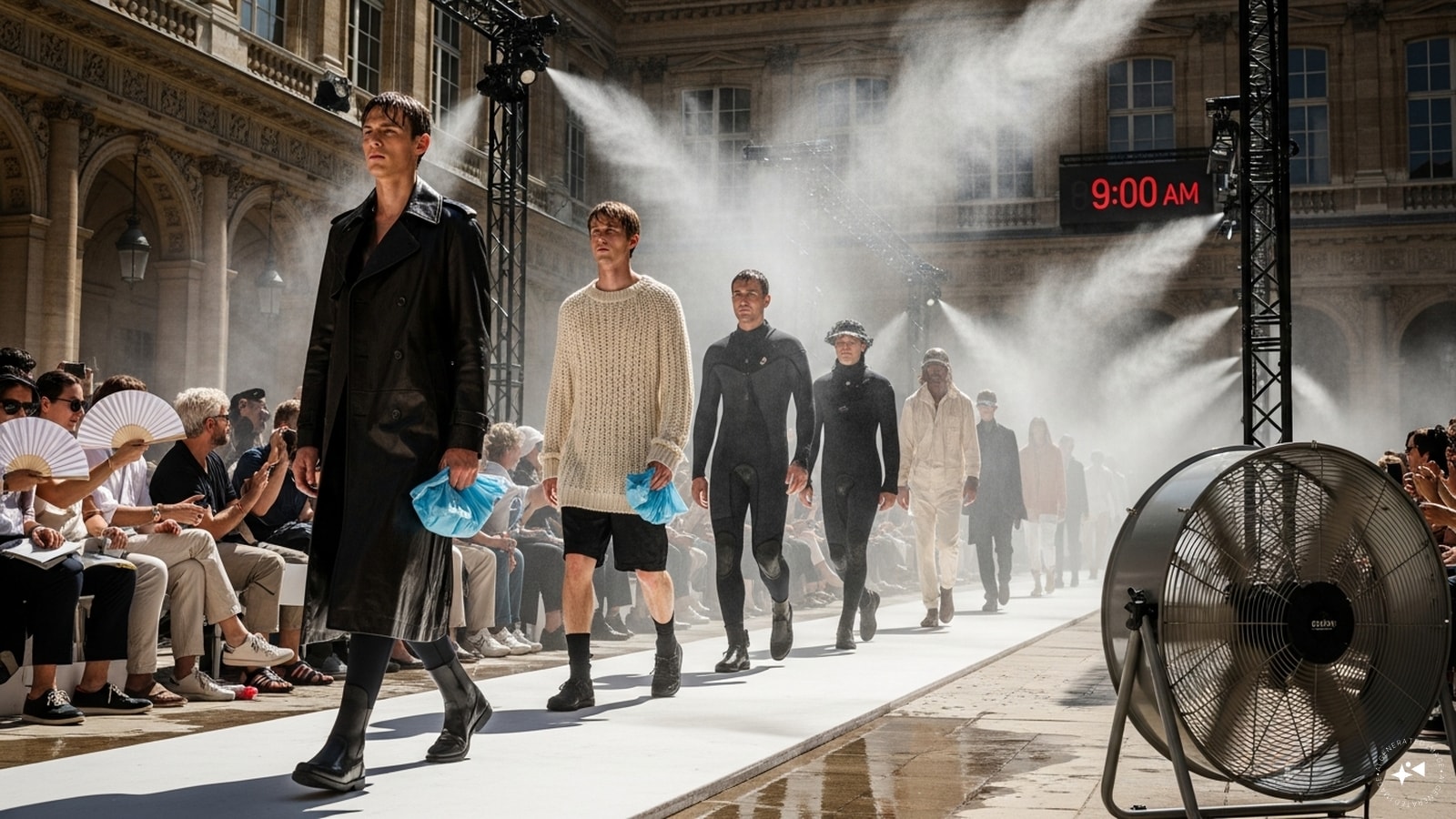
Outdoor event infrastructure faces a structural breaking point where localized mitigation tactics—such as localized misting systems and physical cooling packs—fail to counteract macro climate anomalies. The recent severe heatwave during Paris Fashion Week exposed a fundamental vulnerability in luxury supply chains and experiential marketing: the industry’s operational model relies on climate predictability that no longer exists.
To understand why traditional contingency plans failed, the crisis must be deconstructed into a three-part operational breakdown: thermodynamic limitations of temporary infrastructure, supply chain friction in high-heat environments, and the degradation of brand equity when physical environments become inhospitable.
The Thermodynamic Limits of Temporary Mitigation
Luxury brands frequently rely on temporary outdoor structures to preserve exclusivity and aesthetic control. During extreme heat events, the energy budget required to maintain ambient comfort within these structures scales non-linearly. The failure of Paris Fashion Week's heat mitigation strategies stems from a fundamental misunderstanding of localized thermodynamics.
- Evaporative Cooling Saturation: Misting systems rely on the latent heat of vaporization to lower ambient air temperatures. When relative humidity matches high ambient temperatures, the air reaches vapor pressure deficit saturation. The water droplets fail to evaporate efficiently, leading to high humidity levels that inhibit the human body's natural thermoregulation via sweat evaporation. Instead of cooling, the system increases localized heat index values.
- Thermal Mass and Radiant Heat Transfer: Temporary pavilions constructed from canvas, plastics, and lightweight metals possess low thermal mass. They absorb solar radiation rapidly and re-radiate longwave infrared energy directly onto occupants. Micro-mitigation tools like hand-held ice packs or localized fans modify the immediate convective boundary layer of an individual, but they cannot counter the systemic radiant heat load delivered by hundreds of square meters of uninsulated enclosure materials.
- The Air Conditioning Deficit: Deploying industrial HVAC units into open or semi-open historic spaces creates an immediate efficiency bottleneck. Without a sealed thermal envelope, cold air escapes continuously via displacement ventilation, requiring continuous peak-load power generation. This creates a secondary vulnerability: localized electrical grid failure due to macro-level cooling demand across the municipality.
Supply Chain Friction and Workforce Degradation
The operational execution of a fashion show relies on a highly synchronized, just-in-time human supply chain. Extreme heat acts as a friction multiplier across three distinct labor layers, causing cascading delays and asset degradation.
[Macro Heat Wave]
       │
       ▼
[Labor Productivity Drop (Thermoregulatory Fatigue)]
       │
       ▼
[Just-In-Time Operational Delays (Backstage Bottlenecks)]
       │
       ▼
[Material & Presentation Failure (Textile Degradation)]
The primary layer is workforce physical capacity. Technical crews, stagehands, and logistical personnel operating in temperatures exceeding 35 degrees Celsius experience rapid onset of thermoregulatory fatigue. The physical labor required to transport staging, configure high-voltage lighting, and manage crowd flow drops in efficiency by an estimated 20 to 30 percent for every 5-degree rise above baseline comfort zones due to mandatory mandatory hydration and rest intervals. When setup schedules operate on strict 2-hour windows between events, these marginal delays compound, forcing delayed starts that disrupt subsequent schedules across the entire city-wide calendar.
The second layer involves the immediate presentation environment. High-fashion garments are frequently constructed from volatile natural polymers, delicate silks, and structured synthetics that behave unpredictably under thermal stress. High ambient heat and humidity alter the tensile strength and drape of textiles, causing delicate pleating to collapse and heavy embellishments to sag under softened fabric matrices.
Backstage holding areas, rarely equipped with permanent climate control, become high-risk environments for cosmetic and hair styling products. The time required for touch-ups doubles as products melt or run, creating a structural bottleneck immediately prior to runway entry.
The Financial Risk Profile of Experiential Marketing
The economic justification for a multi-million-dollar, 15-minute runway show rests entirely on the generation of pristine digital content and high-value client relations. The introduction of extreme heat disrupts the mechanism that converts physical events into digital and financial equity.
The core asset of a live show is the attention and sentiment of top-tier clients, retail buyers, and media figures. When physical discomfort reaches a specific threshold, cognitive load shifts from brand engagement to climate survival. This introduces immediate downside risk to wholesale order placement: fatigued buyers truncate post-show networking, skip showroom appointments, or exhibit lower conversion rates during seasonal buying windows.
From a media perspective, extreme heat introduces uncontrollable visual anomalies into the final content product. High-definition broadcast lenses capture visible physical distress, perspiration, and environmental haze, directly undermining the aspirational, highly curated imagery fundamental to luxury positioning. The financial return on investment (ROI) drops significantly when the primary output—the media asset—is visually compromised.
Strategic Alternatives for Climate-Resilient Event Models
To insulate operations from future climate disruptions, luxury brands must transition away from reactive, ad-hoc cooling tactics toward structural resilience frameworks. The following matrix outlines the strategic alternatives available to event organizers, balancing execution difficulty against risk mitigation efficacy.
| Strategy | Operational Mechanism | Primary Limitation | Risk Reduction Level |
|---|---|---|---|
| Decentralized Digital-Physical Hybrids | Restricting physical attendance to core stakeholders while utilizing localized micro-hubs globally for regional buyers. | Loss of singular global media amplification moment. | High |
| Subterranean or Permanent Architectural Selection | Abandoning temporary historical spaces in favor of permanent structures with deep thermal mass and integrated HVAC infrastructure. | Restricted aesthetic optionality and loss of historic venue prestige. | Very High |
| Chronological Shifting | Migrating runway schedules to nocturnal or early dawn windows to capitalize on diurnal temperature drops. | Disruption to traditional hospitality, dining, and global media time-zone alignment. | Medium |
Shifting events to late-evening windows minimizes direct shortwave solar radiation, effectively removing the largest variable from the localized heat equation. This adjustments reduces the cooling load required by temporary structures by up to 40 percent. However, this strategy introduces a secondary challenge: it extends the operational day for production crews into high-cost overtime brackets and alters the ambient lighting parameters, necessitating heavier investments in artificial illumination infrastructure.
The selection of permanent architectural venues offers the highest level of climate insulation. Structures featuring heavy stone masonry or modern, high-performance curtain walls provide natural thermal damping. The internal environment remains decoupled from external spikes for a longer duration, reducing reliance on temporary generator rentals and mitigating the risk of localized grid brownouts.
Executing the Structural Transition
Brand executives must audit their event portfolios against localized climate projection data for the next five years. Relying on historic weather averages to plan summer production schedules introduces unacceptable operational risk. Contingency planning must transition from a line-item budget for ice and fans to a comprehensive structural framework that determines venue selection based on thermodynamic viability.
Organizers must implement a hard ceiling for ambient indoor temperatures, above which an event automatically triggers a pre-negotiated secondary indoor venue. Contracts with production agencies must include specific clauses defining labor rights and pacing adjustments during municipal heat alerts. By treating climate volatility as a structural financial liability rather than an unpredictable act of God, luxury enterprises can protect their supply chains, workforce, and brand equity from the realities of an accelerating global thermal baseline.